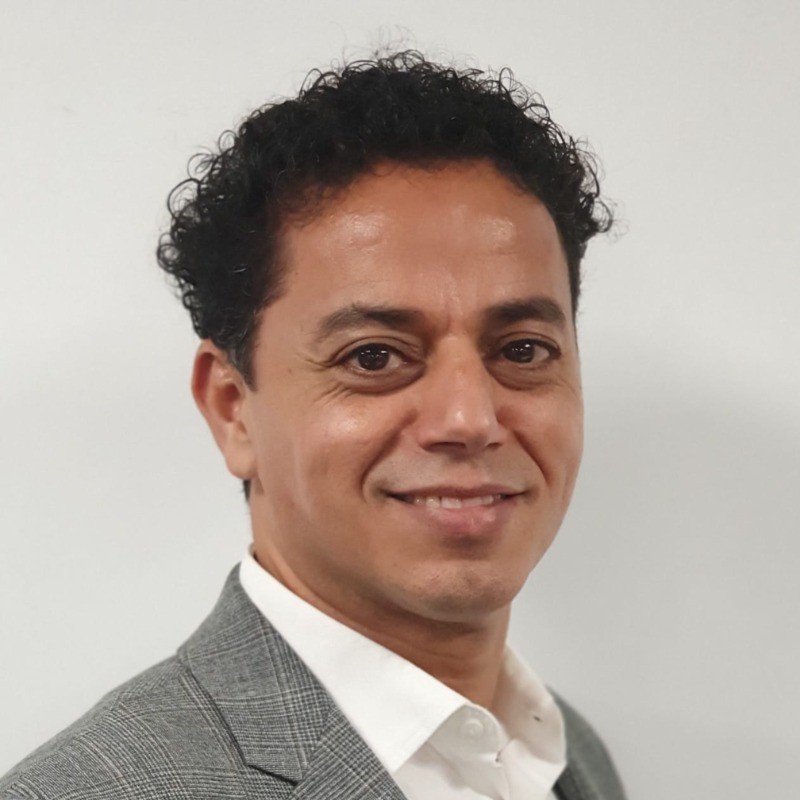
Ahmed Hilami
Ahmed Hilami is CEO at Flyer.be.
In this Connexi podcast, Ahmed Hilami tells how he started young as a print broker after organizing events in the 90s, discovered that combining print jobs slashes costs, and built Flyer.be into Belgium's largest online printing company, active in the Benelux and France. He describes three turning points: the birth of his daughter twelve years ago, which changed his priorities and made him a mirror-aware leader; buying out his shareholders in 2012 when their exit-driven vision clashed with his long-term vision, forcing him to master the entire production process alone; and a period of growing too fast, hiring the wrong people, and having to let a group go at once to restore the company's DNA. He also discusses leading by example, allowing employees to make mistakes, coping with loneliness at the top via his board and conversations, and using meditation, breathing techniques and Chinese medicine since 2010-2011 to find calm and make better decisions. He closes with advice to fellow entrepreneurs to let go more, protect their health, and keep ego and fear in check.
Insights & takeaways
Ahmed Hilami's thinking runs along two connected tracks: the hard-won operating philosophy he built at Flyer.be, and a later, evidently deepening conviction about Morocco's place in the future of artificial intelligence. Both tracks share a common thread — a preference for seeing what others overlook and building patiently rather than chasing shortcuts. At Flyer.be, that meant spotting "holes" in the traditional printing world, bundling orders to spread a single start-up cost across many jobs, and selling at two to three times below what conventional printers pay in cost price, all through process optimization rather than compromising the product 5. In his AI ventures, the same instinct shows up as a bet on a country "iedereen" ignores while staring at Silicon Valley and India: "Marokko is vandaag één van de meest onderschatte strategische opportuniteiten voor Europese bedrijven" .
The Flyer.be years reveal a founder who values control and long-term ownership over quick exits. He bought out his shareholders in 2012 precisely because their appetite for a fast sale clashed with his own horizon, describing misaligned visions between founders as corrosive as a couple growing apart, felt even by employees 5. That same episode taught him how badly unchecked growth can hollow out a company: hiring anyone who "roughly fit the profile" left him not recognizing his own business, forcing him to let people go simultaneously and take tasks back himself before the feeling returned 5. The fix he settled on was patience in hiring — three to five interviews, a preference for trainable juniors over quick senior fixes — and an explicit company culture where mistakes are allowed, because "zo leer je het meest. Ik heb altijd geleerd van mijn fouten" 5. He is candid about decisiveness too, describing how he founded the company without overthinking it — "Ik heb het gewoon gedaan" — and that he prefers bigger challenges to smaller ones: "Hoe groter de uitdaging is, hoe liever dat ik het heb" 5.
Running underneath the operational lessons is a clear view on psychology and leadership. He names "Ego en angst" as the biggest enemy of good decision-making 5, and describes coping with the loneliness of being sole shareholder-CEO by thinking out loud with his board, processing problems as he speaks and reading colleagues' reactions in real time 5. Since around 2010-2011 he has leaned on Chinese medicine, meditation, yoga and breathing practice to gain distance and calm before tackling business challenges 5, and he manages expectations deliberately — accepting that too many expectations invite disappointment, so when a project collapses he gives it a place and moves on within minutes rather than dwelling 5. He also structures his own attention year by year, picking one deep focus area at a time, whether reorganizing production across fourteen machines or, later, contracts and digitalization projects 5 — a habit of concentrated, sequential building that reappears later in how he talks about bridging Europe and Morocco "al 17 jaar" .
That bridge-building is where his more recent public voice concentrates. He frames his seventeen years moving between Belgium and Morocco not as a side activity but as the foundation for a new conviction: Morocco, in his telling, is now Africa's most industrialized country, but for him the industrial statistic is secondary to "de snelheid waarmee het land evolueert: industrie, digitalisering, innovatie... en vooral artificiële intelligentie" . He is explicit that this started as a pragmatic choice and became something firmer over time — "Aanvankelijk was dat een strategische keuze. Vandaag is het een echte overtuiging geworden" . The elements he keeps pointing to are consistent across posts: strong AI engineers and developers, universities producing more digital talent every year, the national Digital Morocco 2030 strategy, and the country's geographic position between Europe, Africa and the Middle East . Tellingly, he frames Morocco's ambition not as imitation but as an original model: "Het bouwt aan een eigen model, gebaseerd op zijn sterke troeven: talent, stabiliteit, de nabijheid" .
Commercially, this conviction has moved from advisory work — helping Belgian companies set up Shared Service Centers in Morocco through Elavi — into a direct AI product bet with FLUGIA | AI Business Platform, which he describes as continuing "diezelfde brug" between Europe and Morocco . His stated philosophy for the product is unambiguous: AI should be "eenvoudig, toegankelijk en vooral praktisch," aimed at helping companies integrate smart AI solutions into real operations rather than treating AI as an abstraction . That practicality shows up concretely in the "AI Coworkers" he has built and named — David, Emily, John — framed less as software features than as staff members: Emily, the AI Customer Support Manager, already handles "tot 85% van de inkomende oproepen," a figure he offers as proof that the technology delivers measurable, not theoretical, results .
Taken together, the arc from the 2020 podcast to the 2025-2026 posts shows a fairly consistent operator temperament applied to a new domain. The Flyer.be-era lessons about disciplined hiring, tolerance for mistakes, and calm decision-making under pressure read as the groundwork for someone now comfortable making a contrarian regional bet in public and backing it with sponsorship visibility, such as FLUGIA's debut as headline sponsor of the BW Classic cycling event, which he uses explicitly as a venue for talking with entrepreneurs about how AI "vandaag al een concrete meerwaarde creëert voor bedrijven" . The throughline for anyone taking stock of his thinking is that he distrusts hype in either direction — he does not romanticize entrepreneurship as effortless, given how openly he discusses layoffs and burnout-adjacent overgrowth, nor does he treat AI as magic, insisting instead on measurable, integrated, "praktisch" use 5. The concrete takeaway he offers is less a single slogan than a repeated method: identify an overlooked structural advantage, whether in printing logistics or in a country's talent pipeline, commit to it over many years rather than chasing quick wins, and build the organizational discipline — in hiring, in psychological composure, in patient product design — that lets that advantage compound 5.
- Flyer.be's origin came from discovering that printing multiple orders together (one start-up cost) makes each job dramatically cheaper — he saw 'holes' in the traditional printing world and replaced the middleman.
- Flyer.be's sale prices are two to three times cheaper than the cost price of a traditional printer, achieved purely through process optimization and efficiency rather than cutting product quality.
- He bought out his shareholders in 2012 because they wanted to grow the company to sell it while he builds for the long term — misaligned visions between shareholders, like a couple growing apart, are bad for the founders and for the employees who sense the tension.
- Growing and hiring too fast — taking anyone who roughly fit the profile — created a negative atmosphere until he no longer recognized his own company; he had to let several people go at the same time and take tasks back himself, which restored his feeling with the business.
- After the layoffs he changed hiring: take long, do three to five interviews to really get to know candidates, and prefer juniors with potential you can train over quick senior fixes that break the whole.
- Employees at Flyer.be are explicitly allowed to make mistakes because that's how you learn most; if you don't allow mistakes the company becomes stiff and cramped and nobody tries anything new.
- He leads by showing rather than dictating: he goes on the road with his people, demonstrates his way of working, but leaves room for them to reach the same result in their own way.
- As sole shareholder-CEO he copes with lonely decisions by thinking out loud: he calls his board of directors together and talks through problems, because while speaking he processes and reads reactions.
- Since 2010-2011 he uses Chinese medicine, meditation, yoga and breathing courses to take distance, calm down and see solutions to business challenges.
- Each year he deliberately dives deep into one aspect of the company — 2019 was reorganizing production with fourteen machines, 2020 is contracts, partnerships, the new French agency and digitalization projects.
- Too many expectations create a bigger chance of disappointment; when a project falls through he gives it a place and moves on within minutes — analyse, accept, turn the switch.
Career
- FLUGIA | AI Business SolutionsCo-Founder & CEO2025 – Present
- ElaviFounder & CEO2022 – Present
- Bowls.beFounder & CEO2020 – Present
- batteriaFounder & CEO2002 – Present
- Flyer GroupFounder & CEO2002 – Present
- KrowCo-Founder, Board Chair & CEO2014 – 2020
- Youssef ImpressionsBoard Director & Deputy CEOAug 2013 – Aug 2016
- PrintConcept.comCEO & Owner2012 – 2023
- ONEOCo-Founder, Board Chair & Co-CEO2011 – 2016
- Flyer ExpressCEO& Owner2007 – 2011
- Flyer.be - The OriginalFounder & CEOSep 2002 – Apr 2026
- G-SpotFounder & CEO1997 – 2004

From public career histories · 13 entries
Media & appearances
1- 5podcastConnexi · 23 Mar 2020
Ahmed Hilami, founder-CEO of Flyer.be (Belgium's largest online printing company), shares his three pivotal moments: the birth of his daughter, buying out his shareholders in 2012, and the painful lesson of growing and hiring too fast.