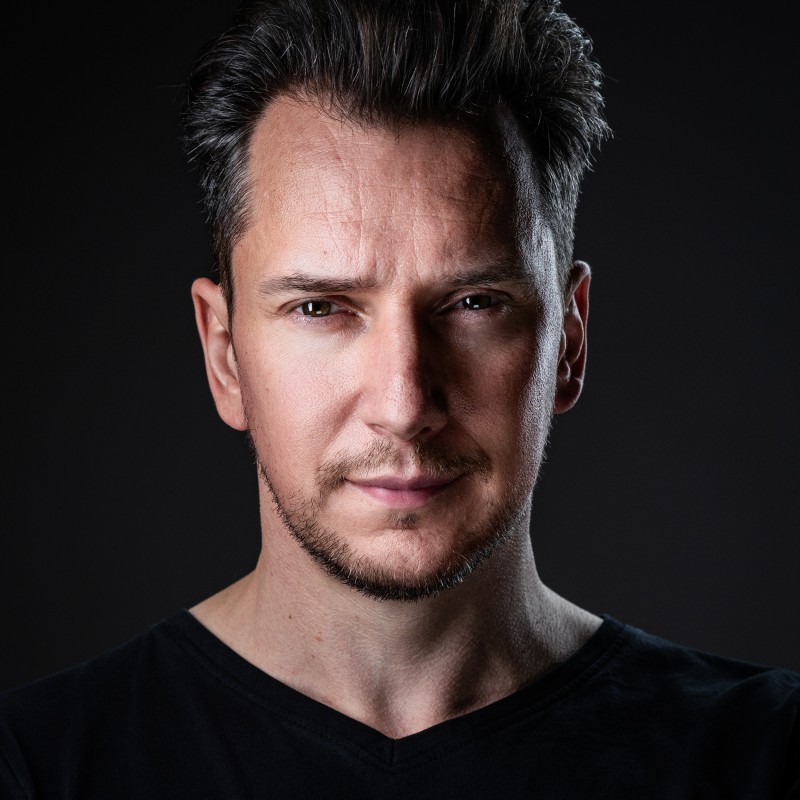
Andy Coomans
Andy Coomans is Coach/Advisor at BlackBird Business Events.
Insights & takeaways
Andy Coomans returns obsessively to one idea across two decades of podcast episodes, promos and posts: the company must become bigger than its founder, and almost nothing else matters until that happens. He calls the alternative a trap disguised as freedom, warning that "zodra dat je die ondernemingsnummer in handen hebt, beseffen dat je uw oude baas hebt ingewisseld voor een nieuwe baas: u bedrijf" . His own turning point came from hitting exactly that wall, a moment of maximum frustration with his business that pushed him to rebuild it into something self-steering rather than sell it outright . That restructuring, he says, is what later made a multi-million euro sale possible even though selling wasn't the original goal . The clearest marker of success, in his framing, is almost paradoxical: "het mooiste compliment dat een ondernemer aan zijn eigen kan geven is thuis zitten in verveling en zeggen: nu hebben die mij compleet niet meer nodig deze week" 12. He repeats a related line from Erik Moniquet approvingly in spirit: operational management is the killer of entrepreneurship, and it only becomes fun "als dat bedrijf voor u werkt" 28.
Exit-readiness is the second pillar of his thinking, and he insists, quoting himself across multiple promos, that it cannot start when someone is tired or near retirement — "de optimale exit-strategie voor u als ondernemer begint niet op de dag dat je beslist om je bedrijf te verkopen, het begint vele jaren vroeger" 6967. He treats this as identical to the work of simply building a healthy, financeable SME, not a separate late-stage project . Concretely he pushes entrepreneurs to split distinct business activities into separate legal entities years ahead of any deal, having watched a €1.1M share deal collapse into a €750k asset deal, netting only about €350k after tax, because a portal site sat inside the wrong company 12. He also urges keeping a running, yearly-updated valuation of the business and defining in advance the exact bank balance needed to justify selling, so an offer is judged rationally rather than emotionally — "de beste beslissingen in uw ondernemerschap, die neemt ge vanuit een rationele positie... minder drama, meer Spock" . He mocks the romantic myth of the effortless sale directly: "ik zat op mijn terras met een gin tonic, mijn telefoon rinkelde en ineens, poef, had ik mijn bedrijf verkocht. Ja, zo werkt dat dus niet" .
On growth and ownership, Coomans is unsentimental about dilution. He says plainly he'd "liever vandaag 30% van een taart die 50 miljoen waard is dan dat ik 100% heb van een bollenwinkeltje dat misschien 3 miljoen waard is" 12, and frames the choice as building "een hele grote berg waar ik een stuk eigenaar van ben dan dat ik de koning van de molshoop moet zijn" 12. This is backed, in his account, by studies showing that entrepreneurs who dilute systematically build the largest absolute wealth, while those clinging to 100% just own more of something small 12. He treats growth itself as a decision rather than an accident: "Groei is mogelijk, altijd. Het is een keuze" , and he's skeptical when entrepreneurs claim satisfaction with the status quo, usually tracing their reluctance back to fear of losing operational comfort or not knowing how to build structure for scale .
His hiring philosophy follows the same logic: cheap, junior first hires are a costly mistake, and "I can't pay them" is a financing question, not a truth 12. He recounts replacing twelve junior employees with six experienced, more expensive profiles and generating 40% more revenue the following year despite a loss-making transition period 12. Beyond roughly ten to fifteen employees, he argues, a founder can no longer steer everything personally and needs systems, dashboards and delegated authority — otherwise the business runs entirely out of the founder's head, which he says describes 90% of Belgian SMEs with 5-15 staff 12. He's equally firm that durable entrepreneurial skill isn't about platform tools like SEO or AI, but about reading a market and finding product-market fit, a skill that transfers across any business 12. That skepticism toward tech-as-shortcut surfaces sharply in his warning against blind trust in AI: "Wie ChatGPT blind volgt, bespaart zich arm," aimed at entrepreneurs letting AI draft contracts or assess acquisitions without judgment .
Financially, he keeps circling back to cashflow and numbers literacy as the dividing line between amateur and serious entrepreneurship. "Een bank financiert geen dromen," he says, arguing that smart entrepreneurs use financing proactively in good times rather than approaching banks in crisis . He's alarmed that most entrepreneurs can read a balance sheet but can't compute a current ratio, even though it's one of the first things banks check on a credit application , and he frequently notes that roughly 90% of entrepreneurs in his sessions never heard their own accountant explain basic salary-versus-dividend optimization 13. He also flags the concentration risk most owners never confront: he asks rooms of entrepreneurs what they'd do if their banker proposed putting 90% of their savings into a single stock, since that is effectively what they've already done with their own company shares .
A more polemical, public-facing strand of his voice appears in his LinkedIn commentary, where he pushes back hard against what he sees as media and political hostility toward entrepreneurs. He bristled at a headline framing shareholders as villains, calling out the "90% van het algemene -niet ondernemende- lezerspubliek" who miss the nuance of who actually owns large listed companies . He applied the same defense to a festival's dividend headline, insisting the visible payout obscures "decennia lang gebouwd zonder dividend" and appealing to readers to "gunnen we dit aan diegenen die bouwen" . On a proposed law making companies pay ombudsman costs for consumer complaints, he calls it an "attitudeprobleem" being mistaken for a systemic flaw, comparing it to buying a child candy every time it screams at a checkout , and separately argues real businesses need better internal feedback systems rather than external policing, since "er zijn weinig 'slechteriken'" and many more with an "voordeur die té veel willekeur toelaat" . On tax policy equalizing dividends and salaries, he warns of a "personal risk gap" where the compensation for entrepreneurial risk disappears just as it's needed most, since companies "kent eerst enkel risico, vaak lang voor er belastbare winst ontstaat" .
The throughline across all of this, business coaching and public commentary alike, is that Coomans treats entrepreneurship as a discipline that punishes emotional decision-making and rewards early, deliberate structuring. He views the company itself as an asset to be actively managed and eventually transacted on, not a "baby" to be sentimentally protected, and he consistently credits his own scars, not theory, as the source of his authority: "Ik predik in Blackbird over niks wat ik niet zelf eerst met mijn botten in het slijk heb gedaan en een trackrecord kan aantonen" 12. Wh
- Learning M&A material early changes how you structure and run your company from the start; many SME owners postpone it and don't realize how much value they leave on the table.
- The vast majority of Belgian businesses are solo or micro enterprises whose owners lead very risky existences: the business depends entirely on their presence, yet these are exactly the owners who plan continuity the least.
- Two converging trends threaten sellers: babyboomer owners retiring with too few successors (a thinning market for small retail) and an expected post-crisis consolidation wave — 'after every good crisis comes a consolidation wave'.
- A hobby stops being a hobby the moment you build a business on it and become financially dependent on it; it can only become a hobby again once that dependence disappears.
- SME owners discover buy-and-build far too late because the media only covers big acquisitions, while small takeovers can put a turbo on a company and de-risk growth versus purely organic scaling.
Career
- BlackBird Business EventsSpreker, woordvoerder en inspiratorMay 2022 – Present
- Touched By Nature Travel (pty) ltdShareholderMar 2022 – Present
- Division4 bvShareholderJan 2021 – Present
- Glowbus bvShareholderOct 2020 – Present
- Noodles bvShareholderDec 2019 – Present
- Google#40factorySpeaker and digital expert | Digitaal AtelierSep 2015 – Aug 2018
- nmg | maakt indrukFounder & ownerMay 2007 – Mar 2020
- Google Elevator Program2017 - 2017
- KHK Geel#340schoolBachelor, IT / Online media2000 - 2003
From public career histories · 9 entries
Media & appearances
106- 11podcastBlackBird Business Events · 08 Jun 2026 · 42:28 · 74 views
- 12podcastBen's Mentors · 20 May 2026
Andy Coomans (sold marketing agency NMG via MBO, now co-founder of BlackBird Business Events, 16-company portfolio) explains how to build a company that runs without the founder: A-player hires, measurable processes, thinking as a shareholder, and knowing your exit number years in advance.
- 13podcastBlackBird Business Events · 19 May 2026
Astro founder Thomas Aertgeerts (ex-tax lawyer, ex-KPMG Legal Innovation) explains how he's disrupting Belgian accountancy with a tech-first, integrated accounting platform focused on small entrepreneurs that big firms deliberately price out.
- podcastBlackBird Business Events · 28 Apr 2026
Third-generation automotive entrepreneur Joé Vanspringel (30) explains how he took over a garage with his father at 19 after a family exit, grew the team from 4 to 10, involved six family members with clear role separation, and is now building a new full-circle mobility concept in a six-times-larger location.
- 14podcastBlackBird Business Events · 07 Apr 2026
Sabine Van Hove explains how she, her sister and husband gradually took over 60-year-old family business Ramen en Deuren Van Hove (22 staff, ~€5M revenue), professionalized it via processes and a company restructuring after realizing there's no third-generation successor.
- podcastBlackBird Business Events · 18 Mar 2026 · 43:47 · 394 views