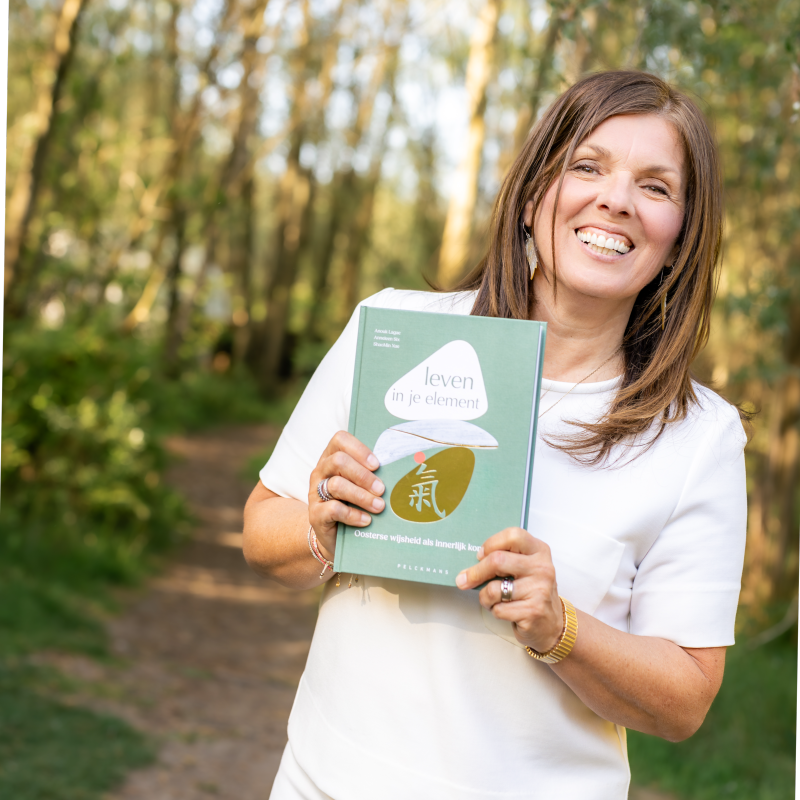
Anouk Lagae
Anouk Lagae is CEO at Accent Jobs. ## Background
Insights & takeaways
Anouk Lagae's thinking centers on a single recurring image: the leader as gardener rather than conqueror. "Ik zie mij nu veel meer eigenlijk als een tuinier," she says, describing her job as CEO of Accent Jobs as tending "een prachtige tuin" where she must make sure "de juiste mensen de juiste vitaminen krijgen, op de juiste plaats. Die heeft veel zon nodig, de ander net niet" 6. This is not a soft metaphor for her, it is a rejection of command-and-control management. She pairs it with the image of migrating birds setting a crystal-clear direction, a "magnetic field," and then trusting the flock to self-organize, alternate leadership and deviate from the straight line to catch the flow 56. The through-line in both metaphors is the same: give people a strong sense of direction and the right conditions, then get out of the way.
That trust has a hard edge, though. She is explicit that a toxic, over-regulated environment kills initiative, which she says is "what happens in many corporates" 6, and just as explicit that culture violations get near-zero tolerance even from top performers, on the logic that "prevention is better than cure" because one unchecked bad cell can sicken the whole company 5. So the gardener does not just water and wait; she also weeds ruthlessly when the culture itself is threatened. This combination, generous slack for individual mistakes but no slack for cultural rot, is one of her clearest and most concrete management positions.
The permission to fail is formalized, not just implied. At Accent, she says, "iedereen die tekent bij ons tekent eigenlijk: ik, Anouk Lagae, beloof dat ik fouten ga maken, ik probeer nieuwe dingen, fouten maken, maar me niet schuldig gaan voelen" 6. The point isn't recklessness, it's that big ideas rarely arrive fully formed, and testing ten small things and tweaking them is how something can suddenly become the next big thing, a lesson she says she learned at Duvel after "big bet" thinking failed her at Coca-Cola 6. Underneath this sits a theory of what actually drives growth: quality, not volume. "Bij Duvel wij spraken nooit over volume, en guess what, wij groeien en twintig dertig procent zonder ooit een doel station en zonder grote budgetten" 6, and she is scornful of discounting premium products, asking rhetorically, "Stel dan je Rolls Royce of een Porsche in de etalage, één plus één gratis, waar zijt ge mee bezig?" 6. Growth, in her account, is the byproduct of love for the product and the people, not the target itself.
That last point is where she locates her personal definition of success: "Impact in de maatschappij, dat is mijn definitie van succes" 6. She traces her own capacity to trust and read people quickly to years spent abroad, stripped of the social reference points (school, dialect, neighborhood) that let Belgians box each other in, and she urges others toward the same experience in blunt, personal terms: "Ga naar het buitenland, it's never too late. Het is life changing... zo ongelooflijk verrijkend dat geen enkele studie dit kan bijbrengen" 6. Her closing formula from that period of her thinking is almost a slogan: "Focus op de liefde voor de people and the outcome volgt gewoon" 6.
By 2026 her public voice has shifted register, from corporate leadership commentary toward Traditional Chinese Medicine and wellness, though the vocabulary of balance and energy carries over almost unchanged. She co-writes and promotes a book, "Leven in je element," describing it to a podcast audience as an accessible intro to TCM built around the question "niet wát ons ziek maakt, maar waarom we ziek worden" . She frames bodily signals, even something as unglamorous as a dog's bowel habits on a Melbourne tram, as diagnostic information: "Je 'grote boodschap' vertelt vaak meer dan je denkt... een belangrijke graadmeter is voor de balans in je lichaam" . She reiterates the same conviction in shorthand elsewhere: "Food is medicine" . And she treats the book's commercial success, a second print run within a month of publication, as validation of a broader cultural appetite for this material, noting "Jullie boek is Vlaanderen aan het veroveren" .
Read together, the two phases of her public statements are less a break than a continuation of the same instinct: that health, whether of an organization or a body, is a matter of balance, right conditions, and attentive small signals rather than force or scale. The concrete takeaways she offers are consistent across both registers, set direction clearly and then trust the system to self-organize, treat culture breaches as non-negotiable even when growth or talent seem to argue otherwise, resist the urge to discount or dilute quality in pursuit of volume, build in explicit permission to fail without guilt, and pay attention to the small, easily ignored signals, whether they come from a team or from your own body, because they tend to say more than they first appear to.
- The real strength of a leader is not being the fastest or smartest, but being the one who extracts the most potential from the whole team.
- Living abroad forces you to assess and trust people in split seconds without any social reference points (school, dialect, neighborhood), a 'muscle' Belgians rarely develop because they constantly place people in boxes.
- A CEO should act like a gardener: give each person the right nutrients, sun or shade, and guard against a toxic, over-regulated environment that kills initiative — which is what happens in many corporates.
- Leadership is like migrating birds: set a crystal-clear direction (the 'magnetic field') and then let the team self-organize, alternate leadership and deviate from the straight line to catch the flow.
- At Duvel Moortgat volume was never discussed — 8 out of 10 meetings with Michel Moortgat were about better quality (best supplier, ingredient, packaging) — yet the company grew 20-30% without volume targets or big budgets, proving quantity is an outcome of quality.
- Sustainable profit comes from choosing quality at every link in the chain, e.g. refusing 1+1 promotions on a premium beer ('you don't put a Rolls Royce on sale buy-one-get-one-free') and making fewer but beautiful, durable parasols that last 20 years.
- At Accent every new hire signs a commitment to make mistakes when trying new things and — most importantly — not to feel guilty about it, because not trying is worse than failing; the board explicitly commits never to say 'I told you so'.
- Big ideas rarely arrive fully formed: test ten small things and tweak; after five tweaks something can suddenly become the next big thing — a lesson learned at Duvel after big-corporate 'big bet' thinking failed her at Coca-Cola.
- Corporates avoid risk because the bigger you are, the more you have to lose; Accent deliberately anchors 'stay a cheeky rascal' as a core value so fear never creeps in as the company grows.
- Magical companies run on love, not fear: Duvel had an almost irrational love for the product, Accent has an incredible love for people — fear is not tolerated, and profit follows as an outcome of that love.
- She chose Accent by brainstorming with her children what would make society better if she 'sold more of it' — her son answered 'more jobs for Syrian refugees', which matched Accent's mission of placing more people in jobs.
- A CEO should be a gardener (right nutrients, right place, no toxic over-regulation) and set direction like migrating birds following a magnetic field — trust the swarm, don't dictate the path.
- Culture violations get near-zero tolerance even from top performers, because 'prevention is better than cure' — one unchecked bad cell can sicken the whole company.
Career
- Kinepolis#600factoryIndependent Director at the BoardMay 2025 – Present
- Muchin - Lifestyle MedicineCo-Founder of MuchinApr 2024 – Present
- Accent Jobs#322factoryChief Executive OfficerJul 2020 – Mar 2024
- DeceuninckIndependent Director at the BoardJan 2017 – Apr 2025
- Duvel MoortgatPresident - Core EuropeJan 2017 – Jun 2019
- Duvel MoortgatChief Marketing OfficerMar 2012 – Feb 2017
- The Coca-Cola Company#228factoryGeneral Manager - Incubators - North West EuropeAug 2010 – Feb 2012
- The Coca-Cola Company#228factoryEuropean Marketing Director - Innovation Still BeveragesJan 2008 – Aug 2010
- The Coca-Cola Company#228factoryMarketing Manager - Waters/Teas/InnovationOct 2005 – Dec 2007
- The Coca-Cola Company#228factoryGroup Brand Manager Youth Brands - Sprite/DrPepper/LiltMay 2003 – Oct 2005
- The Coca-Cola Company#228factorySenior Brand Manager Coke light / Coca-ColaFeb 2001 – May 2003
- Unilever#158factoryGroup Brand Manager1998 – 2001
INSEAD#15schoolExecutive Education - Finance For Executives, Finance2019 - 2019
- ICZO Antwerp (Instituut voor Complementair Zorg Onderwijs)Basics of Traditional Chinese Medicine / Graduated in Phytotherapy (Herbal Medicine)2015 - 2018
- Northwestern University - Kellogg School of Management#99schoolExecutive Education - Director Development Program2015 - 2015
Vrije Universiteit Brussel#7schoolMasters, Engineering and Commerce1993 - 1998
- Koninklijk Atheneum KortrijkLatin - Mathematics (8h)1987 - 1993
From public career histories · 17 entries
Media & appearances
2- 5podcastConnexi · 19 Dec 2022
Connexi's 2022 year-in-review compiles the best moments from a year of Bert Vandebuerie's interviews with Belgian entrepreneurs — covering burnout, cofounder conflict, family succession, bankruptcy, company culture and work-life boundaries.
- 6podcastConnexi · 23 May 2022
Anouk Lagae, CEO of Accent Jobs, explains how living abroad, Chinese medicine and Duvel Moortgat's quality-over-quantity philosophy shaped her 'gardener' leadership style focused on unlocking team energy rather than conquering markets.