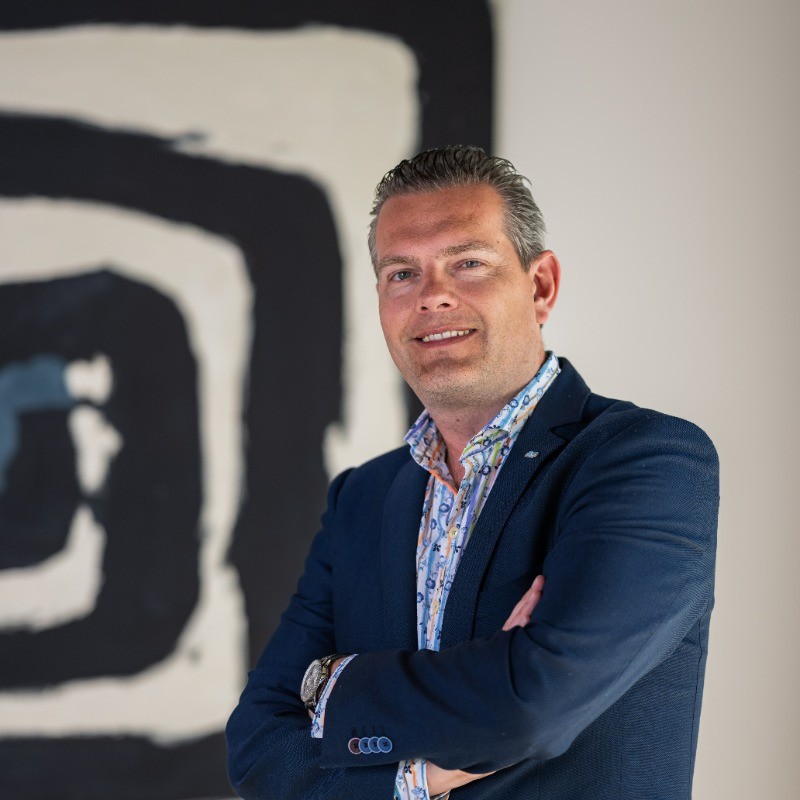
Bart Verhelst
Talks about
Bart built ITP Group (IT Provider) from 2011, growing it into a portfolio of ICT companies including DVIT and Lovatech. ITP Group became part of AXI ICT Services, where Bart took on the Group CEO role in January 2025. He is also active in JCI Belgium.
As Group CEO, Bart drives AXI's positioning in enterprise IT and transformation, managing a portfolio of services and clients across Belgium and beyond.
Insights & takeaways
Bart Verhelst's thinking centers on a single, hard-won insight: growth through acquisition only works if you protect what you are buying, not just what you are buying it with. Describing his own path from a small Tielt-based MSP into a buy-and-build platform, he frames entrepreneurship itself as a discipline requiring an obsessive attention to timing and consistency. "Eigenlijk is ondernemen een beetje topsport ook. Als ge een dag niet hebt, dan verliest ge de wedstrijd" 2, he says, treating the business as something that demands daily performance rather than accumulated momentum. This competitive framing underlies much of his later thinking about deal structure and integration: nothing compounds automatically, and revenue can shrink as easily as grow if an owner sits still too long 2.
That belief shows up most concretely in how he talks about acquiring companies without erasing them. In the case of LOVA, he resisted folding the acquired business into IT Provider's existing service model, insisting instead that a company serving GP practices needs a different operating rhythm than one serving SMEs. The lesson he draws is broader than that single deal: acquirer ego pushes toward uniformity, but uniformity can destroy the very value being paid for 2. That same instinct for preserving distinct identities carries through years later into the group structure he helped build with Strada and IceLake, which he describes as "a group of founder-built companies, joining forces while keeping the soul of what made each of them special" . The through-line is consistent: scale should not mean sameness.
Verhelst is unusually direct about the ethics of acquiring under pressure. Describing the purchase of a business from a terminally ill owner, he lays out a personal code rather than a negotiating tactic: "Ik kan jou één ding beloven, dat is dat we dat heel fair gaan spelen, want ja, je hebt niet veel tijd, dus ik ga daar absoluut ethisch correct mee omgaan en zorgen dat je een correcte prijs krijgt voor jouw bedrijf" 2. He is explicit that this changes the entire dynamic of a deal: the seller isn't optimizing for maximum price but for a safe landing for clients, staff, and family, and the buyer's leverage should not be exploited just because it exists 2. He also defends a controversial operational choice from that same deal, informing staff only after the transaction had legally closed, arguing that this protected the process rather than deceived anyone, since the joint announcement from both owners was well received once it came 2.
On partnership structure, Verhelst is candid about a mistake he does not want repeated. He and his original co-founder built the business together without ever discussing what would happen if their paths diverged. "Achteraf gezien waren wij aan het huwelijk begonnen, maar hebben wij nooit gepraat of nagedacht over de scheiding," he admits 2, and the result was a rushed, difficult buyout in 2015 when ambitions no longer matched. The takeaway he offers is procedural and unambiguous: agree on exit and split mechanics before starting a partnership, not after tension has already built 2.
His approach to personal financial risk follows the same logic of turning concentration into structure. Rather than sell outright, he used what he calls a "smart deal" to diversify his own wealth away from a single concentrated business while retaining half ownership and full operational control, effectively becoming an entrepreneur-investor with stakes across other similarly structured companies 2. Even so, he is careful to signal that this was about de-risking, not exiting: "Ik heb al heel wat waarde, maar ik wil die baby nog niet verkopen" 2. The phrase captures his broader stance toward the businesses he builds: instruments for controlled risk-taking, but also things he remains emotionally attached to and unwilling to let go of prematurely.
By the time the group had grown into the Strada and IceLake chapter, Verhelst's language shifts from operational mechanics to gratitude and trust, but the underlying values are the same ones he articulated years earlier. He credits Strada for giving him "ambitie without ever taking away ownership, in every sense of the word" , and frames every founder who joined the platform as someone who "didn't just sell us a company, you entrusted us with your life's work" . That sentence functions almost as a summary of everything else he has said: acquisitions are, in his view, acts of trust that carry an obligation to protect what was built, whether that means fair pricing under time pressure, resisting forced integration, or structuring partnerships so that ownership and ambition can coexist rather than compete.
- When starting a business partnership, agree upfront on how a split would work; Bart and his co-founder never discussed 'divorce' scenarios, forcing a rushed, difficult buyout in 2015 when their ambitions diverged.
- When acquiring from a dying owner, the negotiation dynamic changes: the seller's goal is a safe basis for clients and staff and provision for his daughters, so the buyer must act ethically, move fast, and pay a correct price rather than exploit leverage.
- In the LOVA acquisition, staff were only informed after the deal was legally closed and money transferred, to avoid complicating the process; the joint announcement by both owners was immediately well received.
- The smart deal let Bart convert concentrated business risk into diversified wealth while keeping 50% ownership and operational control, moving him from entrepreneur to entrepreneur-investor with stakes in other smart-deal companies.
- Don't force full integration of acquired companies: LOVA serves GP practices differently than IT Provider serves SMEs, so preserving the acquired firm's identity and service model protects the value you paid for, even if the acquirer's ego pushes toward uniformity.
- Never assume revenue automatically compounds — competition, mistakes and departing employees are certainties; entrepreneurs who sit too long often see value shrink instead of grow.
Education
MBA Highlights, Solvay Brussels School of Economics and Management (2017)
- Organizational Leadership, JCI Belgium (2015)
Career
Roles
AXI#223factoryGroup CEOJan 2025 – Present
- Verhelst Invest CommVOwnerNov 2005 – Present
- JCI VlaanderenBestuurder Partnerships JCI Vlaanderen VZWAug 2020 – Aug 2021
- JCI TieltPast PresidentJul 2017 – Aug 2018
- ITP Group BVCEOJan 2011 – Dec 2024
- Xylos#351factoryFreelance System Engineer2005 – Jan 2011
OrganiSupport and system engineer2003 – 2005
Education
- JCI Belgium VZWOrganizational LeadershipApr 2015 - Apr 2015
Karel de Grote-Hogeschool#9schoolBachelor Toegepaste Informatica2000 - 2003
- XaveriuscollegeBorgerhout, Economics Mathematics1991 - 1999
From public career histories · 12 entries
Media & appearances
1- 2podcastBlackBird Business Events · 16 Feb 2023
Bart Verhelst tells how he grew IT Provider from a small Tielt-based MSP into a 20-person buy-and-build platform, including an emotional acquisition from a terminally ill owner and bringing 50 private investors on board via a smart-deal to de-risk his personal wealth.