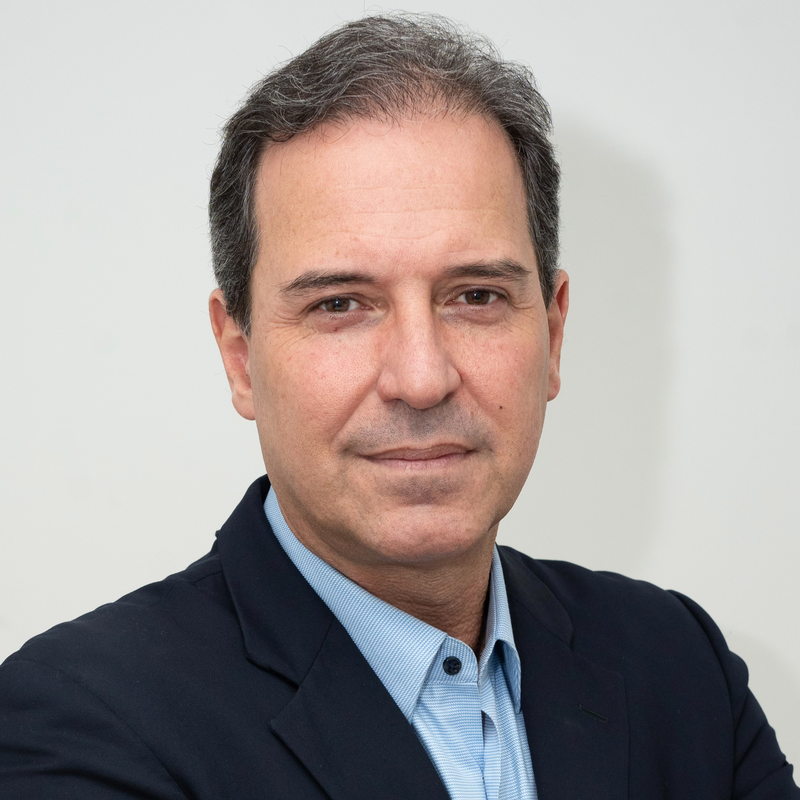
Carlos Reis
Carlos Reis is co-founder and chief executive officer of Epimed Solutions, a role he has held since August 2008, and is based in Rio de Janeiro. He states expertise in benchmarking de desempenho, sistema de informações hospitalares and ferramentas de business intelligence. He also co-founded InterFisio in December 2000 and MedEstratégia in August 2025, and between January 2012 and December 2021 was co-founder and director of InfoSalutis.
Earlier he joined Medcenter Solutions as chief medical officer in December 1999, becoming vice president in 2002 and then co-founder and chief executive officer until December 2009. He was executive director of the Instituto D'Or de Pesquisa e Ensino from January 2010 to December 2011 and a business mentor at Endeavor from 2010 to 2015. He worked as an intensive care physician at Hospital Barra D'Or - Rede D'Or São Luiz from 1998 to 2003, served as IT director at SOTIERJ, and founded MedStudents in June 1995.
Reis took his MD at the Federal University of Rio de Janeiro, completed an internal medicine residency at the Hospital de Força Aérea do Galeão and an MBA at Ibmec, and studied ICU leadership at the Université libre de Bruxelles and artificial intelligence in health care at the MIT Sloan School of Management.
Insights & takeaways
Carlos Reis writes almost entirely about one intersection: artificial intelligence, clinical governance, and the practical work of running health institutions. Across his posts a consistent argument emerges. AI is not a threat to be resisted or a magic fix to be adopted blindly, but a force that has to be organized, supervised, and matched to human judgment at every level. He returns again and again to the same structural point: technology usually is not the bottleneck. When discussing Brazil's CFM Resolution nº 2.454, he notes that hospital leaders "já conhece a Resolução CFM nº 2.454, mas ainda busca entender como transformar suas exigências em processos dentro da instituição," and concludes plainly that "a maior dificuldade quase nunca é tecnológica" . The real work, in his view, is institutional: defining responsibilities, evaluation criteria, and monitoring, and simply "dar o primeiro passo de forma estruturada" .
This governance instinct is not abstract for him; it is calibrated to risk. He insists that "nem toda IA na saúde exige o mesmo nível de governança," distinguishing a document-organizing tool from one that "influencia decisões clínicas," and argues that monitoring and controls "devem ser proporcionais aos riscos envolvidos" . That same proportionality shows up in how he frames the evidence base of medicine itself. Citing researchers from UCL, Moorfields Eye Hospital, Tsinghua University and Singapore National Eye Centre, he lays out a hierarchy of data, information, evidence, and clinical practice, arguing that large language models can radically transform the first two levels, while the move to evidence still depends on method and validation . His summary of the field's core tension is characteristically compact: "LLMs aceleram a produção e a síntese da informação. Evidência científica continua dependendo de método e validação" .
A second recurring theme is his refusal to let efficiency substitute for critical thinking. Discussing an MIT Sloan Management article on what he calls "AI gravity," he warns that "quanto mais eficiente a IA se torna, maior a pressão para usá-la como atalho cognitivo," and frames the real risk not as using AI but as "perder a capacidade de reconhecer quando ela está errada, incompleta ou desalinhada com o contexto" . He explicitly endorses the article's prescription to use AI "como uma treinadora cognitiva, não apenas como uma fornecedora de respostas prontas" . This same conceptual clarity appears when he distinguishes generative from agentic systems, summarizing an MIT Sloan Management Review framework: "A IA generativa responde perguntas. Agentes de IA perseguem objetivos" . He is drawn to frameworks that let him separate categories cleanly, whether it is data versus evidence, or chatbots versus agents, and then apply that clarity to concrete health-system decisions.
Reis positions physicians and medical leadership, not technologists, as the rightful drivers of this transformation. He states directly that "poucas vezes na história da Medicina surgiu uma oportunidade tão relevante para que médicos liderem uma transformação profunda na forma como a assistência é prestada," arguing that clinical training and assistential experience are precisely the knowledge base needed to implement AI "de forma segura, ética e centrada no paciente" . He frames clinical governance not as a regulatory burden layered on top of medicine but, in his words, as an opportunity rather than merely "uma nova obrigação regulatória" . This leadership argument connects to his own long-running work with clinical data: he describes nearly twenty years spent turning clinical data into applied intelligence for intensive care, with a base now covering "mais de 10 milhões de pacientes críticos, provenientes de mais de 2.300 UTIs em 15 p[aíses]" , and he treats this scale as evidence that data-driven governance produces measurable results, pointing to a state-level clinical governance project in Goiás as a concrete example "gerando resultados concretos" .
On patient safety and organizational learning, he pushes back against a common managerial error: treating low incident reporting as automatically good news. Commenting on an article by Laiane Silva, he warns against "confundir ausência de evidência com evidência de ausência," noting that low notification rates can reflect excellence but can equally reveal "medo, baixa adesão ou falta de confiança no processo." For him the real marker of maturity is not the absence of reported incidents but "a capacidade da organização de aprender com os incidentes e transformar esse aprendizado em melhorias concretas" . This is consistent with his broader worldview that metrics and technology are only useful insofar as institutions build the judgment and processes to act on them, echoed in his account of an internal AI agent competition at Epimed Solutions Brazil, where he concludes that the biggest outcome was not any individual AI agent but the fact that "cada apresentação permitiu que todos conhecessem melhor o trabalho das outras áreas" .
Outside the AI and governance material, Reis occasionally steps back to offer more personal, reflective observations that still tie into decision-making. On hiring, he describes learning that first impressions of candidates are more predictive than resumes or interview performance, summarizing it as "a entrevista começa antes da primeira pergunta," and adds that whenever he ignored a negative first impression and hired anyway, he "quase sempre descobri, mais tarde, que minha primeira impressão estava certa" . On navigating crises and market turbulence, he invokes an expression he picked up early in his career, "siempre que llovió, paró," adapted into Portuguese as "sempre que choveu, parou," using it to argue that not every decision needs to be made "no auge da tempestade" and that "calma e paciência também são estratégias" . These pieces round out a picture of someone whose operating philosophy, whether applied to AI governance, hiring, or crisis management, consistently favors structure, proportionality, and patience over reflexive action.
Career
- MedEstratégiaCofundadorAug 2025 – Present
- Epimed SolutionsCo-Founder, Chief Executive OfficerAug 2008 – Present
- InterFisioCo-FounderDec 2000 – Present
- InfoSalutisCo-Founder and DirectorJan 2012 – Dec 2021
- EndeavorMentor de negóciosJul 2010 – Oct 2015
- Instituto D'Or de Pesquisa e EnsinoExecutive DirectorJan 2010 – Dec 2011
- Medcenter SolutionsCo-founder and CEOMay 2006 – Dec 2009
- Medcenter SolutionsVice PresidentJan 2002 – Apr 2006
- Medcenter SolutionsChief Medical OfficerDec 1999 – Dec 2001
- SOTIERJDiretor de informáticaJan 1999 – Dec 2000
- Hospital Barra D'Or - Rede D'Or São LuizIntensive Care PhysiciansMar 1998 – Mar 2003
- MedStudentsFounder and CEOJun 1995 – Nov 1999
MIT Sloan School of Management#40schoolArtificial Intelligence in Health CareNov 2024 - Jan 2025
Université libre de Bruxelles#10schoolCourse, ICU Leadership2018 - 2018
- IbmecMBA, Senior Health Care MBA2001 - 2002
- Hospital de Força Aérea do GaleãoInternal Medicine Residency ProgramJan 1998 - Dec 1999
- Federal University of Rio de JaneiroCardiology Intensive Care Unit - InternshipJan 1996 - Dec 1996
- Hospital Municipal Miguel CoutoIntensive Care Unit - InternshipJan 1996 - Dec 1996
- FIOCRUZ - Fundação Oswaldo CruzInternship, NeurologyJan 1995 - Dec 1995
- Hospital Municipal Miguel CoutoEnergency Department - InternishipJan 1995 - Dec 1995
- Federal University of Rio de JaneiroMD, Medicine1991 - 1997
From public career histories · 21 entries