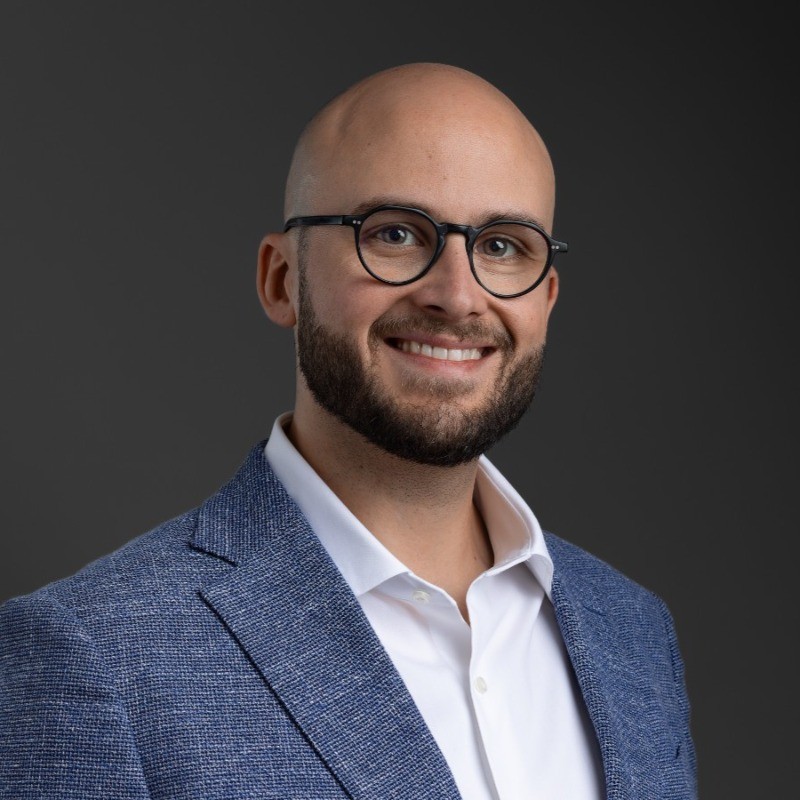
Christophe Ricevuto
Christophe Ricevuto is co-founder and CEO of Nalios, a company he co-founded in November 2020, and is based in Brussels. He states expertise in project management, ERP software, enterprise resource planning and ERP implementations. Since January 2025 he has sat on the board of advisors of FlowUP, and since March 2025 on the board of advisors of EKKOFIN.
Before Nalios, he worked at Odoo from March 2017 to November 2020, first as a business analyst and project manager and, from September 2018, as team leader for business services. He spent close to eight years at VOO, joining in July 2009 as a second line helpdesk advisor and moving in October 2013 to a role as reporting analyst and web developer. Earlier he was a PC technician at Inventec SPRL from 2007 to 2008 and worked at Carrefour S.A. from January 2008 to June 2009.
He studied at the Institut Notre-Dame de Jupille, took a bachelor's degree in accounting and finance at ECI Liège and a master's in management science at the Université de Namur.
Insights & takeaways
The through-line
Across nearly every post, Christophe Ricevuto returns to one preoccupation: dependency, and how to eliminate it, whether it is dependency on a single employee, on an integrator, or on stale, scattered data. Early posts frame this around Odoo as a way to centralize information so a business does not collapse when one person leaves or one document goes missing . As the month progresses, the argument sharpens into an explicit critique of his own industry, arguing that integrators profit from keeping clients dependent and that the right approach is to train clients into autonomy . By mid-to-late August the same logic gets applied to a new frontier, AI plugged directly into Odoo, where he insists the real bottleneck is not the technology but the cleanliness of the underlying data . The position has not really changed, but the target has widened, from "don't depend on one person" to "don't depend on your integrator" to "don't expect AI to fix a messy database."
On dependency and autonomy
Ricevuto repeatedly frames a well-run ERP project as one that makes the client independent, not one that locks them in. He states plainly that "Une bonne mise en place doit surtout vous rendre autonome" and that "Le but n'est pas de rester dépendant d'un prestataire pour chaque modification ou chaque question" . He goes further and names the incentive problem in his own trade: "Un intégrateur a tout intérêt à ce que vous dépendiez de lui. Chaque formation, chaque nouvel utilisateur, chaque question, c'est une ligne de facture de plus" . His prescribed fix is a "champion Odoo" trained internally so "la connaissance reste dans vos murs," warning that otherwise "vous ne pilotez plus votre outil, vous le louez" . The same worry about single points of failure applies to people, not just vendors: "Quand votre commercial part, il ne devrait pas emporter avec lui toute la relation client" , and he uses a concrete test for organizational health, "Demandez à quelqu'un de retrouver un devis signé il y a 6 mois" .
On centralizing data
The centralization argument shows up in nearly every vertical he addresses, from field service to e-commerce. For technicians on site: "le technicien remplit sa feuille de travail directement sur sa tablette, la fait signer sur place et l'information remonte immédiatement" . For e-commerce sellers juggling multiple tools: "Shopify est un excellent outil pour vendre en ligne. Le problème, c'est tout ce qu'il y a autour" . And centralization is presented as the precondition for everything else he cares about, financial visibility and AI usefulness alike: "Plus vos données sont centralisées, plus vous profitez réellement des capacités de l'IA" .
On real-time financial visibility
He challenges founders directly on whether they actually know their numbers: "tu connais ton résultat de la semaine dernière ? Pas une estimation. Pas un ressenti. Le chiffre" . The danger he names is drift into failure without noticing: "on peut glisser vers la faillite en pensant que tout va bien. Simplement parce qu'on regarde ses chiffres dans le rétroviseur" . His remedy is unifying project management, invoicing and accounting so margins are visible "en temps réel pour repérer rapidement les écarts" , rather than discovering profitability "une fois qu'il est terminé" .
On AI plugged into the ERP
Ricevuto treats Odoo's native MCP server capability as a structural advantage over competitors who sell AI as an add-on: "Odoo devient lui-même un serveur MCP... Un endpoint, une clé, et votre assistant interroge vos commandes, vos stocks, vos factures," contrasting this with rivals where "L'IA posée à côté du système, jamais dedans. Ce n'est pas la même philosophie. Ce n'est pas le même budget" . But he is careful to puncture hype: "Ce n'est pas magique. Si votre base est sale, l'IA vous répondra vite et mal. Si vous ouvrez l'écriture trop tôt, vous créez un problème que vous n'aviez pas" . The practical case he gives is a churn-detection question, "quels clients commandaient régulièrement et ont arrêté depuis six mois," that used to cost "une demi-journée" and now takes "30 secondes" once Claude is connected to Odoo .
On changing the method, not just the tool
He argues that switching ERPs without changing how the business works is the most common failure mode: "Beaucoup d'entreprises changent d'ERP sans vouloir changer leur façon de travailler... c'est souvent là que le projet déraille" . His conclusion is blunt: "ce n'est pas le changement d'ERP qui fait la différence. C'est le changement de méthode" . The same instinct against forcing pace over adoption shows up in his repeated Big Bang critique: "La vitesse d'un projet ne se mesure pas au jour du go-live. Elle se mesure au moment où les équipes s'en servent vraiment" .
From the stage
In interviews he explains why integrators exist at all in an ecosystem that already has Odoo itself, pointing to supply and demand imbalances and the value of local proximity for SMEs and larger accounts 16. He also describes Nalios Impact, a program extending the same digitalization work to public organizations and nonprofits (ASBLs) in Wallonia and Brussels, including VAT recovery help and a free 4500 euro project analysis, which is not mentioned anywhere in the written posts 18. On a personal note, he mentions combat sports as a counterbalance to his daily work in software integration 16, and in the Cercle de Wallonie-Bruxelles interview he traces his path from leaving school at 17, a brief tiling apprenticeship, and supermarket work, to co-founding a 35-person company, framed around a drive to prove himself 17.
Takeaways
- Before a Big Bang go-live, consider phasing the rollout by wave; adoption speed matters more than go-live date .
- Ask whether your team can retrieve a six-month-old signed quote quickly; if not, you have a centralization problem worth fixing .
- Do not let sales relationships live in one person's inbox or head; centralize client history so departures do not cost you the account .
- Before deploying AI on your ERP data, clean the database first, a dirty base means fast, wrong answers .
- When choosing an integrator, ask whether they train your team to be self-sufficient or keep you paying for every question .
- Track project margins in real time rather than waiting for the accountant's after-the-fact report, by the time you see a loss it may be too late to fix .
Career
Roles
- EKKOFINMember of the Board of AdvisorsMar 2025 – Present
FlowUPMember of the Board of AdvisorsJan 2025 – Present
NaliosCo-Founder & CEONov 2020 – Present
Odoo#48factoryTeam Leader - Business ServicesSep 2018 – Nov 2020
VOO#248factoryReporting Analyst & Web developerOct 2013 – Mar 2017
- Carrefour S.A.Supermarket employeeJan 2008 – Jun 2009
- Inventec SPRLPC TechnicianJan 2007 – Jan 2008
Education
Université de Namur#18schoolMaster, Management Science2015 - 2017
- ECI LiègeBachelor, Accounting and Finance2011 - 2014
- Institut Notre-Dame de Jupille2001 - 2006
From public career histories · 12 entries
Media & appearances
3- 16podcastGroupe UCM · 1 year ago · 24:15 · 98 views
Christophe Ricevuto discusses how Nalios operates as an Odoo integrator, explaining that the company helps businesses digitalize by implementing Odoo software and translating their specific business needs into the software solution. He describes why integrators like Nalios are necessary alongside Odoo itself, citing supply and demand imbalances and the local proximity integrators provide to SMEs and larger accounts. He also briefly mentions his personal interest in combat sports as a counterbalance to his daily work in software integration.
- 17interviewCercle de Wallonie-Bruxelles · 1 year ago · 49:45 · 413 views
Christophe Ricevuto discusses his journey from supermarket shelf-stocker to CEO and co-founder of Nalios, a company of 35 people specializing in Odoo software integration for SMEs across Belgium, France, and Switzerland. He explains his motivation to prove himself and grow personally and professionally, and describes leaving traditional education at 17 due to family circumstances, briefly attempting an apprenticeship in tiling, then working as a supermarket employee before eventually starting his business with an associate he met while working as an Odoo consultant.
- 18interviewNalios · 1 year ago · 3:02 · 83 views
Christophe Ricevuto explains that Nalios Impact is a program designed to help public organizations and non-profit associations (ASBLs) with their digital transformation, building on Nalios' existing work with SMEs. The program focuses on organizations in Wallonia and Brussels with social and environmental impact, offering benefits including VAT recovery, a free 4500 euro project analysis, and support in balancing budgetary constraints with service quality. Interested organizations can apply through impact.nalios.com or contact Nalios via LinkedIn and YouTube.