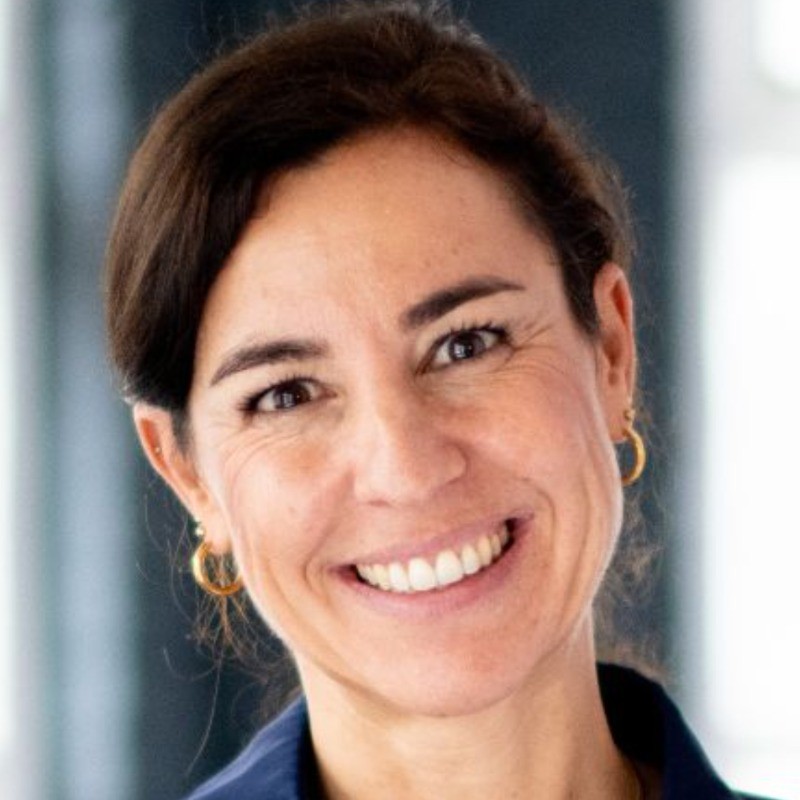
Dewi Van De Vyver
Talks about
Dewi Van De Vyver operates across the Belgian tech ecosystem as a founder, board member, and public speaker. She focuses on the intersection of ethics, AI, and leadership, and is one of the more prominent voices advocating for women in Belgian tech.
Her keynote work and board roles position her as an ecosystem connector who contributes at both the company and community levels. She was among the voices amplified in the Belgian tech mafias discussion, representing the broader ecosystem beyond the mafia companies themselves.
Insights & takeaways
Across the sources spanning her entrepreneurial exit and her later cultural commentary, Dewi Van De Vyver keeps returning to a single instinct: pay close attention to patterns, whether they show up in a P&L, in a body under stress, or in a decade-old science fiction film. In 2026 she frames this explicitly as a historical observation about technology and society, noting "We have lived through all the emotions of what is happening today before" . Her "Xennial Doomsday Collection" is not offered as film criticism but as a warning system: she picks titles for "hun voorspellende karakter" rather than "hun cinematografische waarde" , and she frames the present moment, with its control states, AI, robots and predictive policing, as something Hollywood already scripted and that we are now living inside . This is the through-line in her public thinking: technology and organizational life are not neutral, and the signals of where they are heading are usually visible well in advance to anyone willing to look.
That same attentiveness to early signals runs through her account of her own 2015 burn-out. She insists on describing it in physical, almost clinical terms rather than as a vague mood: "Burn out is het langdurig hebben van stress en dat u lichaam uitgeput geraakt om eigenlijk de adrenaline die dat stress veroorzaakt van die af te breken en dat is echt een fysisch proces" 2. This matters to her because it cuts against the instinct to treat burn-out as a willpower problem. She describes her own reflex on falling ill as trying to manage her way out of it, immediately lining up a coach and a September restart, only to be told by her doctor that her body was simply depleted and no amount of planning would fix that 2. Her insight is that the very drive that makes someone successful is what makes them blind to their own collapse: "Ik werk keihard, ik heb alles onder controle, en waarom gaat dat je het nu niet?" was the attitude she had projected onto people who supposedly lacked motivation, when in fact her problem was that she had too much of it 2.
She generalizes this into a broader claim about who burn-out actually hits. It is not the disengaged or the lazy who break down, in her account, but precisely the strong-willed, the people whose determination lets them push through deadlines and difficulty right up until that same determination becomes self-destructive when applied without limit. This is her version of flogging a dead horse: a coping mechanism that works under short-term pressure and fails catastrophically when treated as a permanent operating mode 2. It is a personal insight, but she extends it into leadership advice, arguing that recognizing this dynamic in yourself and in employees is part of running a "mensen business" responsibly 2.
On the mechanics of building a company, she draws a clean distinction between managers and entrepreneurs that she clearly still uses as a mental model. Managers, in her formulation, exist "om letterlijk een situatie die dat de al bestaat in goede banen te leiden, letterlijk te managen," while entrepreneurs look at an existing situation and ask how to make it better or how to fix what is not working 2. She pairs this with a candid point about the invisible labor before a company's official founding date: entrepreneurs are typically already working and self-funding long before incorporation, a reality she thinks is underexposed when people look only at founding dates and funding rounds 2. She also names a very concrete structural problem for agencies: around 30 employees becomes a genuine ceiling, forcing a choice between acquiring other companies, hiring ahead of growth at a temporary loss to diversify skills, or consolidating with a larger partner, which is the path that led to Flow Pilots' deal with ACA IT Solutions 2.
Her account of leadership culture centers on open communication, but she is careful to strip that phrase of its usual softness. "Open communicatie wilt niet zeggen dat zomaar alles kan," she says 2, and she describes a system with real mechanics: no gossip or grapevine, mistakes admitted without judgment, and every suggestion either acted on or given an explained no, so that the loop is always closed and people feel genuinely heard 2. This is presented not as a values statement but as an operating discipline, one that she credits with making people willing to speak up in the first place 2.
Underneath all of this sits a stated willingness to trade profit for people, and she treats that trade as a defining choice rather than a regret. "Hadden we meer winst kunnen maken? Waarschijnlijk wel, absoluut. Maar dan hadden we mensen minder moeten betalen, en we zijn een mensen business," she says, and she measures the payoff not in margin but in the fact that everyone at Flow Pilots could buy apartments and renovate homes 2. She holds up the scale of entrepreneurial impact in almost startled terms: "Als ondernemer hebt ge ongelooflijke grote impact, dat is hallucinant eigenlijk als je daar bij kijkt" 2. This same lens turns critical when she looks at Big Tech's mass layoffs, which she reads as a sustainability failure: companies took covid-era subsidies, hired aggressively, and then dumped tens of thousands of people, draining brainpower from the wider economy and leaving behind traumatized human capital that society has to absorb 2.
Taken together, the throughline from her entrepreneurial reflections to her later commentary on dystopian film is a consistent belief that consequences are visible ahead of time, whether in a person's body, a company's headcount, or a culture's relationship with surveillance and AI. The concrete takeaway she offers listeners and readers is not abstract optimism or pessimism but a call to notice the signal early: recognize when drive has become self-destructive, build communication systems that actually close the loop, size a company's growth honestly rather than hiring and firing on subsidy cycles, and treat the patterns Hollywood already put on screen as data rather than fiction 2.
- Entrepreneurs are typically already working and investing heavily before the official company start — an underexposed reality: Flow Pilots' founders were building and self-funding well before incorporation in 2011.
- The difference between managers and entrepreneurs: managers steer an existing situation in good order, entrepreneurs look at the existing situation and take action to change or improve it.
- Burn-out is a physical process: prolonged stress exhausts the body's (adrenal) capacity to break down adrenaline, leading to lying awake exhausted while your mind keeps churning.
- Recovery from burn-out could only start once she accepted it; her entrepreneurial reflex of immediately hiring a coach and planning a September restart was rejected by her doctor because her body was simply depleted.
- Burn-out hits precisely the strong-willed: the willpower and drive that lets you push through deadlines becomes counterproductive when applied permanently — 'flogging a dead horse'.
- Around 30 employees is a difficult cap for an agency: you either do M&A, hire ahead of future growth at a temporary loss to diversify skills, or consolidate with/sell to a bigger partner — which is what led to the ACA IT Solutions deal.
- Open communication is not a complaining or bullying culture: it requires respect, no gossip ('grapevine'), admitting mistakes without judgment, and closing the loop — every suggestion gets acted on or an explained 'no', which makes people feel heard and willing to speak up.
- Big Tech layoffs are a sustainability failure: companies took covid-era subsidies, mass-hired, then dumped 10,000s of people — draining brain power from the wider economy and creating traumatized human capital that society must absorb.
- Deliberately choosing lower profit to pay employees well is a viable strategy: everyone at Flow Pilots could buy apartments and renovate homes, which she counts as real entrepreneurial impact.
Career
Roles
- SECO BelgiumNon Executive boardmemberOct 2024 – Present
- EthiasNon Executive Board MemberMay 2023 – Present
- ProvironNon Executive Board MemberApr 2022 – Present
- STEM PlatformCommittee MemberJan 2021 – Present
- Voka-Vlaams netwerk van ondernemingenNon Executive Board MemberSep 2021 – Present
- the dewi corp.FounderJan 2020 – Present
Thomas More#356factoryNon Executive Board MemberNov 2020 – Present
EffexCEO & Co-FounderSep 2022 – Apr 2026
Flow PilotsCEO & Co-founderNov 2018 – Sep 2022
- NiscayahKey Account Project ManagerJan 2010 – Nov 2012
- BNP Paribas Fortis#6factoryICT & Communication managerSep 2007 – Sep 2009
- PrimevisionMarketing & Communication OfficerMay 2006 – Jun 2007
- University GhentScientific CollaboratorJan 2005 – Apr 2006
- FPS Chancellery of the Prime MinisterCommunication OfficerSep 2003 – Dec 2004
- Jong VLDPresident2003 – 2005
Education
- GUBERNA - Instituut voor Bestuurders/Institut des Administrateurs#193schoolDirector EffectivenessJan 2026 - Feb 2026
- GUBERNA - Instituut voor Bestuurders/Institut des Administrateurs#193schoolCertificaat, Business Administration and ManagementDec 2025 - Dec 2025
- GUBERNA - Instituut voor Bestuurders/Institut des Administrateurs#193schoolCertificat, Board EffectivenessSep 2022 - Dec 2022
Vlerick Business School#3schoolCertificate, Strategy Implementation2021 - 2021
Antwerp Management School#19schoolCertificate, Leading Digital Transformation2020 - 2021
HOGENT#8schoolGoint4Growth2015 - 2015
- Academie TemseBachelor, Grafische Vormgeving2008 - 2013
Ghent University#2schoolEuropean Master Law & Economics2006 - 2006
- Duke University#304schoolSummer School, Law & Economics2005 - 2005
- EHSAL Management School#25schoolBusiness Administration2003 - 2004
University of Antwerp#5schoolMaster, Communication Science1998 - 2003
From public career histories · 32 entries
Media & appearances
1- 2podcastConnexi · 03 Apr 2023
Dewi Van De Vyver (co-founder Flow Pilots, sold to ACA IT Solutions in 2022) opens up about starting her tech agency in 2011, her 2015 burn-out, and her exit — with sharp takes on tech ethics, human-first leadership and the entrepreneur/manager distinction.