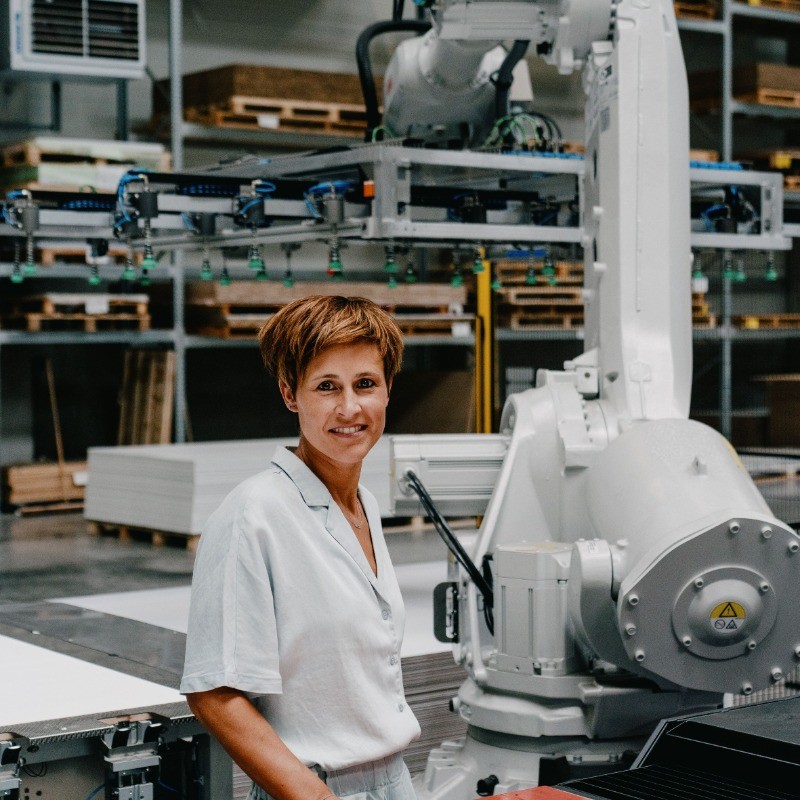
Femke Helon
Femke Helon is CEO & co-founder at 3Motion. ## Background
Insights & takeaways
Femke Helon's public voice centers overwhelmingly on one story: how a business built from scratch became inseparable from her family life, and how a personal and professional crisis became the occasion for growth rather than collapse. On the Connexi podcast she describes the death of her father coinciding almost exactly with the collapse of 3Motion's events and trade-fair order book at the start of COVID, and her response was not to retreat but to reorient the company's product range within days toward plexiglass screens, floor stickers and safety displays 3. She is direct about how she frames this period: "Het is ook gelukt om van zoveel negativiteit zoveel positiviteit te maken" 3. That sentence is the closest thing to a personal thesis in her public remarks, the idea that adversity is material to be converted rather than merely endured.
A second recurring theme is her rejection of the conventional language of work-life balance. Rather than trying to separate the two domains, she describes actively merging them: "Ik ben gestopt om te zoeken naar een balans. Ik heb gezocht naar de manieren waarop ik het gewoon kan combineren en dan wordt het gewoon een geheel" 3. This is not presented as a compromise but as a deliberate design choice, reinforced practically by hiring someone who splits time between company work and helping with the children and cooking at home, a hybrid role that she says gave her both extra working hours and calm domestically 3. Her children being drawn into the business from a young age fits the same pattern: family and company are treated as one continuous structure rather than two competing obligations.
On strategy, Helon and her husband positioned 3Motion from the outset as solution sellers rather than printers, asking clients what they needed and adding installation services on top of print capacity, a move she credits with immediately separating them from traditional print shops 3. Neither of them came from a graphic-sector background, and she is explicit that this shaped how they built the company: they focused on hiring people who were better than themselves at the craft while keeping their own attention on sales and long-term company building, rather than doing the day-to-day production work themselves 3. This same instinct for structural delegation shows up later in her account of introducing a teamleader structure with natural leaders, which made teams partly self-steering and let the founders step back from being operationally indispensable 3.
Her account of landing 3Motion's first reference client is one of the more concrete, almost tactical stories she tells. She was working for Kipling, a company in the supplier sector she intended to enter, and rather than concealing her plans she told her employer directly that she was leaving to start a competing business and asked for a chance to bid on their work 3. That directness got her Kipling as a first client, which she says opened doors to further customers 3. It is a small anecdote but it carries a clear implicit position: transparency about intent, even when it might seem risky, can be the thing that generates trust and opportunity rather than closing it off.
On leadership under pressure, she is candid that the sense of obligation was intense rather than abstract. She recalls the scale of responsibility bluntly: "Er waren veertig mensen op mij aan het wachten van: oké, wat gaan we doen?" 3, and describes the mindset that followed as leaving no room for hesitation: "There was no other option. Het moet gewoon lukken" 3. She also acknowledges that the pivot looked irrational to outsiders at the time, noting that "Bepaalde mensen verklaarden ons ook volledig gek" 3, which she offers not defensively but as part of the texture of making an unconventional call under pressure. Her view of leadership in crisis is that positivity has to be actively injected rather than assumed: employees are only positive, in her account, if leadership itself brings positivity and makes a point of celebrating successes, particularly when things are uncertain 3. She pairs this with a admission that runs somewhat against a purely self-reliant founder image, that of needing to "Hulp durven vragen, hulp durven aanvaarden" 3, asking for and accepting help.
Beyond the pandemic pivot, she also identifies a specific external opportunity she is watching: Brexit, which she sees pushing international clients who previously produced in the UK to look for mainland production in Belgium or the Netherlands so they can distribute and install across Europe 3. This sits alongside her account of the COVID reorientation as evidence of a consistent operating instinct, that market disruptions of very different kinds, whether a pandemic or a trade policy shift, are read primarily as openings for repositioning rather than threats to be defended against.
Taken together, her public statements describe a fairly consistent operating philosophy rather than a set of isolated anecdotes: build a company by hiring people better than yourself at the craft and buying back your own time as sales and long-term development, refuse to separate business from family life and instead deliberately fuse them, tell the truth about your intentions even when it seems risky, and treat crisis as raw material for reinvention as long as leadership is willing to supply the positivity that makes that reinvention possible for the people depending on it 3. Her more recent posts, brief as they are, gesture toward the same team-oriented register, framing hiring around being "klantgericht," "organisatorisch sterk," and "hands-on" and treating ordinary team days as worth publicly marking with warmth , consistent with the emphasis she places elsewhere on culture and morale as something a leader actively produces rather than something that simply exists.
- She and her husband deliberately positioned as solution sellers rather than printers: instead of selling printer capacity, they asked clients what they needed and added installation services, which immediately differentiated them from traditional print shops.
- Without graphic-sector backgrounds, they focused on hiring people better than themselves for the craft while they concentrated on sales and building the company long-term, rather than doing the day-to-day graphic work themselves.
- She openly told her employer Kipling she was leaving to start a business in their supplier sector and asked for a chance to bid — landing Kipling as the first reference client, which opened doors to other customers.
- She stopped searching for work-life balance and instead engineered work and family into one integrated whole, with the company woven into family life and children involved from a young age.
- They hired someone (Marjan) who works part-time in the company and part-time helps with the children and cooking — a household/company hybrid role that gave Femke extra working hours and calm at home.
- Introducing a teamleader structure with natural leaders made teams partly self-steering and allowed the founders to become less operationally indispensable.
- When COVID killed the events/trade-fair order book days after her father died, they reoriented the product range within days to plexiglass screens, floor stickers and safety displays — helping clients stay open safely — and closed 2020 with strong growth.
- Brexit is creating an opportunity: international clients who produced in the UK now seek mainland production in Belgium or the Netherlands to distribute and install across Europe.
- As a leader in crisis she felt it was her duty to inject positivity: employees are only positive if the leadership brings positivity and celebrates successes, especially during uncertainty.
Career
- FebelgraBestuurslidJun 2022 – Present
- Fespa BelgiumVoorzitterJun 2022 – Present
- UNIZO Oost-VlaanderenRaad van bestuurJun 2022 – Present
3MotionOwnerJan 2011 – Present
- VF CorporationMerchandising CoördinatorOct 2006 – May 2009
- Stella PBestuurdersopleidingJan 2024 - May 2024
Vlerick Business School#3schoolKMO ExcellenceMar 2021 - Jun 2021
- EHSAL Management School#25schoolMaster's degree, Marketing/Marketing Management
From public career histories · 8 entries
Media & appearances
1- 3podcastConnexi · 31 Jan 2022
Femke Helon (3Motion, WOMED Onderneemster van het jaar 2020) tells how she and her husband built a visual communication company from scratch, integrated family and business as one whole, and turned her father's death and the COVID crisis into a pivot that produced strong growth in 2020.