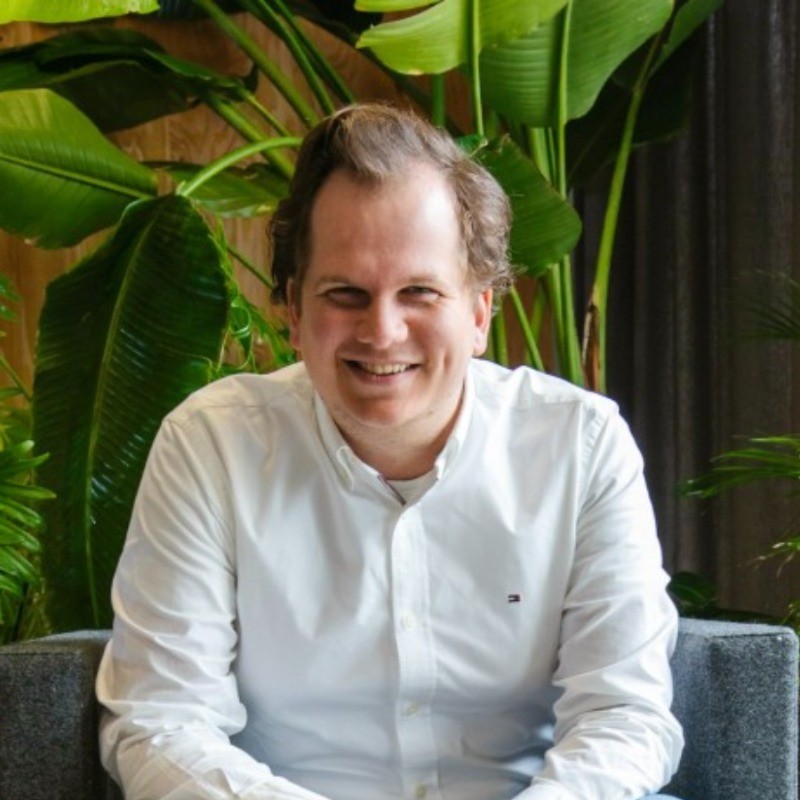
Filip Smet
Filip Smet is CEO and founder of AMOTEK Technologies, a serial entrepreneur who also founded Immowi, OneGrid, Qualico, and Vinix.
Talks about
Insights & takeaways
The through-line
Across Filip Smet's posts and interviews, one preoccupation keeps resurfacing: value has to be earned, not assumed, whether that is AI adoption, a business idea, or a team. In his 2026 LinkedIn commentary on generative AI he keeps asking whether people actually get enough out of a tool to pay for it , and whether an "AI use case" survives contact with a real user . In his 2021 and 2024 podcast appearances the same instinct shows up applied to himself and his companies: goals that started purely quantitative became qualitative 8, and a company he once built to sell became one he explicitly never wants to exit 7. The shift over time is from optimizing for growth numbers to optimizing for what gives him energy and for building things that last without him.
On AI's real value
Smet is skeptical of AI enthusiasm that doesn't translate into use or payment. He points out that in Flanders "𝐓𝐨𝐝𝐚𝐲 𝐢𝐭 𝐢𝐬 𝟏𝟓 𝐩𝐞𝐫𝐜𝐞𝐧𝐭" paying for AI, up from 8 percent, but that "five out of six people in Flanders still pay nothing," concluding "The question is no longer whether people use AI. It is whether they get enough value out of it to open their wallet" . He applies the same lens to enterprise AI projects, describing a landscape of "Pilots that impress the steering committee and never reach a real user" and "Ten 'AI agents' automating a task that took five minutes anyway," arguing that "An idea costs nothing" but execution is now the real differentiator since "everyone can build now, so building stopped being the hard part" . On search specifically, he notes that as "AI gets slapped onto everything," good software has to "take you straight to the right answer instead of leading you further away from it," which is why people increasingly go "straight to an app like Claude or ChatGPT" .
On culture and team
For Smet, team composition is treated as a strategic decision, not a soft one: "Culture is built by the people you choose to surround yourself with every day," with "No drama. No energy wasted on negativity" . This carries into how he screens investments: "everything starts with the team," fulltime commitment is non-negotiable, and he weighs coachability, gratitude, and whether a case "gives him energy" 7. He also uses equity deliberately as a culture tool, giving key people ownership even unprompted, because shareholding creates long-term commitment, while stressing that clear shareholder agreements are essential since people forget how things came about 8.
On time and priorities
Time, not money, is Smet's stated scarce resource. "Time is the only thing you can buy," he says of what changes after exiting a company young 7, and he protects it accordingly, running without a business phone or personal mailbox for years so an assistant filters out 90 percent of what reaches him 7. Earlier, in 2021, he framed the same idea more universally: "Iedereen heeft evenveel tijd" and the real issue is priorities, not hours in the day 8. He also distinguishes urgency from importance, noting people chase "de meest dringende dingen maar niet altijd de meest belangrijke dingen" 8.
On building to last
Smet's model has moved from building a saleable hosting business to explicitly building something he never wants to sell. AMOTEK Technologies is designed as "𝐈𝐤 𝐰𝐢𝐥 𝐝𝐚𝐭 𝐨𝐨𝐤 𝐧𝐨𝐨𝐢𝐭 𝐞𝐱𝐢𝐭 𝐨𝐟𝐳𝐨" — a lifelong finance-and-IT knowledge hub where the consulting arm only needs to break even while upside comes from participations and spin-offs 7. This contrasts with his earlier Road21/Lemon era, where he "manage[d] niet op hoe de dingen doen, puur op resultaat" and turned employees into entrepreneurs by co-founding ventures with them 8, and where he deliberately exited or stepped back once a company needed more structure than energized him 7.
From the stage
Only the podcasts surface the mechanics behind Smet's philosophy that the written posts never mention: his rule of separating shareholder, board member and manager roles as a company grows, including appointing at least one external, binding board member rather than an informal advisory board 7. He also describes the personal cost of scaling: at 40-50 employees you're capped at five or six direct reports, forcing delegation, and some early employees simply can't grow with the company 8. He credits informal mentors, especially a self-made SME founder neighbor further along in the entrepreneurial process, as more influential than any capital he raised 8, and traces his original spark for technology to seeing QR-code ordering in the Seoul metro over a decade before it became common 8.
Takeaways
- Treat AI investment decisions the way users do: ask whether a tool solves something that used to cost time or money, not whether it's novel .
- Before scaling an "AI use case," check it against real usage, not steering-committee approval; unused pilots and dashboards are the default outcome otherwise .
- Screen any investment or hire on team and fulltime commitment first; side projects and lack of coachability are disqualifying 7.
- Protect your time structurally, not just mentally: remove default access channels (business phone, personal inbox) and filter aggressively 7.
- Separate shareholder, board, and management roles early, and put at least one external binding board member in place as the company grows 7.
- Use equity deliberately to build commitment, but pair it with written shareholder agreements to manage memory and expectations 8.
- He didn't dare start his capital-intensive smart trash bin idea 12 years ago because hardware was expensive and the main customers (municipalities/government) meant very long sales cycles as a first mover — now those bins are everywhere.
- The mental push from his entrepreneurial in-laws ('what do you have to lose?') mattered more than capital: a service business needs little investment, and if it fails you just get a job again.
- Hosting is a powerful business model because a customer stays 5-10 years if service and price are right, creating a very valuable recurring customer base.
- From day 1 Lemon developed software for clients while reinvesting cashflow into its own products, deliberately growing without external capital.
- Early on his goals were purely quantitative (revenue growth), but they evolved into qualitative goals: what drives me, what gives me energy, what makes me happy.
- Nobody lacks time — everyone has the same amount; the real question is what your priorities are, and choosing where your time goes is one of the most valuable freedoms of entrepreneurship.
- At 40-50 employees you cannot have more than five or six direct reports, so you're forced to delegate, structure and follow up — and some early employees can't grow with the company.
- A good technician is not automatically a good manager or project manager; promoting people into roles they can't handle is a mistake he learned from.
- A business only generates real value when it runs without the founder; you must consciously work on making yourself dispensable, which is the hardest thing he has done.
- He gives key people equity in the companies even when they don't ask for it, because shareholding creates long-term commitment — but clear shareholder agreements and expectation management are essential because people forget how things came about.
- Road21 turns employees into entrepreneurs by co-founding new ventures with them, aiming to build a Belgian version of a venture builder like Rocket Internet.
- He manages purely on results, not on how busy people are: what you deliver at the end of the month is what counts.
- When you nearly double the team every year, your company is a different company every quarter, and you must keep asking whether people can stretch with that growth.
- Surround yourself with fellow entrepreneurs who are further along in the process than you and learn from them — he credits informal mentors including a self-made SME founder neighbor.
- His Erasmus in South Korea, where QR-code ordering in the metro existed over ten years ago, ignited his passion for technology and entrepreneurship.
- Filip deliberately anticipated the consolidation wave in webhosting by partially exiting his company several times, and steps out of companies once too much structure/bureaucracy arrives because that's not where his energy or strengths lie.
- Having exited a few times at a young age changes you as an entrepreneur: you get a longer horizon, think more strategically, and time becomes your most valuable and scarce resource rather than money.
- AMOTEK is explicitly designed as a lifelong vehicle Filip never wants to exit: a finance+IT knowledge hub whose consulting arm only needs to break even, while the real upside comes from participations, own products and spin-offs.
- Filip's investment filter: everything starts with the team, fulltime commitment is a hard requirement (side projects are an immediate no), plus coachability, gratitude, whether the case gives him energy, and cross-pollination with the portfolio.
- Filip protects his time maniacally: no business phone, notifications off, and no personal mailbox for 8-9 years — an assistant filters everything with a target of only 10% reaching him.
- As a company grows you must strictly separate the roles of shareholder, board member and manager; appointing at least one external, binding board member (not just an informal advisory board) is a good decision for every company.
Career
Roles
- RDY.VCVenture PartnerMar 2025 – Present
- NXT Investment ClubInvestorJun 2024 – Present
- ALIC1Founder/PartnerMar 2023 – Present
- Immowi InternationalPartnerJan 2023 – Present
- HeaditFounder/PartnerJun 2021 – Present
AMOTEK TechnologiesFounder and CEOMay 2020 – Present
- CompanionsFounder/PartnerMar 2020 – Present
- SOD.DEL SCAPartnerMay 2020 – Present
- Stretch_innovationFounder/PartnerJun 2020 – Present
Birdhouse#72factoryMentor & PartnerMay 2017 – Present
- rondFounder/PartnerDec 2017 – Present
Lemon CompaniesFounder/PartnerJul 2015 – Present
- IBM#7factoryBusiness Analyst2013 – 2014
- L'Oréal#151factoryBusiness Analyst Internship2013 – 2013
Education
Vlerick Business School#3schoolExecutive MBA2016 - 2018
Solvay Brussels School of Economics and Management#6schoolExecutive program in IT Management, Executive Master in Digital Marketing2015 - 2016
- Founder Institute#230schoolFI Brussels 20142014 - 2014
- Tecnológico de Monterrey#134schoolBusiness Engineering, Economics&Finance2012 - 2012
The London School of Economics and Political Science (LSE)#72schoolSummer program - Business Engineering2012 - 2012
- Hanyang UniversityBusiness Engineering, Economics&Finance2011 - 2011
KU Leuven#1schoolMaster of Science (M.Sc.), Business Engineering2008 - 2013
- LUT UniversitySummer program - Renewables2013
From public career histories · 23 entries
Media & appearances
2- 7podcastBlackBird Business Events · 14 Mar 2024
Serial entrepreneur Filip Smet (34) explains how he exited his webhosting group amid sector consolidation and now builds AMOTEK Technologies, a never-to-be-sold knowledge hub that combines finance/IT consulting with startup participations, sharing his investment filters and time-management philosophy.
- 8podcastConnexi · 22 Mar 2021
Filip Smet (31), founder-CEO of tech holding Road21 (~130 people, ~€30M revenue, 13-14 companies), explains his 'just do it' start, his painful shift from entrepreneur to manager, and his deliberate return to venture-building entrepreneurship.