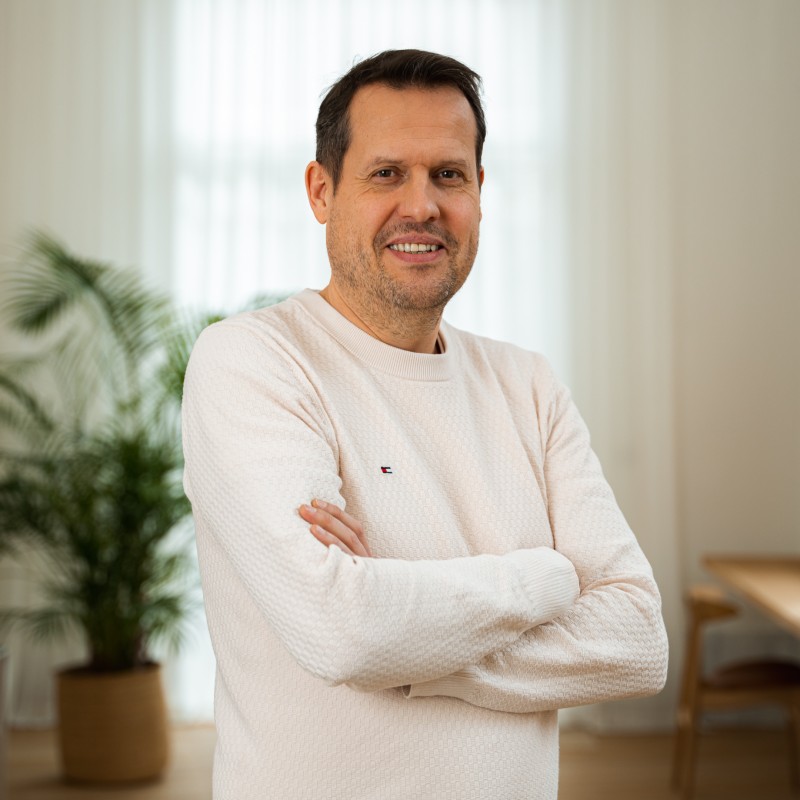
Filip Tack
Filip Tack is co-founder and CEO of Talentguide, a Ghent-based AI-powered skills management SaaS that raised EUR 1.3 million in early 2026 to expand into the Dutch market.
Tack is a serial SaaS entrepreneur with over 20 years of experience. He previously co-founded Nomadesk, raising EUR 10 million in Venture Capital and leading its acquisition by Unifiedpost (now Banqup). He also led growth projects at Itineris and served as chairman of the board at Unifly. Talentguide is based at Ghent's Wintercircus innovation hub and helps mid-sized and large organizations map skills, link them to learning paths, and plan their workforce using an AI-driven platform.
Insights & takeaways
The through-line
Across these posts, the same underlying move keeps showing up: take something that feels vague, anxious, or contested at work, and answer it by making the skills involved visible and structured. AI hollowing out roles gets answered with "skills transparency" . The hiring cliché of choosing "attitude" over skills gets answered by folding attitude back into a "skills profile" alongside tasks, tools, knowledge, and languages . A slowing labor market with persistent competency shortages gets answered by mapping what an organisation needs against what it already has in-house . Even the question of purpose at work, raised at Vlerick's HR Day, gets answered through "ownership: your competencies, your development, your next step" .
The scope of this argument widens over the period covered. It starts as a targeted response to one problem, AI-driven role anxiety and abandoned AI projects , then becomes a critique of a specific hiring habit , then scales up into a claim about four converging workplace forces at once, skills-based hiring, AI agents, hybrid work, and pay transparency, arriving together and outrunning actual practice . By the labor-market survey post it has become a broader thesis about organisations shifting from external recruitment to internal talent development , and at Vlerick it gets historicised, framed against decades-old ideas about work and purpose .
On skills transparency
The clearest statement of the core idea comes from the reading of Harvard's Das Narayandas: professionals whose roles are hollowed out by AI become "royalty without a kingdom" , and at least 30% of AI projects get quietly abandoned not because the technology fails but because "people protect their sense of who they are at work" . Tack's proposed fix goes a step further than the "redeployment pathways" researchers suggest: "You can't reassure people about a role you've never made visible. Break the work down into its actual skills, and suddenly everyone can see what AI takes over, what it supports, and what stays unmistakably human" . He names this directly as "skills transparency" .
On hiring for attitude
Tack takes on Simon Sinek's line, "You don't hire for skills, you hire for attitude. You can always teach skills," calling it "only half... right" and a "problem when it's used to avoid accountability" because it lets hiring managers skip the harder questions of which skills a job requires, at what level, and whether an employee can realistically gain them . His resolution is structural, not oppositional: "Attitude and skills were never opposites... Attitude doesn't sit above the skills profile. It sits inside it" , with traits as one of several building blocks of a skill profile alongside tasks, tools, knowledge, and languages .
On converging workplace forces
Tack frames skills-based hiring, AI agents, hybrid work, and pay transparency as "Four forces reshaping the workplace, four initiatives each looked at on its own. And that is exactly where it goes wrong" . His diagnosis is a persistent gap between announcement and practice: dropping degree requirements barely changes hiring, "fewer than 1 extra hire in 700" per Harvard/Burning Glass data , and AI rollouts show real value in only 6% of cases per McKinsey . He frames this as more than an HR issue: "a critical question about how your organisation actually works: which work goes to people, which to systems, what skills are required, and how you pay for it fairly (wages, or tokens?)" , concluding you need "a platform that aligns the forces" .
On shifting from external hiring to internal development
Commenting on the ManpowerGroup Employment Outlook Survey, Tack writes that it confirms what talentguide already senses and bets on: "de arbeidsmarkt vertraagt, maar het tekort aan kritische competenties verdwijnt niet" . He describes a shift in organisational focus: "Het draait niet langer om zoveel mogelijk vacatures invullen, maar om het veiligstellen van talent" . For HR this means a move toward strategic talent management built on two clarities: what competencies the organisation needs, translated into a competency-based dynamic job house, and what competencies already exist in the current workforce .
From the stage
In the Pluxee testimonial, Tack speaks about compensation rather than skills architecture, a topic the written posts do not touch. He explains that talentguide partnered with Pluxee to offer meal vouchers and eco-checks as part of staying competitive in the tight tech talent market, describing these as tax-friendly remuneration tools that support employee purchasing power while nudging behavior toward more conscious consumption 11. He also stresses the practical importance of broad acceptance and responsive communication from a benefits provider, since employees come to regard such perks as part of their salary 11.
Takeaways
- Before reassuring employees about AI, make the underlying skills of their role visible; "skills transparency" is positioned as the real antidote to AI-driven role anxiety .
- Don't let "hire for attitude" excuse skipping the harder questions about which skills a job needs, at what level, and whether they're teachable; treat attitude as one component inside a full skills profile, not an alternative to it .
- Watch for practice lagging announcement: dropping degree requirements produced fewer than 1 extra hire per 700, and only 6% of companies see real value from AI rollouts, so treat these initiatives as connected, not separate .
- With the labor market slowing but critical-skill shortages persisting, shift talent strategy from filling vacancies to securing talent, starting with mapping organisational competency needs against the current workforce .
- Track development plans through to completion, not just creation; talentguide added status tracking from "active" to "completed" directly in response to customer requests .
- In competitive talent markets, tax-friendly benefits like meal vouchers and eco-checks matter for retention, but only when the provider offers broad acceptance and responsive communication, since employees treat these as part of salary 11.
Career
Roles
NomadeskNon Executive DirectorJul 2023 – Present
TalentguideChief Executive OfficerFeb 2023 – Present
- Thirdexpert Management & ConsultingFounder ¦ Managing PartnerDec 2005 – Present
Miles AheadBusiness Partner ¦ Entrepreneur in ResidenceNov 2022 – Feb 2023
Itineris#192factoryVice President Strategic DevelopmentSep 2021 – Oct 2022
FixsusMember Of The Board Of AdvisorsMar 2019 – Dec 2022
Unifiedpost Group#111factoryGroup Corporate Development - M&AFeb 2017 – Sep 2021
- Ground lionBoard AdvisorApr 2016 – Nov 2018
Unifly#524factoryNon Executive Chairperson of the BoardApr 2016 – Apr 2022
CaramblaCo-founder ¦ Director on the BoardOct 2011 – May 2016
- The Founder Institute#269factoryMentorApr 2011 – Dec 2015
- SolventureBoard AdvisorMay 2010 – Mar 2013
- Bizidee - Ondernemingsplanwedstrijd Vlaanderen VZWDirector on the BoardDec 2009 – Jul 2012
- European Commission#26factoryExpert2005 – Jan 2015
- PorthusMarketing Manager ¦ Business Development ManagerJan 2001 – Jun 2004
- Alcatel#277factoryArea Sales Manager ¦ Telecom EngineerApr 1997 – Jan 2001
- Cargill#230factoryArea Sales ManagerOct 1996 – Apr 1997
Education
Vlerick Business School#3schoolDirector Effectiveness (GUBERNA)2019 - 2019
Ghent University#2schoolMaster, Agriculture and Biosystems Engineering1991 - 1996
- Ghent AviationPrivate Pilot License, Aviation2015
From public career histories · 26 entries
Media & appearances
1- 11otherPluxee Belgium · 2mo ago · 2:21 · 65 views
Filip Tack, CEO and co-founder of Talentguide (an HR technology company), explains that his organization partnered with Pluxee (formerly Sodexo) to offer meal vouchers and eco-checks to employees as part of competitive compensation in the tight tech talent market. He describes these benefits as tax-friendly remuneration tools that support employee purchasing power while steering behavior toward conscious consumption, and emphasizes the importance of Pluxee's broad acceptance and responsive communication in managing what employees consider part of their salary.