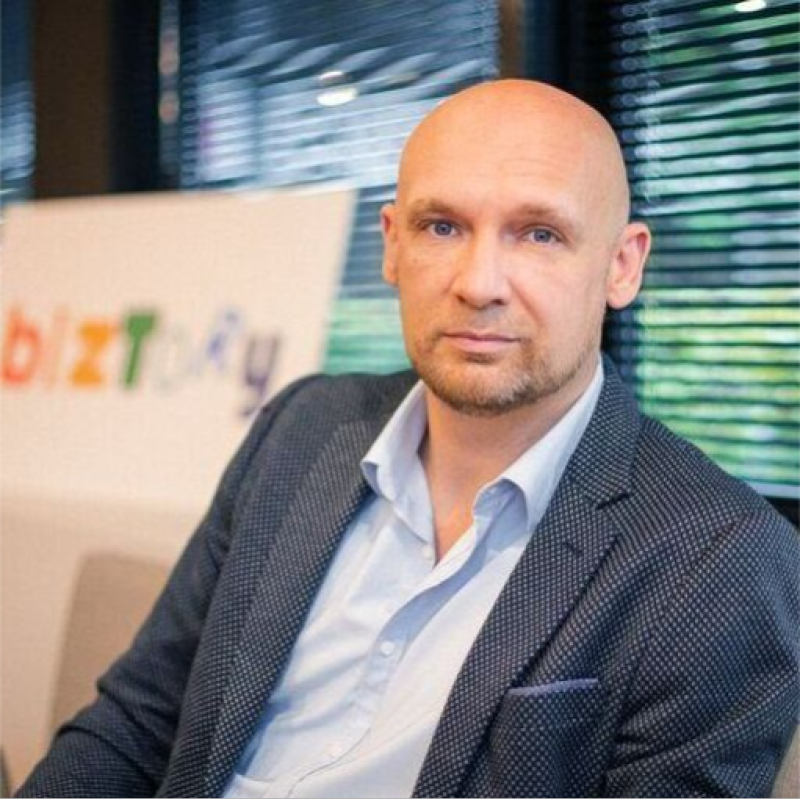
Geoffrey Smolders
Geoffrey Smolders is the founder and managing partner of Biztory, which he founded in June 2014, and is based in Antwerp. In January 2026 he founded Orika, where he is also managing partner. He has owned SUBDIO EBVBA since December 2010, has served on the EMEA Partner Advisory Council at Tableau Software since January 2018, and has been a member of Spire. since January 2022.
Earlier, Smolders worked in business development at Datamotive from 2011 to 2014 and at Agiliz from 2008 to 2015. At Cronos Groep he was a corporate account manager for ICT with Crosspoint Solutions from 2008 to 2011 and worked in business development until 2014. He coordinated Clevver between 2010 and 2013. Before that he was an ICT account manager at Mobistar from 2006 to 2008, and from 2003 to 2008 he was chief buyer, infrastructure consultant and consumer and e-shop sales at Hofline International. He began as a technician at Accel Computers from 2000 to 2003.
Insights & takeaways
The through-line
Across these posts, Geoffrey Smolders keeps returning to one idea: the hard part of AI is never the model, it is what surrounds it, context, governance, permissions, and where the work actually happens. Whether he is talking about a Salesforce headless cockpit, an agentic discovery tool, or a Claude bot dropped into Slack, the argument is the same, capability was mostly already there, the unlock is the form factor and the trust layer around it . This shows up first in his sales thinking (discovery decides deals, not top-of-funnel volume) , then increasingly in his product and delivery thinking as Biztory shifts from a Snowflake/Tableau analytics partner 1617 toward building and shipping agentic tools on Claude and Anthropic through mid-to-late 2026 . Over the arc of the sources there is a visible move from "we implement platforms" toward "we build governed agents that reason alongside consultants," with a parallel, more cautionary voice warning that AI making things easy to start does not make them safe to run .
On discovery
Smolders treats discovery, both in B2B sales and in enterprise AI deployment, as the actual site where value is won or lost, not the flashy part everyone optimizes for. On sales: "Discovery is different. It's where deals are actually won or lost" and "The best rep on your team asks at least 10-15 questions in a discovery call. The average rep asks maybe 2-3," while "We pour budget into filling the pipe" instead of fixing that gap . He carries the same logic into how Biztory builds AI: "Agentic AI fails for one simple reason: it tries to do the work before understanding the business," which is why Biztory's own agents "interview in depth, trace your workflows, navigate your fragmented data silos" before any deployment . This thinking is operationalized directly in Biztory Scout, launched for client discovery work with "overwhelmingly positive" feedback and its "first billable engagement" , and in the Agentic Enterprise Scout that interviews customers on their processes and feeds it into "years of Biztory experience" .
On governance and trust
A second recurring theme is that AI is only useful if it is governed, auditable, and bounded, otherwise it is a liability. His headless Salesforce experiment is explicit about this: "the interface isn't what matters, trusted context, identity, permissions and governed action are," and the reasoning running "inside Salesforce's Einstein Trust Layer... is what makes it enterprise-grade rather than a toy" . He extends the same caution to the wave of AI-built internal tools, warning "AI did not make building easy. It made starting something way easier" and drawing a direct line to the Microsoft Access era of ungoverned shadow apps, concluding "The tools changed. The pattern did not," with a simple rule of thumb: "If it holds your customers, your money, or your regulated data, buy it" . At Digital Workforce this becomes a formal method, agents are not deployed as "plug-and-play" tools but "onboard them like you would treat an employee," with "a salary," a "probation period," and graduation before scale .
On where AI actually sits
Smolders is preoccupied with placement, arguing that moving AI into the tool people already use, rather than a separate destination, is what changes adoption. Adding a Claude tag to Slack, he writes, "What changed last week wasn't the model. It was where it sits," removing the "friction" of "stop what you are doing, open another tab, copy your context across, come back," so that "The form factor is the unlock" . He makes the identical claim about interfaces in his Salesforce headless build, "The Helm" running live demo data with role switching, Data360 for grounding, and Agentforce for reasoning, concluding twice, in near-identical language across two posts, "The future of Headless isn't around the corner. It's here" .
On naming and framing
Smolders is also attentive to how mislabeling a category distorts how people think about it. On embedded analytics, he argues the term itself is misleading and that it "should be called 'external analytics'," since it is really about sharing interactive dashboards with customers and suppliers, not a purely technical embedding exercise, done to measure engagement and open new revenue streams 16.
Takeaways
- When evaluating an AI tool, ask where it sits in the existing workflow before asking what model powers it, placement removed more friction than any capability upgrade did .
- Apply a governance filter before letting AI-built tools near production: if it touches customer data, money, or regulated data, buy rather than let it grow organically .
- Treat discovery as a deliberate discipline, not an afterthought, both in sales calls and in agentic AI rollouts, understanding the business before deploying anything is the difference between success and failure .
- Onboard AI agents with the same rigor as employees, defined scope, a trial period, and a graduation gate, rather than dropping them into legacy systems and expecting ROI .
- Don't assume "embedded" analytics is just a technical integration question, reframe it as "external analytics" aimed at customer and supplier engagement and new revenue 16.
Career
Roles
- OrikaFounder & Managing PartnerJan 2026 – Present
- Spire.Proud Member of SpireJan 2022 – Present
- Tableau SoftwareEMEA Partner Advisory Council MemberJan 2018 – Present
BiztoryFounder & Managing PartnerJun 2014 – Present
- SUBDIO EBVBAOwnerDec 2010 – Present
- DatamotiveBusiness DevelopmentJan 2011 – Dec 2014
- ClevverCoördinator - ClevverJan 2010 – Dec 2013
AgilizBusiness DevelopmentMay 2008 – Mar 2015
- Cronos GroepBusiness DevelopmentMay 2008 – Dec 2014
- Cronos GroepCorporate Account Manager ICT - Crosspoint SolutionsMay 2008 – Dec 2011
- Mobistar#139factoryAccount Manager ICTMar 2006 – Apr 2008
- Hofline InternationalChief Buyer - Infrastructure Consultant - Sales Consumer / E-ShopMay 2003 – Mar 2008
- Accel ComputersTechnician2000 – 2003
From public career histories · 13 entries
Media & appearances
2- 16otherGeoffrey Smolders · 7 years ago · 6:01 · 77 views
Geoffrey Smolders discusses embedded analytics, which he argues should be called "external analytics" since the term refers to sharing interactive data dashboards with customers and suppliers rather than a purely technical embedding process. He explains that the trend is rising because companies want to provide data-driven insights to external stakeholders, measure how customers interact with their data to improve sales conversations, and create new revenue streams.
- 17otherGeoffrey Smolders · 8 years ago · 1:46 · 4,209 views