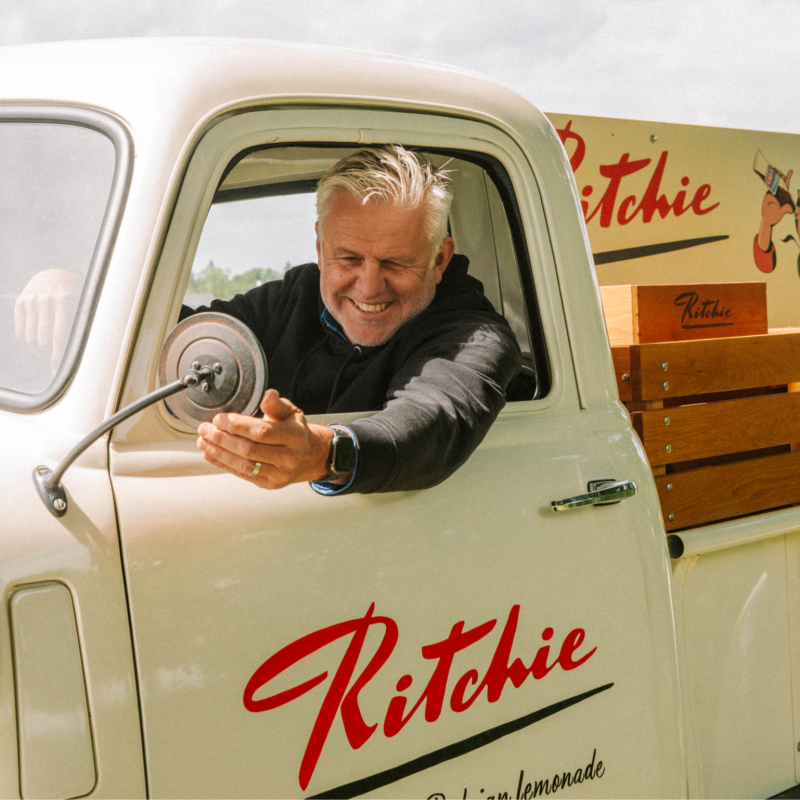
Jan Verlinden
Jan Verlinden, fourth-generation heir of a family brewery in Lubbeek, declined to take over at 22 and instead built a 15-year international marketing career at large corporates like Lucky Strike and PepsiCo across multiple continents. At 47, tired of corporate life and its limited 'shelf life', he relaunched Ritchie, the family lemonade brand, roughly 8 years ago. He entered a huge but brutal market (125 litres of soft drinks per Belgian per year, 4.2 billion consumptions) dominated by deep-pocketed multinationals, and chose to bootstrap: production and logistics outsourced to avoid capex, his own salary set to zero, and a self-imposed 5-year deadline. He deliberately refuses external investors so nobody can veto contrarian moves like sponsoring The Masked Singer while still tiny, designing his own bottle, and refusing 1+1 promos even when retailers threatened not to list him. His strategy 'in horeca you try, in retail you buy' was tested hard by COVID, but early media investment kept the brand growing 36% in volume that year, and Ritchie has been profitable every year.
Insights & takeaways
Jan Verlinden's public thinking centers on a single decision he keeps returning to: leaving a secure corporate marketing career to relaunch his family's lemonade brand. He frames that choice not as a leap into risk but as an escape from a hidden one. "Volgens mij was het het grootste risico om het niet te doen en ongelukkig te zijn, dan het risico te nemen om het wel te doen," he says, arguing that the corporate "golden cage" has a shelf life most people underestimate 11. He did not want to reach 65 with regret, "had ik het maar gedaan," and generalizes this into a broader observation about human psychology: "Mensen hebben voornamelijk spijt van dingen die ze niet hebben gedaan, niet zozeer van wat ze wel hebben gedaan" 1112. The word he keeps coming back to is "goesting," which he distinguishes carefully from ordinary desire. Wanting to run a marathon is not enough; goesting means training through the rain even when you don't want to. "Ik heb zin om een marathon te lopen, maar ik heb geen goesting om een marathon te lopen, dus ik ga er nooit gaan lopen" 12. For him, "Goesting is een schoon Vlaams woord. Als je goesting hebt, ja, dan moet je dat doen" 11.
That personal philosophy translates into concrete business discipline. He bootstrapped Ritchie without outside investors, and defends the choice on three grounds: nobody can veto his contrarian moves, negotiations with investors would slow down bold bets, and investors enter with an exit in mind, which conflicts with building something for the long term 11. He is blunt about what actually keeps a company alive: "Dat is de enige manier dat er geld binnenkomt: is dat er iemand bereid is om voor uw product te betalen. Dat is de essentie van zaken doen," and "Uiteindelijk de beste manier om jezelf te financieren is winst te maken" 11. He set his own salary to zero in the early years, refused a standard retail promo demand even when told he would not get shelf space, and has stayed profitable since year one, reinvesting into marketing rather than drawing capital out. When a distributor tried to force him into loss-making 1+1 deals he simply walked away: "En dan heb ik gezegd: dat is goed, dan kom ik er niet in" 11. Underneath this is a clear-eyed acknowledgment of scale: "Je vecht tegen de grootste merken ter wereld met de diepste pockets" 11.
His go-to-market thinking is summarized in one recurring line, repeated across interviews and now embedded in how he talks about the brand publicly: "In horeca you try, in retail you buy" 11. Horeca functions as the discovery and trial engine, while retail captures the repeat purchase, and he has kept pushing this logic even as circumstances changed it. When COVID shut down horeca and retail failed to compensate, he accelerated media investment years ahead of plan, still landing 36 percent volume growth that year, and concluded that horeca presence and media advertising reinforce each other even at a small brand's scale 1112. That same instinct now shows up in his sponsorship of cafés through initiatives like Kroegtijgers and the Nationale Cafédag, where he frames the support in almost civic terms: "Want een dorp of stad zonder café verliest een stukje van zijn ziel" .
On marketing itself, he keeps insisting that advertising is only the visible tip of the discipline, not its foundation. "Iedereen denkt dat marketing reclame is. Reclame is maar een stuk. De P van product van de marketingmix is stap nummer één," and he is emphatic that taste has to come first: "Lekkere limonade maak je met lekkere ingrediënten, punt" 12. Packaging, in his view, is a communication tool rather than a container, on the logic that "we eat and drink packaging," and he treats product placement as a more efficient use of scarce budget than expensive TV production, since every euro not spent on a shoot can instead buy reach 12. This same reach-first logic reappears in how he talks about targeting: asked repeatedly by media buyers who his target audience is, his answer is always "iedereen," reasoning that small brands grow chiefly by increasing penetration, so he avoids niche channels with low reach and high cost per contact even if they feel more "strategic" .
The brand's differentiation claims follow the same product-first conviction. He positions Ritchie Cola explicitly against mainstream cola on health grounds, citing a nephrologist's warning that phosphoric acid burdens the kidneys and can calcify blood vessels, and pointing out that Ritchie replaces phosphoric acid with lemon juice and fermented apple juice and swaps artificial caramel E150d for barley malt, going so far as to note it is a cola some kidney dialysis patients can actually drink 12. This product-led argument dovetails with an economic-patriotism message he has pushed around Belgium's national holiday, proposing July 21st as an unofficial "Ik Koop Belgisch" day, framed not as a boycott but as "een kleine, bewuste (en vooral héél lekkere) keuze" in favor of local alternatives to familiar multinational products .
Running underneath all of this is a psychological framework about expectations and motivation that he applies to both life and targets. "The secret of happiness is low expectations. Als je teveel verwacht ga je altijd teleurgesteld zijn," he says, and he applies this literally to how he sets internal goals: aiming for 100 and hitting 150 feels like a win and motivates the team, while aiming for 200 and landing on the same 150 feels like failure, even though the actual work and result are identical 12. He is equally frank about the emotional cost of the path he chose, describing the early years as "een rollercoaster" where "de wins zijn heel leuk, de highs zijn high, maar de lows zijn heel low" 12. He waves off any framing of Ritchie as a vehicle for a future sale: asked what he'd say if someone offered to buy the brand today, his answer is "neen. Ik amuseer mij teveel. Wat moet ik dan gaan doen, thuis gaan zitten en mijn geld gaan tellen?" 12.
Taken together, his recur
- The corporate 'golden cage' is less safe than people think: there is a shelf life at big companies — you see very few people above 50 — so the biggest risk was not trying entrepreneurship and being unhappy.
- In beverages you can start without heavy capex by outsourcing production, which lowers risk and lets you scale from 100,000 to millions of bottles as demand grows.
- Give yourself a realistic horizon (he gave himself 5 years) and eliminate the biggest cost — his own salary, which he set to zero — to survive the ramp-up.
- He refuses external investors for three reasons: nobody can say 'no' to his contrarian moves, discussions with investors slow down bold decisions like sponsoring The Masked Singer, and investors enter with the intention to exit, which conflicts with long-term brand building.
- He refused the standard 1+1 promo demanded by retailers even when they said he wouldn't get listed — because with sub-50% margins 1+1 is loss-making and once you start promos you can never stop; years later Ritchie is in nearly all retailers without promos.
- His marketing strategy is 'in horeca you try, in retail you buy': premium horeca distribution drives awareness and trial, retail captures the repeat purchase.
- When COVID closed horeca in March 2020 and retail didn't compensate, he accelerated the media/marketing investment far earlier than planned, still achieving 36% volume growth that year and discovering that horeca and media strategies reinforce each other even at small scale.
- Corporate pedigree (PepsiCo) gave him credibility with suppliers — the hardest part of starting — because almost nobody starts a lemonade company from scratch.
- His Chinese bottle supplier admitted they could only guarantee 1 bar of pressure — meaning carbonated bottles could explode — nearly forcing him to restart after two years of preparation and pushing him to a Western supplier requiring €50,000 in molds.
- Surround yourself with fellow founders (e.g. in an incubator) rather than family or ex-colleagues, because only peers going through the same rollercoaster understand what you're dealing with.
- He never signs marketing checks he can't already pay and reinvests profit every year, staying in the green since year one — 'the best way to finance yourself is to make profit'.
- Belgium is a small market for marketers at multinationals — a country of 10 million where you grab or lose a bit of market share; the real breakthroughs happen in Asia and other big markets.
- Packaging is a communication element, not just a container — 'we eat and drink packaging'; most startups underestimate this part of the marketing mix.
- Product placement is more cost-efficient than TV commercials because production costs (e.g. €80,000 for a 20-second spot) drain budget that could go to media reach; every euro should go to brand visibility.
- Deliberately removing complexity — only delivering full pallets, refusing small orders — keeps the cost structure low so maximum budget can go into marketing.
- Measuring brand attribution isn't worth the cost for a small brand; the only thing that matters is that doing everything simultaneously makes volumes go up.
- His channel strategy 'in horeca you try, in retail you buy' collapsed during COVID lockdowns since horeca was both his trial engine and over half his volume, forcing him to invest in advertising instead.
- Starting a company with the sole goal of cashing out within five years is a recipe for unhappiness because the odds of a successful exit are small; build for enjoyment instead.
- 'Goesting' differs from mere desire: it's passion combined with willingness to keep going through setbacks — like training for a marathon in the rain.
- Set budgets below what you expect to achieve: hitting 150 against a target of 100 creates motivation, while missing 200 with the same 150 result kills it — the target choice doesn't change the work, only the psychology.
- Ritchie cola replaces phosphoric acid with lemon juice and non-alcoholic fermented apple juice, and artificial caramel E150d with barley malt — making it the only cola kidney dialysis patients can drink.
Career
- RitchieChief Lemonade MakerOct 2015 – Present
- PepsiCoBrand Director Lay's WESAJun 2014 – Oct 2015
- PepsiCoMarketing Director Belgium/LuxemburgOct 2011 – Oct 2014
- New ShoesIndependent Marketing ConsultantSep 2010 – Sep 2011
- British American TobaccoStrategic Innovations ManagerJan 2008 – Sep 2010
- New ShoesIndependant ConsultantJun 2006 – Dec 2007
- British American TobaccoMarketing DirectorAug 2004 – Jun 2006
- Brown & Williamson Tobacco corp.Brand Director (Lucky Strike and on-premise marketing)Oct 2001 – Aug 2004
- British American TobaccoE-commerce : ImagineerMay 2000 – Oct 2001
- British American TobaccoSenior International Brand ManagerNov 1997 – Apr 2001
- Ehrenberg-Bass InstituteHow Brands Grow - for Executives, MarketingJun 2024 - Jun 2024
Vlerick Business School#3schoolMaster of Business Administration (MBA)1991 - 1992
KU Leuven#1schoolCommercial Engineer, Economy/business1987 - 1991
- Sint Jozefscollege#144school
From public career histories · 14 entries
Media & appearances
4- 11podcastBlackBird Business Events · 27 Feb 2025
Jan Verlinden left a 15-year corporate marketing career (PepsiCo, Lucky Strike) at 47 to relaunch his family's lemonade brand Ritchie, deliberately bootstrapping without investors, outsourcing production, refusing retail promos, and using a horeca-first 'try in horeca, buy in retail' strategy.
- 12podcastBen's Mentors · 18 Dec 2024 · 45:15 · 317 views
Jan Verlinden discusses how Ritchie, a Belgian lemonade brand from his father's brewery that disappeared in the late 1970s, was revived after he found a childhood photo of himself at the brewery and decided to bring back his favorite drink from youth. He explains that Ritchie differentiates itself from competitors like Kwas through quality ingredients and craftsmanship, comparing good lemonade-making to making good pizza where the best components are essential. He also mentions his book "The Rich Story," whose proceeds support scholarships for students at a school.
- interviewStudio Rabona · 2 months ago · 44:37 · 156 views
Jan Verlinden discusses reviving the Richie lemonade brand, which his family owned after World War II but had disappeared by the late 1980s. He explains his career transition from working at multinationals like Pepsi and Lucky Strike in marketing to relaunching Richie in November 2016, and he addresses practical challenges like managing product placement in television appearances to ensure drinks appear consumed during filming.
- interviewAnnelies Delmoitié Freelance Administratief Wonder · 7 months ago · 34:58 · 20 views
Jan Verlinden discusses how he relaunched Ritchie, a Belgian lemonade brand, nearly nine years ago and now manages the business with three independent representatives while outsourcing logistics, production, and social media to partners. He explains that the soft drink business requires high volume sales and significant brand awareness investment, which consumes most of his profit margin, and that he personally handles product development, logistics negotiation, accounting, marketing campaigns, and packaging while delegating tasks that don't energize him.