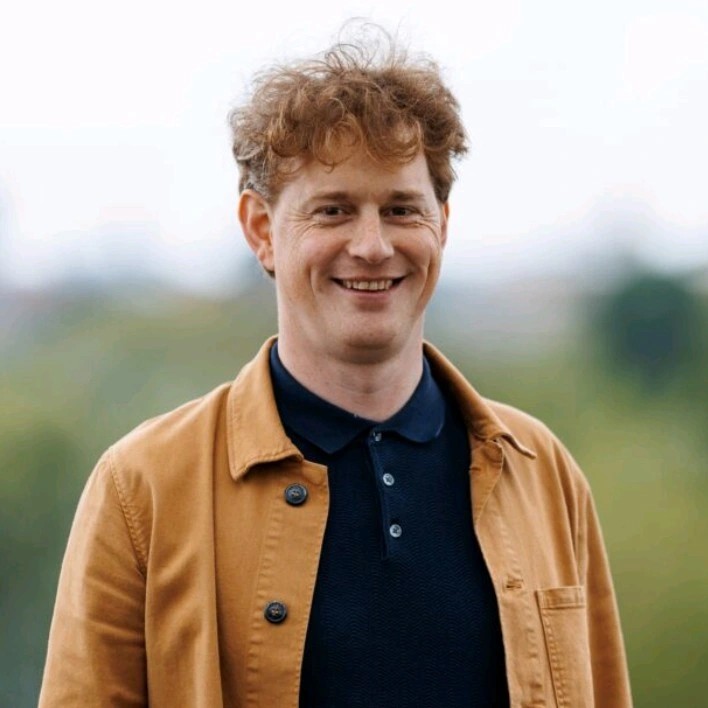
Jelle De Zwaef
Jelle De Zwaef is the founder of Nordend, which he established in June 2019 and where he serves as managing director. He is based in Brussels. Since January 2021 he has worked at Agentschap Wegen en Verkeer as a business and change data migration analyst, and he has been a member of Rubicon since September 2021.
From March 2017 to December 2021 he was a senior GIS consultant at Infrabel, and between April 2015 and May 2019 he was a project delivery manager at Avineon Europe. Earlier roles include geospatial specialist at Intergraph, team leader map production at XMedia AG and business development manager at media swiss ag, both now Ringier Digital. He spent five years at Star-Apic, first as an application support engineer and then as an application consultant, and before that worked as a GIS expert at Tele Atlas and as a cartographer at Geocart.
He studied geography with a major in geomatics at Ghent University, graduating in 2002, and completed an Executive Master Class in Business Process Management at Vlerick Business School in 2015.
Insights & takeaways
Jelle De Zwaef's writing returns constantly to one idea: the gap between what looks finished and what actually holds up when someone else has to touch it. Whether he is describing a municipal geoportal, a BIM-to-GIS translation, or an FME license renewal, the pattern is the same. Something appears calm on the surface, and underneath it a person is quietly compensating for a workaround nobody wrote down. "By the third project, there are four workarounds nobody documented. By the sixth project, somebody on the team has left, and the next BIM-to-GIS translation breaks for a reason nobody can trace" . He tells the same story about geoportals: "A surveyor uploads a file. Someone reformats it by hand. Weeks later, a third team validates the result. By then, nobody remembers what changed" . And about resignations: "The person leaving usually built the FME workflow and remembers why every workaround exists. A 40-page handover document does not solve this" . Across all three, his diagnosis is consistent: documentation is not the same as transferred understanding, and the moment that gap gets exposed is always more expensive than the moment it was created.
This shows up in how he talks about his own company's role in the FME ecosystem. He is explicit that being a reseller carries an obligation he thinks most resellers skip: "Resellers have a second job that the partnership brochure never mentions. You sell the vendor's product to your clients. You also represent your clients inside the vendor's roadmap" . He backs this with a concrete example, a bug report that took three months to become a shipped fix, and turns it into a pointed question for anyone buying FME through a partner: "Ask your reseller what changes they have personally pushed for in the product" . The same instinct toward substantiation over branding appears when he describes discovering, after FME Day, that someone in his own market segment didn't know what Nordend actually does, and reading that both as compliment and warning, since "work running in the background does not write itself onto LinkedIn" .
His stance on speed is unusually firm for someone running a consultancy that presumably wants more clients faster. He names Hemingway, Humboldt, and De Gerlache as his heroes, not business leaders, because "the pattern across all three is patience. Discovery arrives when the conditions are right, and the conditions are usually wrong for a long time before they shift" . He applies this directly to his own client work, pointing to a project built after "a year of slow, low-volume conversations with a client whose problem became clearer every quarter," and warning that "speed has a cost. The receipt arrives months later in the form of workarounds nobody planned" . This same logic drives his summer outreach philosophy: he stopped sending business development messages in July and August years ago because reply rates collapse and conversations restart in September anyway, choosing instead to "let the inbox come to me" .
On his own habits and limits, he is unusually candid. He admits asking for help is "the hardest skill I have had to learn," describing years of doing his own bookkeeping before realizing he needed help, and landing on a compromise: outsourcing most of it but still spending an hour a month so "the company can tell me how it is doing without using words" . He frames this as a general founder tension, between those who "drown in the work" and those who "lose touch with what is actually changing" . He is similarly direct about how he tracks his industry, admitting he has no real system beyond watching Safe Software webinars and following two people, and crediting a deliberate exit from Twitter for sharpening his knowledge: "when you read fewer hot takes, you have more time for the actual signal" .
His account of starting Nordend is framed less as ambition and more as an inevitability he delayed. He'd said he wanted his own company at 20, 25, and 30, and by 39 concluded "the cost of not starting had become higher than the cost of failing" . He connects this later to a marked change in how he sleeps, noting that as an IT consultant in his twenties he lost sleep over problems that weren't technically his, while now, with objectively larger stakes, he sleeps better, because "ownership closes the loop. When the problem is yours, the next step is also yours" . He traces the origin of his affinity for the work itself back to childhood, learning to read at six with a map as his first text, and generalizes from his own hiring pattern at Nordend: "Whatever you read first at six is usually still pulling at you at sixty" .
Taken together, his concrete positions are consistent and actionable rather than abstract. He believes handovers require live pairing, not documents, in the two weeks before someone leaves, not the two months after . He believes license renewals should be preceded by a workflow audit, not a rubber-stamp continuation . He believes cross-border regulatory translation, such as US teams answering to European standards, is a distinct enough problem to warrant a dedicated office and person . And he believes a reseller's value is measurable in specific roadmap changes it can point to, not just in contract tenure . The throughline is a preference for slow verification over fast appearance, in his own working method, in how he evaluates vendors, and in how he tells founders to manage the tension between control and delegation.
Career
- Agentschap Wegen en VerkeerBusiness and Change Data Migration AnalystJan 2021 – Present
RubiconMemberSep 2021 – Present
NordendFounder and Managing DirectorJun 2019 – Present
- Infrabel#166factorySenior GIS ConsultantMar 2017 – Dec 2021
- Avineon EuropeProject Delivery ManagerApr 2015 – May 2019
- IntergraphGeospatial SpecialistNov 2012 – Mar 2015
- XMedia AG (now Ringier Digital)Team Leader Map ProductionJan 2010 – Oct 2012
- media swiss ag (now Ringier Digital)Business Development ManagerJun 2009 – Dec 2009
- Star-ApicApplication ConsultantJan 2007 – Jun 2009
- Star-ApicApplication Support EngineerApr 2004 – Dec 2006
- Tele Atlas#336factoryGIS expertMay 2003 – Apr 2004
- GeocartCartographerOct 2002 – Apr 2003
Vlerick Business School#3schoolExecutive Master Class in Business Process Management, Aligning business and IT2014 - 2015
Ghent University#2schoolMaster Geography, Major in Geomatics1998 - 2002
- Sint-Niklaasinstituut AnderlechtMaths - Science1992 - 1998
From public career histories · 15 entries
Media & appearances
1- 16interviewSolutions Review · 3y ago · 11:52 · 195 views
Jelle De Zwaef discusses how he founded Nordend three years ago after working with FME technology since 2006 in roles involving cartographic software, public safety, and utilities. He describes a key service his company developed to help customers deploy FME Server processes across development, test, and production environments with proper governance, addressing a problem he identified where organizations were struggling with process stability when environments changed.