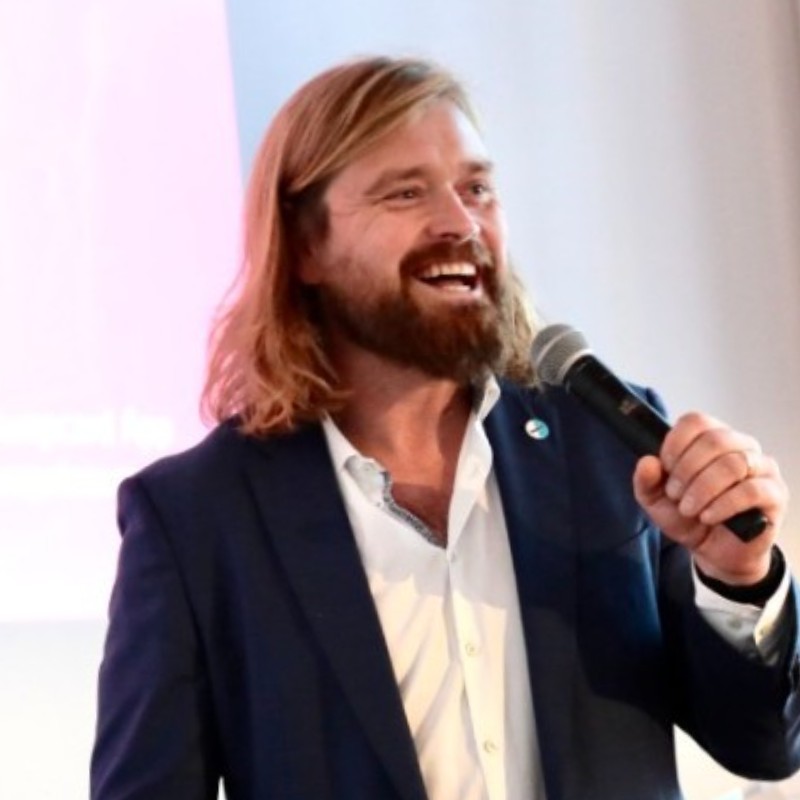
Jelle Demanet
Jelle Demanet is co-founder and CEO of Spatial Dynamics, which he started in December 2024, and is based in Ghent. Since September 2024 he has been a senior business developer at imec, Ghent University and imec-mict-UGent, and in November 2025 he took up the role of chief innovation officer at ENT.A - Entertainment Associatie. He founded Apollo8 in May 2019 and remains its managing partner, and in October 2021 he co-founded XR Valley, where he sits on the board and directs relations with schools, universities and research bodies. He has advised the board of PNI Therapeutics since March 2022 and joined the board of Stereopsia in August 2024.
From July 2019 to September 2024 he managed the HIT lab at Hogeschool West-Vlaanderen, following a period as research and development manager at Profacts. He founded Impulse Research in October 2016 and was its managing partner until November 2018. Demanet studied at Ghent University, where he was a doctoral student from 2006 to 2010 and then a postdoctoral researcher until October 2016, and was a guest professor there from 2016 to 2022. He spent the winter of 2014 to 2015 as a visiting researcher at the Bernstein Center for Computational Neuroscience.
Insights & takeaways
Jelle Demanet's public commentary centers on a single conviction, tested through direct hands-on use: smart glasses have crossed a threshold and there is no going back. After three weeks with the Meta Ray-Ban Display, he is unambiguous that "we zijn er nog niet helemaal, maar het toont wel al aan: het gaat niet meer weggaan" 45. His argument is not speculative but grounded in specifics: the form factor and the 6-7 hour battery life have finally reached a point where all-day wear is realistic, and the device fuses visual and verbal interfaces to AI in a way earlier iterations never managed 45. For Demanet, this is less a product launch than a long-anticipated convergence: "Mensen die ermee bezig zijn, dachten al 10 jaar: dit is het moment dat het allemaal gaat samenkomen. En dit is voor mij nu echt het moment" 5.
As a cognitive psychologist, he brings a distinct angle to the hardware conversation, namely how fast and how thoroughly the brain adapts to it. He describes catching himself glancing bottom-right for notifications even without the glasses on after only a few days of use, calling it evidence of real neural plasticity and a sign that such devices could eventually become more intuitive than the smartphone itself 45. But this adaptability cuts both ways. He is equally insistent that human attention is a fixed, non-negotiable constraint: "Wij kunnen niet multitasken. Onderzoek heeft dat aangetoond. Wij kunnen switchen tussen taken, maar wij kunnen onze aandacht maar op één iets houden" 45. Because the glasses push notifications straight into the visual field without filtering, "het is eigenlijk uw smartphone op speed. Dus je krijgt alles constant zonder filter" 45, and he treats this as a genuine design and safety problem, particularly around timing and placement of alerts during tasks like driving or conversing.
Demanet is careful to note where the technology's limits currently sit, refusing to oversell it. He points out that live translation cannot realistically drop below roughly two seconds of latency because some languages place verbs at the end of a sentence, forcing the system to wait for the sentence to finish before it can translate 45. He also draws a sharp distinction between capturing images only on explicit request, as the Meta glasses do, versus continuous capture as demonstrated by Google's Android XR, noting that true mixed reality would require depth sensors and constant world understanding, which raises its own privacy tradeoffs 5. On the consumer question, he is blunt that the €300-400 premium for the Display version over the standard Ray-Ban Meta is not yet justified for ordinary users, and that only people who want a genuine glimpse of the future interface should buy in at this stage 45.
Where he turns most pointed is on Europe's strategic position. Rather than framing the region as behind, he argues the opposite: "Zijn veel mensen die zeggen dat we te laat zijn, maar dat is geen waar" 45. His proposed strategy is patient and deliberately observational: let American companies launch first, absorb the lessons on use cases and UI/UX (which don't yet have established standards), and then build a better, sovereign, ethically compliant version. He frames this candidly as opportunistic learning: "We kunnen stelen met onze ogen en iets beters maken die beter past bij wat dat wij echt willen dat die devices kunnen" 45. This isn't a call for imitation but for leverage, since he notes that "de meeste grote techbedrijven eigenlijk draaien op basiskennis die in Leuven door IMEC ontwikkeld is," which he takes as proof that Europe already sits in an ideal position to develop its own hardware 45. He extends this into a direct challenge to European capital allocation, suggesting people reconsider where they put their money: "In plaats van allemaal in vastgoed investeren en aan een appartement, misschien moeten wij eens meer overwegen om ook op hardware start-ups te durven investeren" 5.
On regulation, Demanet takes a firm sequencing position rather than a dismissive one: experimentation must precede legislation, not the reverse. "Vanuit de wetgeving gaat er nooit geen innovatie komen. Dus je moet wel de grenzen verleggen in use cases," he says, arguing that only after pushing boundaries in real use cases can the associated dangers be properly assessed and addressed 45. This is consistent with his broader stance that Flanders, not just Europe abstractly, has the ingredients to lead in experience and entertainment innovation, citing a dense regional network of roughly sixteen research centers, a strong start-up ecosystem, and globally recognized players like IMEC, Barco, Kinepolis, Stageco and Tomorrowland as evidence of an already-existing competitive base 45.
Beyond the podcast appearances, his other public statements reflect a consistent professional throughline: enthusiasm for collaborative, applied innovation work that connects technical talent, intellectual property protection, and cross-sector teams to real economic and social impact. He calls the Spatial Dynamics skillscan project a way to help companies map technical talent , welcomes a program on protecting intellectual property "in tijden van AI" held in partnership with Lab of Tomorrow , and celebrates working with "het kruim van innoverend, entertainend vlaanderen" to turn innovative ideas into concrete impact . Taken together, his output reads as that of someone who wants innovation to be tested first-hand, assessed honestly for its cognitive and practical risks, and then built out regionally with confidence rather than deferred to American or purely legislative timelines.
- The Meta Ray-Ban Display marks the breakthrough moment for smart glasses because the form factor and battery life (6-7 hours) finally make all-day wear acceptable — the technology 'is not going away anymore'.
- Humans cannot multitask, only switch tasks; notifications appearing in the visual field while driving or conversing are a real cognitive danger, so app design must account for timing and placement of messages.
- The brain adapts extremely fast: after a few days he found himself glancing bottom-right for notifications even when not wearing the glasses, illustrating brain plasticity and the potential for smart glasses to become more intuitive than smartphones.
- Live translation latency can't easily drop below ~2 seconds because verb order differs between languages, so the system must wait for the end of the sentence.
- Europe should let Americans launch first, observe the use cases, then 'steal with our eyes' and build a sovereign, ethically compliant version of the hardware — leveraging IMEC's chip knowledge that most big tech already relies on.
- Regulation should follow experimentation, not precede it: 'from legislation no innovation will ever come' — you must push boundaries in use cases first, then think critically about dangers.
- For most consumers the €300-400 premium for the display version over the standard Ray-Ban Meta is not worth it yet; only experimenters wanting a glimpse of the future should buy the Display.
- Flanders can be a world leader in experience/entertainment innovation because of its dense weave of ~16 research centers, start-ups, and globally known players like IMEC, Barco, Kinepolis, Stageco and Tomorrowland.
- The Meta Ray-Ban Display marks the breakthrough moment for smart glasses because form factor and battery life (6-7 hours) are finally acceptable for all-day wear, combining visual and verbal interfaces to AI.
- The glasses only capture an image on explicit request, not continuously — unlike Google's Android XR demo — which limits both privacy risk and spatial/mixed-reality capabilities; true MR requires depth sensors and constant world understanding.
- Live translation latency cannot go much below 2 seconds because in some languages verbs come at the end of the sentence, so the system must wait for the sentence to finish.
- Humans cannot multitask — we can only switch between tasks — so notification timing and placement in smart glasses must be redesigned to avoid dangerous interference with tasks like driving.
- After a few days of wearing the glasses, his brain adapted so strongly that he started glancing bottom-right for notifications even without the glasses on — evidence of how flexible the brain is and how such devices could become more intuitive than smartphones.
- There are no UI/UX standards yet for smart glasses; Americans launch and iterate while Europe should observe, then build its own compliant, sovereign version — 'stealing with our eyes' and improving it.
- Regulation should follow experimentation, not precede it: legislating first simply chokes innovation, as seen in the European AI debate.
- Flanders can be a global leader in experience innovation thanks to dense interconnection: 16 research centers, a start-up network, and companies like IMEC, Barco, Kinepolis, Stageco and Tomorrowland.
- The €300-400 premium for the Display version over the standard Ray-Ban Meta is not worth it for regular consumers yet; only buy it if you want to experiment with the future of the interface.
Career
- ENT.A - Entertainment AssociatieChief Innovation OfficerNov 2025 – Present
Ghent University#2factorySenior Business DeveloperSep 2024 – Present
imec#8factorySenior Business DeveloperSep 2024 – Present
- Spatial DynamicsCEO and co-founder Spatial DynamicsDec 2024 – Present
- StereopsiaBoard MemberAug 2024 – Present
- PNI TherapeuticsAdvisor To The BoardMar 2022 – Present
- XR ValleyCo-Founder, Board Member, and Director of Schools, Universities and Research RelationsOct 2021 – Present
Apollo8Founder and managing partnerMay 2019 – Present
- Hogeschool West-Vlaanderen#90factoryManager HIT lab (Human Interface Technology Lab)Jul 2019 – Sep 2024
ProfactsResearch And Development ManagerNov 2018 – Apr 2019
- Impulse ResearchFounder and Managing Partner Impulse ResearchOct 2016 – Nov 2018
- Bernstein Center for Computational Neuroscience (BCCN)Visiting ResearcherNov 2014 – Feb 2015
From public career histories · 17 entries
Media & appearances
2- 4podcastVirtual · 29 Oct 2025
Cognitive psychologist Jelle Demanet shares three weeks of hands-on experience with the Meta Ray-Ban Display smart glasses, discussing how quickly the brain adapts, attention risks, killer use cases, and why Europe should build its own sovereign hardware.
- 5podcastVirtual · 29 Oct 2025
Cognitive psychologist Jelle Demanet shares his three-week hands-on review of the Meta Ray-Ban Display smart glasses, covering usability, cognitive impact, privacy concerns and why Europe/Flanders should build its own XR hardware.