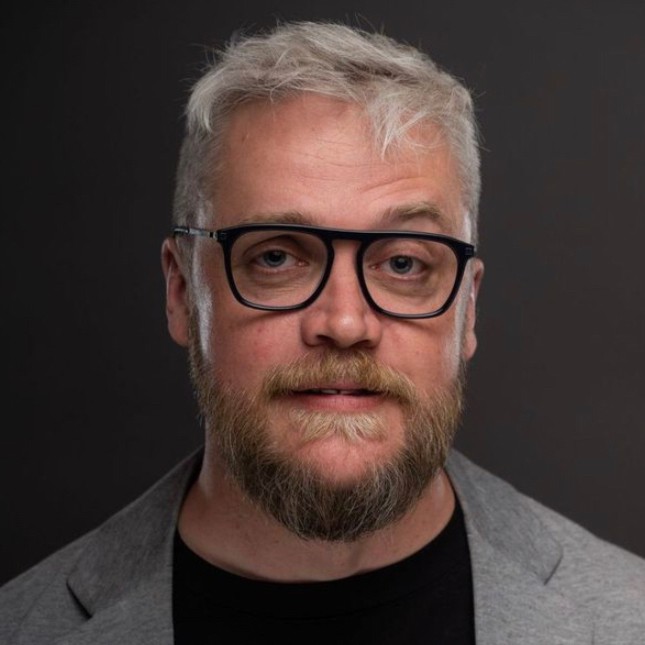
Jeroen Hallaert
Jeroen Hallaert is production/engineering lead, LA at PRG (Production Resource Group).
Talks about
Artificial intelligenceGamification
Insights & takeaways
Jeroen Hallaert's core position, repeated across his appearance on Virtual, is a deliberately measured one on artificial intelligence: it is powerful but immature, and its future usefulness depends on how carefully the industry handles it now. His central metaphor captures this: "Ai is momenteel een stevige kleuter die nog altijd gezonde voeding moet hebben, nog altijd zijn pamper moet ververst hebben... hoe beter dat we AI opvoeden, hoe beter dat we er in de toekomst van kunnen gebruik maken" 12. The framing of AI as a toddler that needs proper upbringing rather than a finished tool runs through everything else he says, positioning him neither as an AI skeptic nor an evangelist but as someone arguing for patient, responsible development.
On the question of whether AI threatens creative work in entertainment, Hallaert is unambiguous: it does not, at least not in the sense of replacing storytelling. "Ai is nog altijd iets generatief, dat is niet creatief. Er zit nog een human aspect aan verbonden," he says 2, drawing a firm line between generative output and genuine creative authorship. He grounds this in a concrete industry example rather than abstraction: generative AI can already produce a full storyboard for a TV show pitch, which speeds up development, but the technology "gewoon een andere tool in de toolbag" 1. His takeaway is practical rather than defensive, that the time saved by AI on production tasks should be reinvested into creative work itself, "als we kunnen meer tijd stoppen in creativiteit, gaat ook de kwaliteit van de producties naar boven" 1. This is a recurring pattern in his thinking, treating efficiency gains from technology as a means to elevate craft rather than a threat to jobs or artistry.
Hallaert extends this same logic to hardware and the viewing experience, specifically pushback against the idea that VR and AR headsets represent the future of entertainment displays. His reasoning is sociological rather than technical: entertainment is fundamentally a shared, group experience, and individual headsets cut against that grain 12. Rather than physical screens disappearing, he sees the trajectory moving toward screens becoming transparent and eventually invisible or holographic, technology that recedes rather than technology that isolates 12. This is a notably grounded take amid AI and immersive-tech hype, prioritizing the social function of entertainment over pure technical novelty.
On the industrial and geographic side, Hallaert speaks from inside the Los Angeles entertainment ecosystem and is emphatic about its continued dominance, stating plainly that "La is nog steeds Entertainment Capital City Of The World, waar de meeste zo niet alle belangrijke beslissingen nog altijd genomen worden" 2. Yet he simultaneously makes the case for Belgian talent and companies, describing how large-scale events like the LA 2028 Olympics generate long-term industrial momentum, and how after the LA fires the city has begun discussing using entertainment industry companies for the rebuild, since these firms excel at logistics and rapid construction once traditional construction firms reach capacity 12. He notes Belgian companies are already part of that effort, a detail he offers as evidence that Flemish entertainment-tech expertise can compete on a global stage even while its center of gravity remains in LA.
Taken together, his appearance reads as an argument for measured optimism paired with local ambition. He does not dismiss AI's disruptive potential, but he insists the disruption is about workflow and speed rather than the erosion of human creativity, and he consistently returns to the idea that new tools are only as good as the care put into developing them. His comments on the LA rebuild and the Olympics reveal a belief that entertainment-industry skills, logistics, construction, and large-scale live production, have value well beyond content creation itself, positioning the sector as adjacent to civic infrastructure work rather than separate from it. The consistent thread from AI to VR to industrial rebuilding is a preference for practical, tool-based framing over speculative hype, judging every technology by whether it serves shared human experience and creative output rather than replacing them.
- After the LA fires, the city is discussing using entertainment industry companies for the rebuild, since they excel at logistics and construction once classic construction firms are at capacity — Belgian companies are already involved.
- Generative AI can produce a full storyboard for a TV show pitch, but it will not replace creativity or storytelling — it frees time that should flow into the creative work.
- VR/AR headsets remain individual experiences; entertainment is fundamentally about shared group experiences, so physical screens won't disappear — the trend is toward transparent and invisible screen technology instead.
- Big sports events like the LA 2028 Olympics create long-term industrial dynamics, and entertainment companies are even being considered for rebuilding LA after the fires because they excel at logistics and rapid construction when classic builders are at capacity.
- Generative AI won't replace creativity — it's already used to make full storyboards to pitch TV concepts faster, shifting jobs rather than eliminating the human storytelling core.
- VR/AR headsets remain individual experiences; in entertainment the shared group experience will keep physical screens relevant, though the trend is toward transparent and eventually holographic displays that make the technology disappear.
Career
Roles
- Flanders Investment & Trade (FIT)#393factoryIndustry Lead M&E (Media & Entertainment)Feb 2025 – Present
- Production Resource GroupVice President Production ServicesJan 2020 – Mar 2025
- Production Resource GroupDirector PRG Projects North AmericaJan 2018 – Dec 2019
- Production Resource GroupBusiness Development & Innovation PRG ProjectsNov 2016 – Jan 2018
- TWICECreative ProducerJan 2014 – Jan 2015
- Production Resource GroupProduction Management PRG Projects2011 – Nov 2017
- Rotor GroupProject ManagerMay 2011 – Dec 2011
- BOZARProduction Manager - Field CoordinatorAug 2009 – May 2011
- DM&SUnit ManagerAug 2007 – Jan 2009
- AquafontalProject ManagerJan 2003 – Oct 2003
- Cirque du SoleilProject ManagerNov 2003 – Jul 2007
- Compagnie d'OProduction Manager - Technical DirectorJan 2001 – Jan 2003
- INAXI internationalEvent ManagerMay 1999 – Jan 2001
Education
- KASK University College Ghent, Royal Academy of Fine ArtsMaster, Fine Arts1996 - 2001
- KASK University College Ghent, Royal Academy of Fine Artsbachelor, Interior Design1992 - 1994
- Stedelijke academie voor Schone KunstenProfessional Bachelor, Assistent Architect1991 - 1994
From public career histories · 16 entries
Media & appearances
2- 1podcastVirtual · 12 Feb 2025
Virtual hosts Pieter and Tim cover Musk's $97B OpenAI bid, the Paris AI Summit and streaming wars, then interview Luc Delrue (Flemish Entertainment Technology Project) and Jeroen Hallaert (PRG, LA) at ISE Barcelona about building an Entertainment Valley in the Rupel region, Belgium's world-leading stage tech, brain drain and AI's impact on entertainment.
- 2podcastVirtual · 12 Feb 2025
Virtual podcast #7: hosts recap the Paris AI Summit (Musk's $97B OpenAI bid, EU's €200B pledge) and streaming wars, then interview Luc Delrue and PRG's Jeroen Hallaert at ISE Barcelona about building an Entertainment Valley in the Rupelstreek and keeping Flemish entertainment-tech talent home.