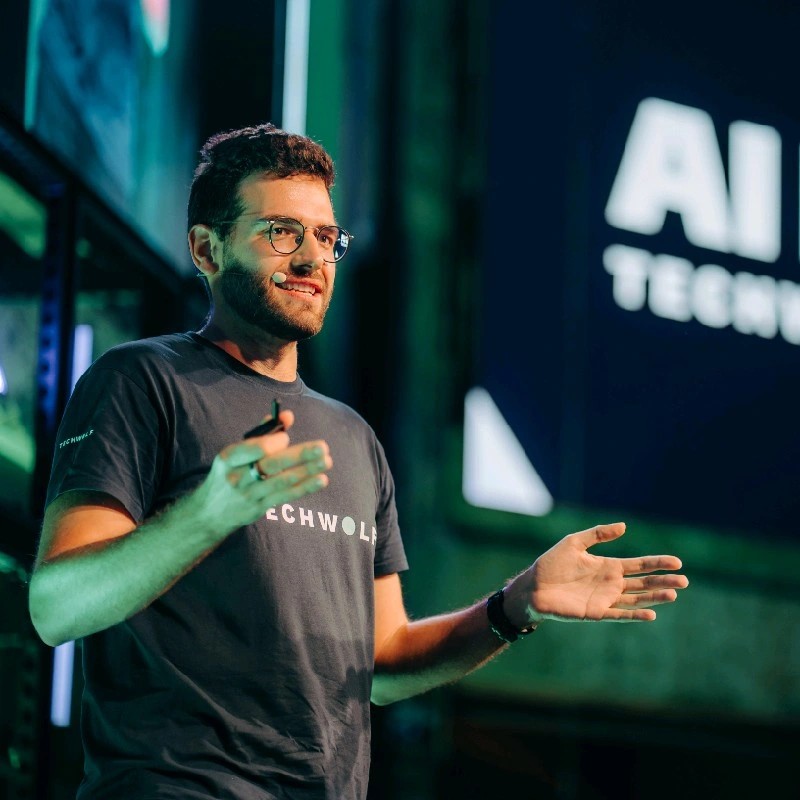
Jeroen Van Hautte
Based in Ghent, Jeroen co-founded TechWolf alongside Andreas De Neve and Mikael Wornoo. TechWolf applies NLP and AI to Skills Ontology and talent intelligence, helping enterprises understand their workforce capabilities. The company is a member of the Wintercircus ecosystem.
As CTO of TechWolf, Jeroen leads the technical direction of the platform, including NLP models, skills graphs, and Enterprise AI integrations. He is a recognized voice in the Belgian AI scene.
Jeroen's work centers on AI-first workforce transformation and skills intelligence. He focuses on building proprietary language models for skills inference that outperform general-purpose models in accuracy and flexibility.
Insights & takeaways
Jeroen Van Hautte's central claim across nearly everything he writes is that the hard part of an AI transformation was never the technology. "Technology isn't the hardest part of an AI transformation. People are," he says, and he means it as a warning as much as an observation . Buying models and licenses is an afternoon's work; changing how people think about their own role is not, and there is no license for that . His practical recipe is deliberately anti-institutional: start with the few people who are genuinely excited, let them show what's possible, let it spread, and skip the company-wide mandate. He is just as firm that AI should never be quarantined into its own department. "A temporary task force is fine. A permanent one just creates an AI silo when it's the opposite of what you need" . This extends into a blunt standard for leadership itself: "A leader who talks about AI but doesn't use it is a huge risk on your AI transformation" . For him, using the tools yourself isn't a nice-to-have, it's the only way to keep the quality of your own decisions from degrading as the ground shifts under you .
That insistence on hands-on use is not rhetorical. He talks about walking on stage at an invite-only CTO event and, instead of a polished keynote, opening his laptop to show whatever he'd built that same morning, because "things move a bit too fast now" to be anchored in yesterday's story . The same restlessness shows in how he treats model selection. For two years the internal rule at TechWolf was simple, "when in doubt, reach for the best LLM," and he says plainly that they are retiring it, because smaller models have caught up on drafting, summarizing and routine tasks to the point that "plenty of people now can't tell the frontier model from one a fraction of its size" . The frontier still matters for genuinely hard, novel problems, but a chunk of everyday work has simply saturated . He frames the shift from unlimited subscriptions to metered, paid tokens (using the Fable 5 relaunch as his marker) as a forcing function that will make people ask, for the first time, whether they really need the highest level of intelligence for a given task: "Training this muscle is going to take time" . This is also why he pushed TechWolf to publish its own adoption and spend numbers live via tokenspend.org rather than keep them secret, and why he frets over variance in adoption, noting that "token spend is not a competition, and tokenmaxxing has gone out of style" while consistent adoption across a team is what actually makes an AI-first approach land .
His writing keeps circling back to what AI does to a person's sense of self, and he does not sand down the discomfort. He connects his own experience handing engineering leadership to a first VP Engineering, an adjustment that "knocked me sideways for about six months" because he'd defined himself as the leader of engineering, to what he now sees happening to people confronted with AI taking over their craft . He is explicit that this is not just an efficiency story: "I'm increasingly seeing software engineers mourn the loss of their craft to AI," and he refuses to wave that away, noting that some will keep the craft deliberately, "the way photographers still develop film," while others will fold the technology in and find something new to be excellent at. Both are fine to him; what isn't fine is "pretending the loss isn't there" .
On organizational design, he treats feedback loops as the load-bearing structure of any AI-first company. He describes deleting TechWolf's early "Customer Work" team, which sat between implementation and engineering, because although it protected both sides it also quietly absorbed the signal about what was actually broken so it never reached the people who could fix it. His rule going forward: keep the pain a problem causes and the resources to solve it as close together as possible, since "AI is making them critical," speeding iteration and increasing how much context can flow through the system . This same systems thinking shows up in how he talks about building for agents rather than humans, distinguishing "human-first," "agent-compatible," and "agent-native" systems, and noting that agents are quickly becoming TechWolf's number one population of users and developers, wanting to be pointed at the underlying data to build things nobody designed for .
He is unsentimental, even wary, about where personal AI use is heading. Describing his own agent Atlas painting itself into a family photo with his fiancée absent, he calls the moment "sweet, maybe, but definitely a bit creepy," and uses it to talk plainly about what happens once a personal agent moves from a private chat into shared family life, doing things like tracking meal planning and offering proactive guidance on the new puppy's health . That same candor turns critical when the subject is AI-generated communication at large: he is openly hostile to what he calls AI slop, saying it "shifts the effort from producing content to consuming it" and "is starting to feel pretty rude," and he's specific about the tell that makes him disengage: "The second I read how something has 'quietly' become 'load-bearing,' I'm out. Just send me a couple of short bullets instead, I don't need the polish" .
Underneath the day-to-day tooling talk sits a longer-running thesis about what TechWolf itself is for, rooted in the company's origin as a student project matching computer science students to jobs before pivoting into enterprise talent management 1718. The company's technology infers employee skills from data sources well beyond CVs and LinkedIn, pulling from HR data and tools like Jira and Confluence, to surface people whose actual specialization is invisible inside broad job titles 171819. He's fond of the concrete image that in a company of 100,000 people, some 15,000 might share the job title "developer" with none of that granularity captured anywhere, and that the technology's job is to move people "rather than being sort of in this developer
- TechWolf deliberately positions as data infrastructure with no employee-facing front-end, making it complementary rather than competitive with existing enterprise HR tools — a key differentiator big enterprises appreciate.
- In companies of 100,000 people, ~15,000 may share the job title 'developer' with no visibility into their actual specializations; inferring skills from data surfaces hidden talent that would never be found otherwise.
- Transformation used to come in waves with recovery time; it is now continuous, making an up-to-date skills view essential and rendering the old 'replace 2,000 people with 2,000 new people' model obsolete.
- Raising money is a commitment to growth — if your market is too small or you lack momentum to deliver on that promise, that should be a red flag against raising; and with institutional investors, value comes from the specific partner on your board, not the fund's brand.
- Europe's downsides include a scarcity of leaders who have seen Series B and beyond, but upsides include less talent competition, longer employee retention, and non-dilutive government grants.
- Thinking about regulation, transparency and explainable AI from the first line of code — a European reflex — became a competitive edge as AI regulation spread worldwide, as did building multilingual (now 50+ languages) from day one.
- Strong CTOs are universal problem solvers, which becomes a trap at scale: being locally the best person for every problem globally costs the company focus; consciously raise the threshold for jumping on problems.
- Requiring people to bring a proposed solution alongside every problem grows their ownership and comfort zone until they stop needing you — the opposite of process-heavy delegation.
- Not knowing how enterprises worked was an advantage: insiders who knew all the hurdles would never have started, while first-principles outsiders could see the problem was now solvable with data instead of surveys — but only paired with obsessive learning about the space.
- Their early London hires were individually stellar but culturally misaligned because they got 'star struck' by available talent and skipped values screening; they had to reboot the office culture by hiring value champions.
- TechWolf concentrates compensation resources on top performers rather than spreading raise budgets evenly, rewarding exceptional impact exceptionally — deliberately unlike large companies.
- TechWolf is office-first but doesn't track office days: they solve the problem 'at the front door' by only hiring people who want to be in the office, then trusting them.
- Even physical details like the distance from a desk to the nearest whiteboard measurably affect how often people get up to collaborate.
- With AI, human skills like delegation, structuring, quality checking and architecture — traditionally manager/senior skills — become more important even for individual engineers.
- In five years, large companies' operating methods will look like what scaleups do today, while new small companies will work in radically different ways with AI cutting dependencies and shrinking cycle times.
Education
MPhil, Advanced Computer Science (NLP focus), University of Cambridge (2018 - 2019), ranked 6th in cohort with 86% average
Burgerlijk Ingenieur (Ir.), Computer Science, Ghent University (2014 - 2020)
Career
- Founders PledgeFounders Pledge MemberOct 2025 – Present
TechWolf#355factoryCo-Founder & CTOSep 2018 – Present
- Antler#88factoryStart-up AdvisorJul 2022 – Jun 2024
From public career histories · 5 entries
Media & appearances
4- 19podcastSuperNova · 10 Sept 2025
TechWolf co-founder & CTO Jeroen Van Hautte explains how their AI skills-inference infrastructure reveals hidden talent in large enterprises, and shares lessons on fundraising, culture, hiring in Europe, and scaling as a first-time founder.
- 16talkTechWolf · 7y ago · 5:28 · 303 views
Jeroen Van Hautte discusses how artificial intelligence can process large amounts of data and recognize patterns that humans cannot efficiently handle manually, enabling more personalized services when human judgment is combined with AI capabilities. He explains that AI learns from context similar to how humans do, using Netflix recommendations and self-driving cars as examples of current applications, and describes an Energy 3.0 project that aims to use AI to assess skill gaps and help individuals understand their position in their industry and growth opportunities.
- 17interviewTech Captains · 2y ago · 26:16 · 30 views
Jeroen Van Hautte discusses how Tech Wolf started by helping computer science students find work matching their skill sets, then expanded into enterprise talent management by using multiple data sources beyond CVs and LinkedIn, including HR data and business tools like Jira and Confluence to infer employee skills. He explains that Tech Wolf's technology identifies skilled workers within large organizations for internal job matching and describes how the company has evolved toward data-driven product prioritization as it reached around 30 enterprise customers.
- 18interviewTech Captains · 2y ago · 26:24 · 512 views
Jeroen Van Hautte discusses how Tech Wolf started as a student project to help match workers to jobs suited to their skills, then pivoted to solving enterprise talent management by enabling companies to identify skilled employees within their existing workforce rather than just screening external candidates. He explains that Tech Wolf combines multiple data sources including HR records, work history, and business tools like Jira and Confluence to infer skills, and describes how the company has evolved its product development approach to be more data-driven as it gained more customers.