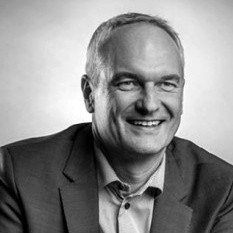
Jurgen Ingels
Jurgen is based in Antwerp and leads Smartfin as Managing Partner. He is also known as the founder of Clear2Pay, a Belgian Fintech that was acquired by FIS. His combination of founder experience and investor perspective makes him one of the most respected voices in the Belgian tech ecosystem.
At Smartfin, Jurgen leads investment decisions, portfolio support, and fund strategy. He focuses on growth-stage tech companies across Belgium and Europe.
Jurgen founded Clear2Pay in 2001, built it to 1,400 employees serving the top 50 global banks, and sold it to FIS (NYSE: FIS) in 2014. He also co-founded NGDATA, the Ghent-based customer data platform, and The Glue, a Belgian SaaS company. Since 2015, he leads Smartfin as a leading European VC, and is the initiator of Belgian tech events The Big Score and SuperNova. Author of "50 lessen voor ondernemers" (NL) / "Start Grow Sell" (EN).
Insights & takeaways
Jurgen Ingels's public voice over the past two years circles obsessively around one conviction: the economics of building a company have changed forever, and almost nobody in Belgium has internalized it yet. He repeats, with only slight variation across podcasts, that where a tech company once needed a hundred people and a decade to hit meaningful revenue, it now needs ten. "Er gaan bedrijven zijn met één of twee man die 10 miljoen omzet gaan doen" 2728, and he goes further still, predicting a two- or three-person company doing a billion in revenue within ten to twenty years: "Ik ben ook overtuigd dat we in de komende 10 20 jaar een bedrijf ga zien dat het bedrijf bestaat uit twee of drie man en dat ze een miljard omzet gaan doen. Dat is misschien absurd wat dat ik zeg, maar ik geloof daar echt wel in" 33. He calls the resulting phenomenon "champignonbedrijven," small teams throwing off 60-70% EBITDA and paying founders dividends far beyond salary 1920. This is not framed as speculation but as something already visible: "Ik zie eigenlijk overal zo wat van die ik noem dat champignonbedrijven ontstaan die met 10 mensen 10 15 20 miljoen omzet doen" 1920.
The corollary he draws, again and again, is that talent and creativity replace capital and headcount as the scarce resource. "AI maakt eigenlijk dat creativiteit veel belangrijker wordt dan puur geld" 28, and technology itself will become undifferentiating: "Software aan zich is niks meer waard, want je kunt het gewoon laten namaken" 20. This is why he says he invested heavily in the production company (referred to as both Caviar and KVA across sources) — creativity, not code, is what he thinks survives automation: "Creativiteit is going to be the one who survives" 30, "Ultimately creativity will always win" 31. But this future is unforgiving to the merely competent. "Dus talent wordt super belangrijk. Dus als je niet getalenteerd zit of niet tot de beste 10 hoort, ja, dan gaat gewoon geen een job vinden" 1920. He states the personal version of this bluntly: "Als je niet de beste zij of in de top drie, dan is life pretty shitty. Zeker in technologie" 25. He sees this as a genuine societal fracture requiring some redistribution mechanism, whether a tax on data/compute funding a universal wage 19 or, in earlier framing, warning that without a tax on data or robots "history says this ends in social revolution or war" 29.
Alongside the AI-and-talent thesis, Ingels maintains a second recurring argument about capital gains tax and the entrepreneurial flywheel, which he treats almost as sacred. His model of how ecosystems compound is explicit: successful founders reinvest their winnings into the next generation of startups, and a capital gains tax breaks this chain by leaving founders with less to risk. "Als je 10 keer een bedrijf van 300 miljoen verkoopt, heb je ook 3 miljard" 25 is his shorthand for how scale-compounding works, and he warns that a 30% tax would push reinvestment down from something like 30 out of 100 to just 5-8 2519, forcing government into subsidy programs it is "bad at deploying" 19. He extends this into a broader complaint about how the Belgian state treats entrepreneurs, saying plainly: "Ik word echt geharrest door de fiscus. Iedere dag opnieuw controles, btw, directe belasting. Als je uw ondernemers op die manier behandelt, ja, dan heb je het risico dat uw ondernemers weggaan" 20. This frustration surfaces concretely in his account of Supernova's funding: he notes Amsterdam offered to bankroll much of the event's costs while Flanders lacks even a large enough venue, and reveals bluntly that "de grootste interessantste optie vandaag die op tafel ligt is eigenlijk Amsterdam" 2019.
On entrepreneurship itself, his advice is pragmatic and repeated with near-identical phrasing across interviews. He tells young people to ignore salary for their first decade and instead accumulate experience, network and knowledge across sectors: "De eerste 10 jaar van uw carrière moet u eigenlijk geen fluit aantrekken van wat ga ik hier verdienen" 25. He insists success correlates with simple effort — "Al de mensen dat ik ken die succesvol zijn die werken gewoon allemaal meer dan de rest. Punt" 25 — and with the willingness to look foolish: "Heel mijn leven zot verklaard. Maar dat is oké. Al de mensen die zot verklaard zijn zitten dikwijls op een goed spoor" 25. He also insists, especially in Ben's Mentors and the Stanton Chase talk, that building a large company is far rarer than people assume, citing that only 0.3% of companies reach meaningful scale 25, and that founders systematically underestimate costs and overestimate revenue timing, hence his standing rule to inflate costs 30% and delay revenue projections by two quarters when reviewing a plan 2532.
A third throughline is his impatience with Belgian and Flemish self-doubt, which he frames almost as a moral failing standing in the way of the country's genuine advantages. He praises local engineering talent repeatedly — "Wij ongelooflijk goede ingenieurs, Cost of Living is goed hier, kwaliteit van de mensen is goed, wij fantastische creativiteit. Wij kunnen hier ook wereldbedrijven bouwen. We moeten het gewoon doen" 28 — and pushes back on the instinct to defer to American or Asian validation: "We're Belgians. I mean, we're like, 'Oh, it's difficult...it's only when it's from America or Asia that it's good'" 26. His preferred register is one of active defiance rather than complaint, distilled into his own recurring line about Belgian culture: "Ik denk ook wel dat de filosofie van get off your ass en doet iets en stop met zagen. Wij zijn ongelooflijk goed in het klagen en zagen hè" 1920. This is also the explicit logic behind Supernova itself, which he frames as proof that ambitious things can be built from Belgium rather than imported: "Sometimes in Belgium we have the expression 'oh it can't be done, it's too difficult, blah blah blah' and I just want to prove that even in Belgium we can get stuff done" 31.
Running underneath all of this is a more personal, almost philosophical note that appears less often but colors everything else: a sense of mortality and deliberate presence that he connects explicitly to his outlook on ambition and risk. He says, in an interview reflecting on downtime, "Ik besef dat het leven eindig is. Daardoor geniet ik bewuster van elk moment" . It fits with his repeated claims that entrepreneurship is inherently chaotic and requires a kind of reckless commitment — "Ondernemen is chaos. Als je ondernemer zij dan is het chaos. Dan z eigenlijk een halve een piraat bij wijze van spreken" 24 — and his belief that passion and willpower are close to sufficient conditions for achievement: "Als je passie hebt in het
- CFOs should build scenario cubes (revenue +/-5/10/15%, cost variations) to give management and the board boundaries on EBITDA and cash flow outcomes, then track which scenario the company is actually in — a practice done too rarely.
- When testing a CFO, the answer to a hard question matters less than how fast they can produce the numbers; a CFO too far from operations who can't interpret figures in business context is a red flag.
- In fast international growth, impose clear rules early — like the lines of a football pitch: local teams can do what they want inside the rules (booking methods, depreciation, salary rounds), but stepping outside means coming back to headquarters.
- Tech companies that used to need 100 people and 8-10 years to reach a revenue level now do it with 10 people in 2 years thanks to automated backends and AI agents; only top talent will find jobs, creating 'champignon companies' with 60-70% EBITDA where 10 people earn dividends of half a million on top of salary.
- Technology and AI tools will become mainstream and undifferentiating; the only remaining differentiator is creative ideas, which is why Ingels invested significantly in film production company KVA with 250 creatives.
- Amsterdam and the Dutch government proactively offered to fund a large share of Supernova's costs to replace TNW, while Flanders lacks a venue for 20,000-30,000 attendees — currently only ~10% of Supernova's €4.7M budget is government-supported.
- AI will not stay cheap: compute costs will rise toward €200-300/month per user, and app companies built on other people's data risk having data owners demand margin or build the app themselves, so many VC-funded AI apps will disappear.
- UBI will likely be funded by a tax on CPU/data usage rather than by companies directly, creating a society split between highly-paid top talent and everyone else on a state-paid wage.
- Democratization of education over the past 10-15 years leveled quality downward; excellence became viewed as strange, which is dangerous when the future economy rewards only exceptional talent and creativity.
- Capital gains tax destroys the startup flywheel: an entrepreneur who nets 70 instead of 100 after a sale will risk perhaps 5-7 on young founders instead of 30, leaving governments to compensate with subsidies they are bad at deploying.
- Politicians misjudge AI because they judge change against a slow lifetime reference frame, assuming they can always intervene afterwards — a fundamental error given the current pace of change.
- An American company can analyze an app and rewrite its software — 100,000 lines — overnight at comparable quality, meaning software itself is becoming worthless as a moat.
- Tech companies that previously needed 100 people and 8-10 years to reach a certain revenue now do it with 10 people in 2 years because the entire backend is automated with agents; this creates 'champion companies' with 10 people, €10-20M revenue and 70% EBITDA margins.
- Many companies will lay off 30-40% of staff in the next 3-5 years; only the top talent will find jobs, creating a societal split between highly paid elites and the rest.
- Technology will become mainstream and everyone will have the same tools, so the only remaining differentiator is creativity — which is why Ingels invested in film production company KVR with 250 creatives.
- AI will not stay cheap: compute costs will rise toward €200-300/month per user, data owners will demand margin from agent builders or build the apps themselves, so many VC-funded AI apps will disappear once the hype phase ends.
- UBI could be funded via a tax on CPU or data usage, redistributing the outsized gains of champion companies to prevent social unrest.
- Flanders should invest in creativity education and in beautifying its cities, using freed-up labor to make tourism a major future economic factor since wealthy people worldwide want to visit Flemish cities.
- The Netherlands proactively offered to co-finance Supernova's move to Amsterdam because they lost The Next Web and want a 'rock and roll' tech conference — while Flanders lacks both venues and proactive support (only ~10% of the €4.7M budget is government-supported).
- Politicians judge the world from a slow reference frame built over their 40-year careers, assuming they always have time to intervene afterwards — a fundamental miscalculation given AI's speed.
- The capital gains tax will shrink second- and third-generation entrepreneur reinvestment: with 30% taken off an exit, founders will risk 5-7 instead of 30 on young startups, drying up the flywheel that took 10 years to build around Wintercircus.
- An American company built software that analyzes an app and rewrites its 100,000 lines of code overnight at comparable quality, meaning software itself is no longer worth anything — data ownership and creativity are.
- Anyone can become an AI specialist in six months by asking ChatGPT weekly for 10 relevant tools for their profession and testing one per week — but almost nobody makes the effort.
- Prior experience as a venture capitalist (6 years managing bank risk capital in the US) let Ingels avoid mistakes and raise capital fast when founding Clear2Pay at 28 — which is why he prefers investing in second-generation entrepreneurs, even if their first venture failed.
- The best entrepreneurs are those who reduce time — either through experience (avoiding trial and error) or through technology; many Flemish companies still work archaically in accounting and sales and leave large efficiency gains untapped.
- Founders are systematically too optimistic on revenue and too pessimistic on costs; Ingels' rule of thumb when reviewing plans is to increase all costs by 30% and shift revenue six months later — and the liquidity picture then roughly matches reality.
- Early-stage fundraising is mostly about credibility, which you can manufacture: give your service free to reference clients in exchange for using their brand, or assemble an advisory board of people with a track record.
- Valuation itself says nothing — the legal terms around it (like anti-dilution provisions) matter far more; raising at inflated valuations leads to down rounds where founders lose the biggest part of their company.
- Never open a foreign office yourself: instead acquire a small local company (or a customer of it), pay 10-20% cash and 80% in shares of your own company — you gain local clients, reduce time-to-market from 18 to 6 months, cross-sell their products internationally, and keep sellers motivated as your share value grows with each acquisition.
- Founders obsess over dilution percentage, but 30% of a company that grows 50x in EBITDA and sells at a higher multiple is worth far more than 100% of the small company you could build alone.
- Ingels believes Clear2Pay was sold slightly too early — the fintech hype exploded in 2015-2017 and they probably could have gotten double the price three years later.
- Ingels was never CEO of any of his dozens of companies — being founder or CFO gives you freedom to work across sectors and cross-pollinate best-of-breed ideas, while a CEO is forced by shareholders to stay focused on one company.
- A capital gains tax would kill Belgium's emerging ecosystem where exited entrepreneurs reinvest 90-95% of their wealth into new risky ventures — 10 years of ecosystem-building would go down the drain.
- During an exit, gratitude is the shortest-lived emotion: once C-level staff knew the company was being sold, some immediately stopped caring about him because he was no longer relevant to their careers.
- A new company model is emerging: 10 fanatic specialists with a fully digitized backoffice, no marketing or sales (product sells word-of-mouth), growing from 0 to €30-40M in three years at 70% EBITDA — needing far less capital and making legacy competitors' overhead untenable.
- SmartFin exists partly to prove Clear2Pay wasn't a lucky shot — that there is a repeatable model ('stramien') that increases the odds of building large tech companies from Flanders, evidenced by Silverfin's €300M+ exit.
Career History
Founder and Managing Partner at Smartfin (Jan 2015 - Present)
- Board Member at WDP - Warehouses with brains (Jan 2018 - Present), BEL 20
Board Member at Materialise (Nov 2013 - Present), NASDAQ
Board Member at Deliverect (Apr 2020 - Present)
- Board Member at Caviar (Jan 2026 - Present)
Education

Media & appearances
18 19podcastVirtual S02#29 LIVE - Hilde Schuddinck & Jurgen Ingels: Wie wint en verliest in het AI-tijdperk?Virtual · 30 Apr 2026
Live Virtual podcast at a book launch where Jurgen Ingels and Hilde Schuddinck (Voka) warn that AI will trigger mass layoffs, reward only top talent and creativity, while Belgian policymakers lag dangerously behind — with Ingels revealing Supernova may move to Amsterdam.
 20podcastTitel: Virtual S02#29 LIVE Hilde Schuddinck & Jurgen Ingels: Wie wint & verliest in het AI-tijdperk?Virtual · 30 Apr 2026
Live Virtual podcast where Jurgen Ingels predicts mass layoffs and the rise of 10-person 'champion companies' in the AI era, while Voka's Hilde Schuddinck warns Belgian policymakers are alarmingly slow on technology.
 21panelDe CFO Podcast goes live: de CFO als motor van groeiDe CFO Podcast · 30 Mar 2026
Four Belgian finance leaders (Jürgen Ingels, Kristof Vande Capelle of Gimv, Rob Steensels of KPMG, Veronique Derycke of delaware) debate how the CFO drives sustainable growth in the first-ever live recording of De CFO Podcast.
 22podcastVirtual S02#23 - Leen Anthuenis & Jurgen Ingels: Reinvent Yourself in het tijdperk van AIVirtual · 05 Mar 2026
Supernova organizers Jurgen Ingels and Leen Anthuenis discuss the SaaS apocalypse, why creativity beats technology as the future differentiator, AI's democratization of entrepreneurship, and landing Arnold Schwarzenegger and Oprah for their Antwerp tech festival.
 23podcastVirtual S02#23 - Leen Anthuenis & Jurgen Ingels: Reinvent Yourself in het tijdperk van AIVirtual · 05 Mar 2026
Supernova founders Jurgen Ingels and Leen Anthuenis discuss AI's impact on jobs and SaaS, why creativity beats technology as the future differentiator, and preview Supernova 2026 with Arnold Schwarzenegger under the theme 'Reinvent Yourself'.
 24podcast"Een land heeft second generation entrepreneurs nodig” - Jürgen Ingels - De CFO PodcastDe CFO Podcast · 02 Feb 2026
Jürgen Ingels (Smartfin, ex-Clear2Pay CFO) on why countries need second-generation entrepreneurs, Smartfin's unusually low 0.6-0.7% fund fee model, the Caviar investment, and getting Arnold Schwarzenegger to SuperNova.