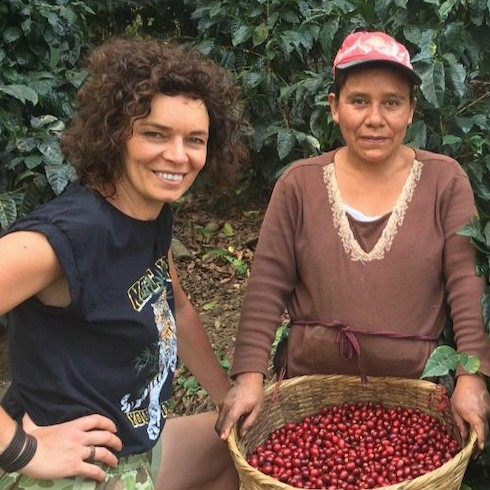
Katrien Pauwels
In this Connexi podcast, Katrien Pauwels recounts almost 20 years of building a coffee business with her husband Tom, starting as a small roastery in Aalst in 2001 while she kept working at Apple. She describes three pivotal moments: winning a public auction for their building via the 'recht van hoger bod' (selling their private house to survive), flying to New York in ~2009-2010 to get a two-hour meeting with the CEO of Le Pain Quotidien who taught them the importance of numbers and cashflow planning, and selling their four coffee bars in November 2019 to focus on the roastery and their green coffee import business Cup-A-Lot. She discusses competitiveness, entrepreneurship as a couple, the value of an advisory board, and how corona exposed the weakness of 90% horeca dependence. Her core message: keep persevering, announce your goals, take action, and never give up as long as you still have 'goesting'.
Insights & takeaways
Katrien Pauwels's thinking centers on one deceptively simple idea: passion alone is not a business plan, and the discipline to quantify what you feel is what separates founders who survive from those who don't. She learned this the hard way, six months into running her first coffee bar, when the rented building she had renovated was suddenly sold at public auction. Rather than fold, she and her husband Tom exercised their right of first refusal against a professional property investor and sold their own house in Ghent to cover it. Looking back, she's blunt about what that moment demanded: "We hebben geen andere keus, we gaan het gewoon doen" 2. That phrase captures a recurring pattern in how she talks about crisis: not bravado, just the recognition that once you've committed, retreat isn't actually an option worth entertaining.
That near-loss also reshaped how she thinks about numbers. She's explicit that a business plan is "not something you make because the bank asks for it," but something you need for yourself 2. Rather than accept vague uncertainty, she flew to New York to sit down with the CEO of Le Pain Quotidien and interrogate him about cashflow and hard numbers, calling it one of the most instructive moments of her life 2. What strikes her most in retelling this isn't just what she learned but how easy it was to get the meeting: a simple email was enough, and she now argues that "passionate, successful people are far more accessible than you assume" 2. This belief that expertise is reachable if you just ask shows up again in her view of Flemish entrepreneurial culture more broadly, which she thinks systematically inverts confidence in the wrong direction: people "overestimate others and underestimate themselves," when in fact everyone admired from outside has quietly struggled through the same bottlenecks 2.
Her approach to validating a business idea is characteristically literal rather than intuitive. Before opening her first coffee bar, she didn't trust gut feeling alone: she stood outside candidate locations at different days and times, counting foot traffic on each side of the street, turning passion into something measurable before risking money on it 2. This same instinct for objectifying belief reappears in how she talks about goals: she considers public declaration a genuine mechanism, not just motivational talk, arguing that a goal spoken aloud gets you pushed and held accountable by others, whereas a plan kept private simply stalls in your head 2. Underneath both habits is the same logic that runs through the New York trip and the auction fight: conviction has to be tested against something outside your own head, whether that's foot traffic, an accountability structure, or someone else's hard-won cashflow expertise.
That external check-and-balance thinking is also why she values a structured advisory board, but she's careful to specify how it actually functions rather than just endorsing it as a concept. Sessions only work, she says, if you walk in with concrete questions and a clear agenda; the two-monthly rhythm itself creates discipline because you're forced to report back on what you promised to do 2. This lines up with a broader lesson she distilled for a compilation of entrepreneur advice: founders driven purely by passion tend to use the bank account as their only compass, and only a real financial plan plus outside advisors can expose blind spots invisible from inside your own bubble 1. Across both sources, the throughline is the same: enthusiasm is necessary but insufficient, and the antidote to self-deception is inviting outside scrutiny early and often.
On customer relationships, she's equally pragmatic. She trained her baristas around a specific reframe: a complaint is a gift, because the customer who complains is handing you information that everyone else silently withholds, so you shouldn't take it personally 2. This is consistent with her broader instinct to treat friction, whether from customers, crises, or property investors, as data rather than as personal failure. She applies the same lens to her most consequential business decision: selling all four coffee bars in November 2019, before the pandemic hit, because running a roastery, retail bars, and green coffee import simultaneously had spread the company across too many fronts. She frames this explicitly as choosing depth over breadth, a return to core competency rather than a retreat 2. In hindsight she connects this directly to resilience, noting that when COVID crushed horeca demand and sales fell to 8-10% of normal, the earlier decision to refocus was likely what let them survive at all, adding candidly that they wouldn't have survived such a shock ten years earlier 2.
Her account of the coffee bar's founding also carries a clear communication philosophy: pitching the concept to enough people taught her that clarity is a competitive requirement, since "if you need five minutes to explain what your business does, your customers are long gone" 2. The scale logic behind Cup-A-Lot follows the same efficiency instinct applied to sourcing: filling a shipping container is far easier with 120 roasteries as clients than with one, which is what makes buying directly from farmers viable for small specialty roasters who could never do it alone 2. Finally, her account of running the company alongside her husband Tom reveals a working philosophy of complementary friction rather than aligned agreement: she describes herself as the restless, fast-moving partner and Tom as the deliberate brake, insisting that keeping separate daily domains, rather than merging into shared tasks, is precisely what keeps both the marriage and the business functional 2. Across all of it, her voice returns again and again to the same conviction, stated flatly about the coffee bar's uncertain beginning: "Ik kan niet verliezen" 2.
- Passion-driven founders often use the bank account as their only compass; a proper financial plan and an advisory board with outsiders exposes blind spots you can't see from inside your own bubble.
- Before opening the first coffee bar she objectified her passion by standing outside candidate locations at different days and times, literally counting how many people passed on which side of the street.
- If you need five minutes to explain what your business does, your customers are long gone — pitching the concept to many people sharpened how she presents the company.
- Six months after starting, their renovated rented building was sold at public auction; they exercised the 'recht van hoger bod' against a professional property investor and sold their private house in Ghent to afford it — without that the company would not exist.
- A business plan is not something you make because the bank asks for it — you need it yourself; the LPQ CEO made her realize the importance of exact numbers and a cashflow plan.
- Passionate, successful people are far more accessible than you assume: a simple email to Le Pain Quotidien's CEO got her two hours of his time in New York, one of the most instructive moments of her life.
- She trained her baristas that a complaint is a gift: the customer who complains gives you information most others withhold, so don't take it personally.
- They sold the four coffee bars in November 2019 (before corona) because running roastery, bars and green coffee import spread them across too many fronts; they chose depth over breadth and returned to their core.
- Corona exposed a structural weakness: with ~90% of revenue dependent on horeca, sales fell to 8-10% of normal, forcing a rethink they say they wouldn't have survived ten years earlier.
- Advisory board sessions only work if you prepare concrete questions and a clear agenda in advance; the two-monthly rhythm also creates discipline because you must report back on your to-dos.
- Cup-A-Lot's logic is scale: filling a container is easier with 120 roasteries as clients than one, making sourcing directly from farmers viable for small specialty roasters.
- Publicly announcing a goal is the first step to action: others will hold you to it and push you, whereas a plan kept in your head goes nowhere.
- As an entrepreneurial couple they work in the same company but never on the same daily tasks: she is the restless fast-mover, Tom the deliberate brake, and that balance plus separate domains keeps both marriage and business healthy.
- Flemish entrepreneurs tend to overestimate others and underestimate themselves; everyone you admire also struggled with bottlenecks and simply persevered.
Career
- Cup-A-LotCo-Founder Cup-A-Lot / Green Coffee SourcerSep 2017 – Jul 2020
- OR Coffee RoastersCo-Founder OR Coffee RoastersNov 2008 – Dec 2023
- AppleChannel Account ManagerJan 2002 – Sep 2008
- AccentAccount manager1999 – 2002
Erasmushogeschool Brussel#23school1992 - 1995
From public career histories · 5 entries
Media & appearances
2- 1podcastConnexi · 25 Dec 2020
Connexi host Bert closes the podcast's first year with a Christmas compilation of 16 Belgian entrepreneurs' best lessons on success, resilience, leadership, failure and family business.
- 2podcastConnexi · 21 Jun 2020
Katrien Pauwels (OR Coffee / Cup-A-Lot) tells how she and husband Tom nearly lost their coffee business six months in, flew to New York to grill the Le Pain Quotidien CEO on numbers and cashflow, and later sold their four coffee bars to refocus on roasting and specialty coffee import.