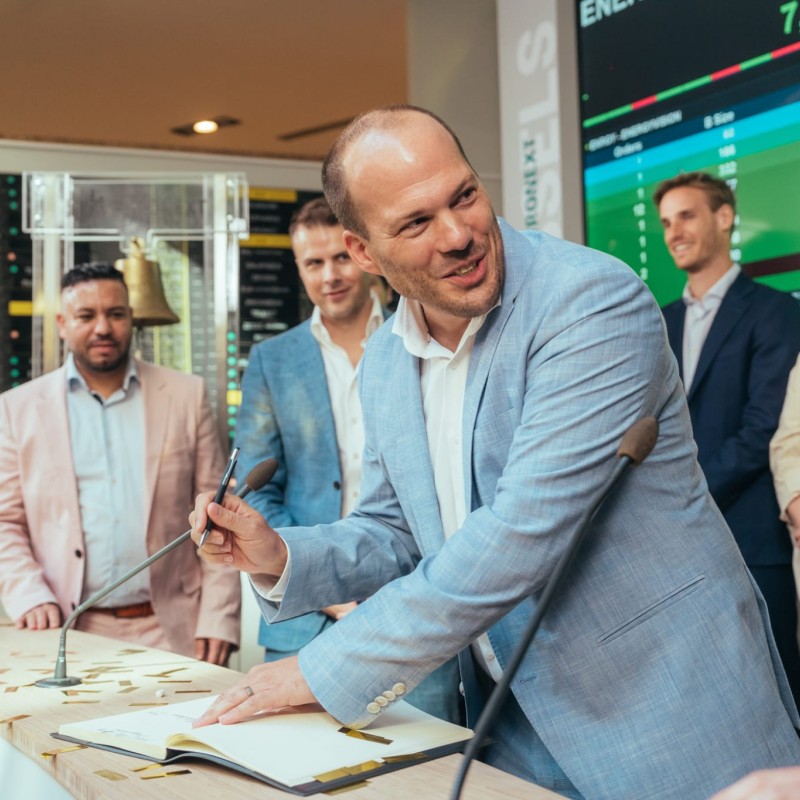
Maarten Michielssens
Maarten Michielssens is Founder and CEO of EnergyVision.
Insights & takeaways
Maarten Michielssens talks about EnergyVision almost entirely through the lens of one idea: ownership. The company places solar panels, batteries and charging stations at customers' homes and businesses for free, but keeps title to the equipment itself, and makes its money by selling the electricity back to those same customers more cheaply than incumbent suppliers can, since it carries no distribution costs 4. This asset-ownership model is the thread running through everything else he says, because it explains both why growth was slow at first and why it later accelerated so sharply.
On growth, his account is unusually patient for a founder describing a scale-up. He is explicit that "het ons 10 jaar gekost om 20.000 klanten te overtuigen" before the company was able to jump to 50,000 customers in a single year 4. He frames this not as a sudden breakthrough but as the payoff of years of quietly preparing people and internal teams for a much bigger business, so that when the hockey-stick moment arrived, the organization could actually absorb it 4. That same rhythm shows up as a kind of personal refrain: "Elk jaar zeggen wij dat het nu echt begint. Dat hebben we dit jaar ook gezegd" 4 — an admission that the company has repeatedly declared itself at an inflection point, which reads less as hype and more as a recognition that growth in this business keeps compounding past whatever milestone came before.
Financing is the other constant in his story, and he is candid about how improbable it looked from the outside. EnergyVision was founded with just €6,200 and later needed to secure a €100 million credit line from a bank to fund the asset-heavy model, since the company itself pays upfront for the solar panels and equipment it installs for free 4. He is blunt about the skepticism this invited — "dan zeggen wat jonge gasten daar" 4 — and just as blunt about the fix: he says plainly that he himself speaks "de taal van een ondernemer," while what convinced the bank was hiring a CFO who "spreekt ook de taal van bankiers" and whose financial modeling was built specifically for what a bank wants to see 4. For him this is a clear operational lesson, not a soft leadership platitude: a capital-intensive, customer-financing model cannot be scaled on founder-conviction alone, it needs someone fluent in the language of institutional capital.
That same combative confidence carries into how he talks about public scrutiny of the company. Around EnergyVision's IPO, he directly quotes and rebuts the press's line by line: "De EnergyVision ipo was te duur, schreven de kranten. Correcte instapprijs, dachten wij" and "Ze groeien niet meer, schreven ze. We zijn nog maar begonnen - afspraak binnen een jaar, zeiden wij" . A year later he returns to that exact bet, framing the anniversary on Euronext Brussels as vindication and stating "we zijn ongelooflijk enthousiast voor wat komt" . The pattern is consistent: skepticism from outsiders is treated as a checkpoint to be answered with results rather than argued away in the moment.
He takes a similar defensive posture, but sharper in tone, when the wider energy sector comes under political fire. When Minister Rob Beenders characterized energy suppliers as engaging in "sjoemelkortingen," Michielssens responded that "we voelen ons bij EnergyVision niet aangesproken," pointing out that the company's discounts run far longer than a first-year teaser and actually increase annually . He goes further to note, somewhat pointedly, that this loyalty-based discount structure isn't even designed to game price comparison sites, since "de prijsvergelijkers tonen onze loyauteitskortingen zelfs niet" . The comment positions EnergyVision's pricing philosophy as customer-retention-driven rather than acquisition-driven, and it's one of the few places he explicitly contrasts the company's practices against the rest of the industry rather than against press narratives.
Across these moments, a few consistent takeaways emerge. Michielssens sees long, unglamorous groundwork as the actual precondition for rapid scaling, not something rapid scaling replaces. He treats financing structure, and specifically who on the team can speak convincingly to banks, as a make-or-break operational detail rather than a background function. And he consistently responds to external criticism, whether from newspapers or a minister, not by disengaging but by directly quoting the criticism and answering it point for point, then trusting time and numbers to settle the argument, as with his year-later promise to "de cijfers spreken" .
- EnergyVision's business model is asset ownership: it places solar panels, batteries and charging stations at customer sites for free, retains ownership, and monetizes by selling the electricity cheaper than competitors without distribution costs.
- It took EnergyVision 10 years to convince its first 20,000 customers, but years of deliberately preparing people and teams for growth enabled a jump to 50,000 in a single year — the hockey stick came after long groundwork.
- For a capital-intensive model where the company finances customers' assets, hiring an experienced, reputable CFO who 'speaks the language of bankers' was essential to securing a €100 million bank line for a company founded with €6,200.
Career
EnergyVisionFounder and CEOOct 2014 – Present
Birdhouse#72factoryMentorJan 2016 – Nov 2018
- EcoNationFounder and CEOSep 2009 – Sep 2014
Vlerick Business School#3schoolMaster in General Management2005 - 2006
KU Leuven#1school2000 - 2005
From public career histories · 5 entries
Media & appearances
1- 4interviewDe CFO Podcast · 17 Apr 2025
EnergyVision founder/CEO Maarten Michielssens explains how his 'free solar panels' asset-ownership model grew from 5 to 50,000 customers and why a bank-fluent CFO was crucial to financing €100M with only €6,200 in founding capital.