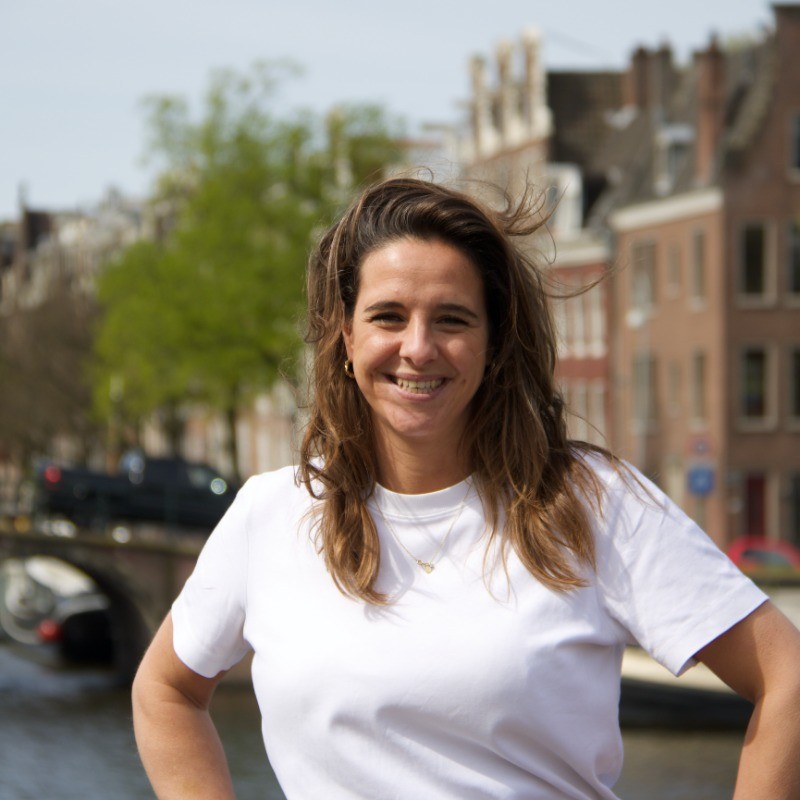
Manouk Draisma
Manouk Draisma is a co-founder of Langwatch, a role she has held since December 2023. She is based in Amsterdam.
Before that, she was Head of CS at Biller from March 2022 to March 2023. She spent eight years at Lightspeed Commerce, formerly SEOshop, joining as an account manager in May 2014 and going on to lead business development in the Netherlands, manage tech support for BLX and DACH, serve as senior manager for customer success in EMEA and, from April 2020 to March 2022, head partnerships for EMEA. Earlier she worked at Hotel V and The Lobby Amsterdam, interned in product management at MediaLAB Amsterdam and interned in marketing at Viacom International Media Networks CEE.
She studied Media & Information Management at the Amsterdam University of Applied Sciences, graduating with a BSc in 2012, and took a Building Partnerships in China programme at Donghua University in Shanghai in 2011. She attended Meridiaan College Het Nieuwe Eemland from 2003 to 2008.
Insights & takeaways
Manouk Draisma's public commentary centers on a single conviction: building AI systems is easy, knowing whether they actually work is the hard and unsolved part. This theme runs through nearly everything she writes. "Teams don't just want to see what their AI did anymore. They want to know whether it actually works, before it ships" . She traces this as a shift in the market itself, noting that a year earlier teams came to LangWatch mainly for tracing and observability, "a safety net for after something went wrong," whereas testing and evaluation has since become "the first question on the table" . She's blunt about how far behind most organizations still are, citing a partner meetup where a team admitted that a year ago they were "shipping on vibes, no evals" , and echoing similar gaps from her own conversations, where she observed that "real testing, observability and regression prevention are still missing in many AI deployments" .
A second recurring thread is cost and waste in AI systems, particularly around coding agents. She frames this not as an abstract efficiency question but as a governance blind spot: "Developers and leaders alike are watching token spend increase month over month, without clarity on where the waste is coming from or how to optimize it" . Underneath that, she points to a structural anxiety in the industry, "the constant concern that today's VC-subsidized token prices will not last, and what would the same usage cost when that ends" . This concern drove the launch of LangWatch's Claude Code usage tracker, which she pitched around a simple diagnostic question: "You know what Claude Code costs per seat. But do you know which sessions burned the budget, which model did the work, or whether your cache paid off?" . She's also willing to poke fun at the very problem she's solving, noting wryly after the launch that "saying: 'great, thanks' cost us 80$" .
Her thinking about who should be allowed to fix AI systems is more developed and arguably her sharpest position. She repeatedly returns to the mismatch between who builds agents and who understands the domains they operate in: "Agents are doing legal, health, and financial work now. But the engineers building them aren't lawyers, doctors, or bankers. The domain experts are. And until now, their contributions died in a backlog" . This is the stated rationale behind Langy, LangWatch's agent for turning production issues into reviewable fixes. She's precise about the workflow she wants to replace, the informal chain of "whoever spotted the problem, to a product manager, into an engineering backlog, and then sit there" , and precise about what she wants engineers to retain: authority. Langy's fixes are "reviewed by your engineers, or it doesn't merge" , and she frames this explicitly as empowerment rather than replacement, "this is more power for you too... nothing ships until you've approved it" . She sees the domain-expert-versus-engineer split as substantively important, not cosmetic: "That split matters more than it sounds" .
On the broader question of AI replacing engineers, she takes a clear, confidently argued position rather than hedging. Her claim is that AI expands the scope of competition rather than shrinking the need for builders: "AI didn't reduce the need to build. It increased the scale of what everyone can build" . She reasons through the competitive dynamics explicitly, "you can ship 3x more now... But so can your competitors. The game didn't shrink. It got 3x bigger" , and concludes that the bottleneck simply relocates to "how much can one engineer produce using AI," which for companies wanting to outrun that ceiling means hiring more engineers, "not fewer" . Notably, she scopes this claim in time rather than treating it as permanent: "I think this holds for the next 2-3 years" , suggesting she views the current dynamic as a phase rather than a fixed law.
A more reflective, almost philosophical thread appears in her writing about what she calls the hidden cost of AI systems: the knowledge companies give up to make models useful. Drawing on Satya Nadella's framing, she writes, "You pay for intelligence twice. Once with money. Once with the knowledge you hand over to make the model any good," adding that "that second payment is the one nobody notices. It does not leave in one transfer. It leaks. Trace by trace. Correction by correction. Eval by eval" . Her conclusion reframes what she thinks companies should actually value, arguing against chasing whichever model is "smartest this month" and instead insisting that "the corrections are the asset, the value... That is not exhaust. That is the company" . This ties directly back to her observability and evaluation obsession: the traces and corrections generated by real usage are, in her view, the durable competitive asset, not the underlying model.
Practically, she also treats dogfooding and documentation as a form of testing discipline. She describes running LangWatch's own Scenario framework against its documentation to check "whether Claude can read our docs, instrument LangWatch, and write its own scenarios, entirely on its own," and is explicit that failure is treated as an internal defect: "If it can't, that's not Claude's problem. That's our docs failing the test. So we fix them" . Her broader point here, "in the agent era, your docs aren't for humans anymore. They're an interface for AI agents. So we test them like one" , is a concrete, generalizable takeaway about how she thinks technical documentation should be built and evaluated going forward.
Across sources, her thinking shows a consistent arc: from observability as an after-the-fact safety net, toward pre-deployment evaluation, toward giving domain experts direct agency over fixes, toward a broader argument about what actually constitutes durable value in AI systems, that it is the accumulated corrections and judgment embedded through real use, not the model itself. The connecting thread in her voice throughout is a preference for concrete, verifiable proof over trust: replays instead of assumptions, tests instead of tickets, evals instead of vibes.
Career
LangwatchCo-FounderDec 2023 – Present
- BillerHead of CSMar 2022 – Mar 2023
- Lightspeed Commerce#559factoryHead of Partnerships EMEAApr 2020 – Mar 2022
- Lightspeed Commerce#559factorySenior Manager, Customer Success EMEAJul 2018 – Apr 2020
- Lightspeed Commerce#559factoryManager, Tech Support BLX & DACHSep 2016 – Aug 2018
- Lightspeed (Formerly SEOshop)Teamlead, Business Development NetherlandsJun 2015 – Sep 2016
- Lightspeed (Formerly SEOshop)Account ManagerMay 2014 – May 2015
- Hotel V & The Lobby AmsterdamPassion; amazed customers with serving delicious food & wine.Apr 2013 – May 2014
- MediaLAB AmsterdamProduct Management InternJan 2012 – Jul 2012
- Viacom International Media Networks CEEMarketing InternAug 2009 – Jan 2010
- Donghua UniversityBuilding Partnerships in China (located in Shanghai)Jan 2011 - Jul 2011
- Amsterdam University of Applied Sciences#128schoolBachelor of Science (BSc), Media & Information Management2008 - 2012
- Meridiaan College Het Nieuwe Eemland2003 - 2008
From public career histories · 13 entries
Media & appearances
2- 11interviewProxify · 2 years ago · 51:40 · 105 views
Manouk Draisma discusses her decade-long career progression from junior account manager at an e-commerce startup through the acquisition by Lightspeed, its IPO, and subsequent acquisitions across European markets. She reflects on the challenges of integrating acquired companies with different cultures and work processes, and contrasts leadership dynamics in startups versus enterprise organizations, noting that startups operate with unified commitment while larger organizations require more structured hiring for specific roles.
- 12podcastVenorTech · 1 year ago · 38:21 · 47 views
Manouk Draisma discusses predictions about AI's role in work, expecting AI to be incorporated as decision-making partners within organizations over the next five years, and anticipating smaller language models becoming more available and competitive within fifteen years.