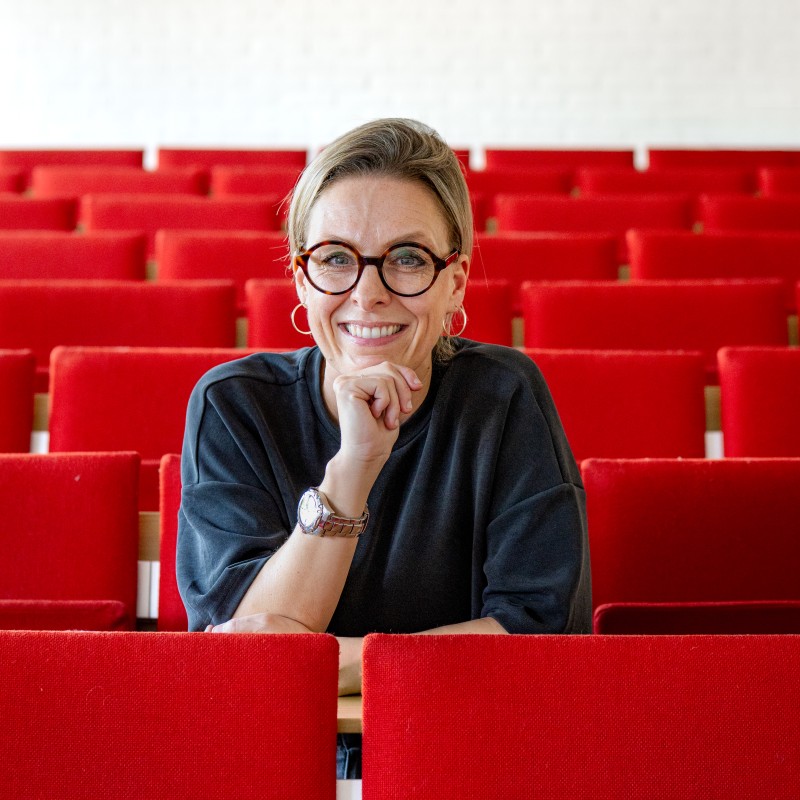
Marieke Froyen
Marieke Froyen is Chief Operating Officer at netcure, a role she took up in October 2023. She is based in Halen. She also teaches at Syntra Limburg, a role she has held since February 2020, works as a freelance trainer for Groep Maatwerk since December 2016, and has been zaakvoerder of Bast and of an HR management, consultancy and training practice since July 2016.
Between August 2011 and January 2017 she worked at Blankedale vzw on training and selection, having previously been a personnel officer there from September 2008 to February 2009. In between she was a vormingsmedewerker at VLAB vzw in 2009, then spent two years at IGO as a trajectbegeleider and coordinator of competence-based training. She began her career as a records administrator at European Air Transport (DHL) from September 2007 to September 2008.
She holds a bachelor's degree in social work from Katholieke Hogeschool Leuven, a postgraduate qualification in sexological counselling from Katholieke Hogeschool Limburg, and a university postgraduate in business administration from Hasselt University. She also studied at the Academie coaching & counselling Antwerpen.
Insights & takeaways
Marieke Froyen's public voice centers on a single organizing idea she keeps returning to: growth requires the right environment. She names this explicitly with the metaphor of "potgrond" (potting soil), asking "Sta ik wel in de juiste potgrond?" and inviting her podcast audience to "eens kritisch nadenken over jouw potgrond" . This isn't decorative language for her, it's the throughline connecting her two main areas of activity: leadership development through the Teamcoach opleiding, and community-building for singles and childfree adults through Club Compagnon. In both domains, her core claim is that people underperform or feel stuck not because of personal deficiency but because the surrounding context, workplace culture, social structures, doesn't fit who they are.
On the professional development side, Froyen positions the Teamcoach training as something that reaches beyond skills acquisition into personal transformation. She amplifies testimonials that reinforce this: one participant, Rob Hendrix, describes how the course revealed that "de normen en waarden van mijn toenmalige werkgever lagen te ver van mijn eigen waarden" , language that echoes her own potgrond framing almost exactly, suggesting she selects and highlights stories that confirm her thesis rather than simply reporting neutral feedback. Another participant, Gilles Bodeux, frames the takeaway differently but complementarily: the course's value was "begrip," specifically the realization that "het niet realistisch is om te verwachten dat mijn team met exact dezelfde instelling als ik naar het werk komt" . Together these quotes show Froyen promoting a leadership philosophy built on self-awareness first (know your own values and fit) and empathy second (accept that others don't share your drivers). She frames the training as addressing concrete, recurring pain points: leaders who lack "een concreet kader," who have experience but want "een stevige (of vernieuwde) basis," people looking for "houvast" as they start out .
On the community side, Froyen's recurring theme is that modern social infrastructure is built for couples, and that singles and childfree people need deliberately constructed alternatives. She states this directly: "de rest van de wereld ingericht lijkt op koppels" and counters it with the idea that community gets built "aan onze dinertafel" . She frames singlehood not as a deficit state but as membership in "de snelst groeiende groep in Vlaanderen" , and her Club Compagnon events, from the Single & Thriving gatherings in Leuven to childfree meetups in Genk, are pitched as spaces for "nieuwe vrienden," "connectie," and celebrating "het sololeven" . This is a consistent reframing move across her posts: rather than treating being single or childfree as something to solve, she treats it as an identity and lifestyle worth actively building infrastructure around.
Her podcast, launched under the Club Compagnon banner, extends this thinking into longer-form reflection. She describes wanting listeners to encounter "inspirerende verhalen, scherpe inzichten en een flinke dosis energie" , and in discussing an episode with Annemieke Dubois, she draws a direct parallel between romantic relationships and friendships, noting "de dynamieken, de communicatie en de manier waarop we ons verbinden met anderen... de basis blijft verrassend vaak hetzelfde" . This suggests her thinking on connection is not siloed by relationship type. She treats matchmaking insight, friendship-building, and team dynamics as variations on the same underlying question of how humans connect and whether the surrounding structure supports or hinders that connection.
A concrete takeaway from her body of work is the practical bridge she builds between personal reflection and structural action. She doesn't just diagnose misfit, she pairs it with invitations to act: attend an opendeurdag, claim a spot in the next Teamcoach cohort, show up at a dinner table event, tag a single friend who needs it . Her tone stays consistently upbeat and mobilizing, "Wacht dan niet te lang," "Weet je al dat dit jóúw jaar wordt?" , reflecting a bias toward action over prolonged introspection. Even her nod to long tenure in the maatwerkbedrijven sector, "meer dan 15 jaar," is used to reinforce the same value system: sustained commitment matters when the fit is right, and she describes doing that work "nog steeds met exact evenveel hart, ziel en bevlogenheid als op dag één" .
If there is an evolution visible across the material, it is in scope rather than substance. The professional-development commentary around Teamcoach reads as more established and institutional (tied to SyntraPXL, HR Dag, Groep Maatwerk), while the Club Compagnon community and podcast work reads as a newer, more personal expansion of the same underlying belief in fit and connection into a different life domain. The practical takeaway for anyone engaging with her content is that she consistently asks the same question in different settings, whether about a job, a team, or a social life: is this the right potgrond, and if not, what would it take to find or build one that fits.
Career
NetcureChief Operating OfficerOct 2023 – Present
- Syntra LimburgDocentFeb 2020 – Present
- BastZaakvoerder BASTJul 2016 – Present
- Groep MaatwerkFreelance trainerDec 2016 – Present
- HR management - consultancy - trainingZaakvoerderJul 2016 – Present
- Blankedale vzwMedewerker Opleiding & SelectieAug 2011 – Jan 2017
- IGOTrajectbegeleider - vormingsverantwoordelijke competentiegerichte opleidingenSep 2009 – Aug 2011
- VLAB vzwVormingsmedewerkerFeb 2009 – Jun 2009
- Blankedale vzwPersoneelsmedewerkerSep 2008 – Feb 2009
- European Air Transport (DHL)Records AdministratorSep 2007 – Sep 2008
- Academie coaching & counselling Antwerpen2015 - 2018
- Katholieke Hogeschool Limburg#31schoolPostgraduaat, Seksuologische hulpverlening2014 - 2015
- Katholieke Hogeschool Leuven#29schoolBachelor maatschappelijk werk, Maatschappelijk werk2003 - 2007
- Amandinacollege Herk-de-StadMenswetenschappen1997 - 2003
- Hagelandse AcademieDrama en expressie1993 - 2003
Hasselt University#13schoolUniversitaire postgraduaat, Bedrijfskunde2018
- Overige trainingen en vormingenSystemisch leiderschap - Conflictbemiddeling - Krachtgerichte arbeidstrajectbegeleiding
- Overige trainingen en vormingenOplossingsgericht coachen op de werkvloer - Coachen van groepen en teams
- Overige trainingen en vormingenAlcohol-en drugbeleid in organisaties, stress en burn-out beleid in organisaties
- Overige trainingen en vormingenMethoden en technieken voor het geven van interactieve en praktijkgerichte vormingen (SLN)
From public career histories · 20 entries