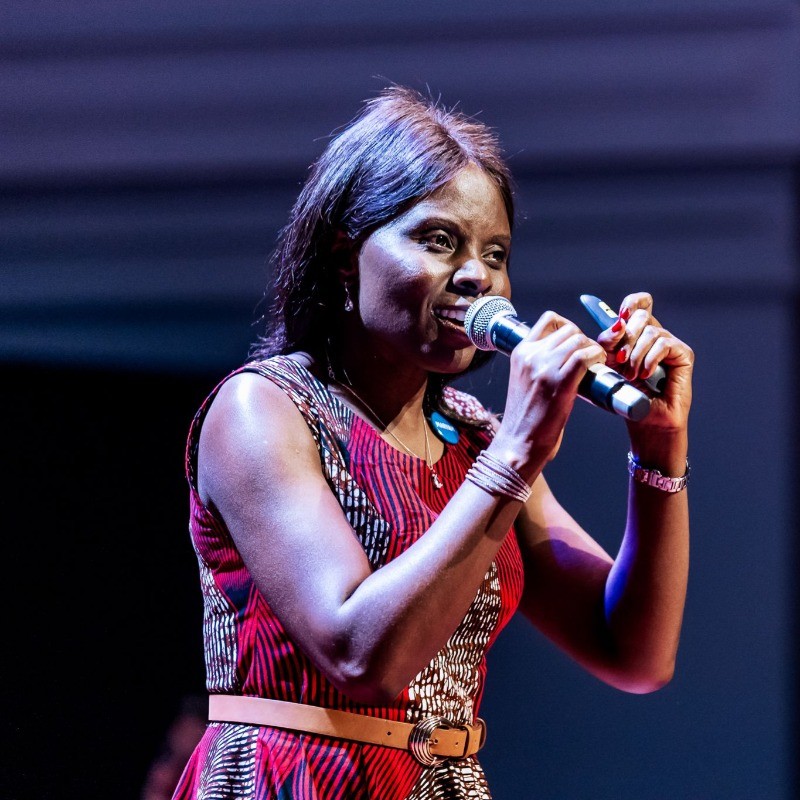
Maryam Imbumi
Maryam Imbumi is Founder & CEO of MaryaNutri.
Talks about
Insights & takeaways
Maryam Imbumi's public statements circle around a single, unwavering commitment: ending malnutrition through insect-enriched food, and refusing to let that ambition die on a shelf after the PhD is finished. "I decided I'm going to end malnutrition. I'm going to do it. I'm going to do something about it," she says , and that declarative, almost blunt phrasing recurs throughout her public voice — she is not interested in hedged academic language when describing her mission, even as her actual work draws on evidence-based nutrition science .
The technical core of her argument is about efficiency and comparison. She makes the case for insects as a protein source by contrasting timelines and yields directly against cattle: "You have an insect, a very small insect like this, and it's like 74% protein. You raise them in 8 weeks and you have the protein that you need. But how long do you have to raise a cow to have that much protein?" . This is her signature rhetorical move — reducing a complex nutritional and environmental argument to a simple, almost provocative side-by-side that anyone can grasp. She also points to regulatory shifts as validation of the field's trajectory, noting that the EU has approved mealworm and cricket for human consumption, including allowing 4% insect powder in food products, which she frames as opening the European market for insect-enriched food .
A second, equally strong theme in her thinking is a critique of academia's disconnect from impact. She is blunt about what she sees as a common failure mode among researchers: "We do very good research and all that, and then we put the books on the shelf and we go to your company to look for a job" . This is not a passing complaint but a structural diagnosis — she argues that PhD-level work often stalls precisely because there is no ecosystem pushing it toward implementation, and she credits environments like the Wintercircus Collective for countering that pattern by surrounding researchers with active startups rather than leaving them isolated .
That belief in surrounding oneself with an active, supportive environment extends into a more personal piece of advice she offers: "If you sit alone in your room, you're going to give up because you see a challenge and you think you're the only one. Go to the people. Go to this environment" . It is a statement about resilience as much as strategy — the implication being that solving a problem as large as malnutrition is not a solitary academic exercise but something that requires community, collaboration, and proximity to others doing similar work.
Her energy and self-description as a mover, not just a thinker, comes through in a more informal but telling line: "When I enter the winter circus like this, I want to dance. I want, you know, like do it, do it. Just do it." . Paired with her declaration about ending malnutrition, this captures a consistent personal register — impatience with inertia, a preference for action framed almost physically, and an insistence on forward motion over deliberation.
Over time, her public activity shows this philosophy translating into concrete institutional engagement. By mid-2026, she is reporting on real partnership discussions under the MaryaNutri banner, describing a meeting with the African Institute for Capacity Development (AICAD) as opening "valuable discussions on possible collaboration to address malnutrition through evidence-based and preventive nutrition approaches in Kenya, Uganda, and Tanzania" . This marks a shift in her public voice from the more conceptual, almost manifesto-like statements of 2025 toward specific, named institutional relationships — she names Prof. James Njiru, Ms. Gladys Mwaka, and Prof. John Kinyuru as collaborators and facilitators, signaling that her stated goal of moving research into real-world use is being pursued through concrete regional partnerships rather than staying at the level of aspiration .
The throughline across both moments is consistency of purpose paired with an evolving sense of how to execute it: the early framing is about the scientific and economic case for insect protein and a critique of academic isolation , while the later framing is about building the institutional pathways — across Kenya, Uganda, and Tanzania — that her own critique of academia demanded . Taken together, her statements suggest a person who sees the fight against malnutrition as requiring three things at once: efficient technology (insects over cattle), personal resolve stated in blunt first-person terms, and institutional collaboration that keeps research from being shelved .
The concrete takeaway from her public record is a call to action aimed at other researchers and institutions alike: do not let good research remain theoretical, seek out collaborative ecosystems rather than working in isolation, and treat regulatory openings like the EU's insect-food approvals as signals to move fast on real-world deployment . Her own words frame this as both a technical and a personal imperative, summarized most plainly in her own resolve: "I decided I'm going to end malnutrition" .
- Insects are a radically more efficient protein source than cattle: a small insect is ~74% protein and can be raised in 8 weeks, versus years for a cow.
- The EU has approved mealworm and cricket for human food, including allowing 4% insect powder in food products, opening the European market for insect-enriched food.
- University research often has no real-world impact because after a PhD 'we put the books on the shelf' and researchers go work for companies instead of building on their own technology — an ecosystem like Wintercircus counters this by surrounding researchers with active startups.
Career
Roles
MaryaNutriFounder & CEOMay 2025 – Present
Ghent University#2factoryDoctoral Researcher – Ghent UniversityFeb 2019 – Present
- University of Nairobi, College of Agriculture & Vet sciences, Depart:Plant Science & Crop ProtectionUndergraduate Teaching AssistantJul 2015 – Sep 2016
- African Women in Agricultural Research and Development (AWARD)Student and Data AnalystJan 2014 – May 2015
- World Agroforestry CentreStudent Research Fellow/NutritionistJan 2012 – Dec 2013
- Tropical Soil Biology and Fertility Institute of CIATStudent-Nutritionist2010 – 2012
Education
- University of the Free StateMaster of Science (MSc), Nutrition Sciences2012 - 2014
- North-West University / Noordwes-UniversiteitHonours BSc, Nutrition Sciences
- University of NairobiUndergraduate, Biology/Biological Sciences
From public career histories · 11 entries
Media & appearances
1- promoWintercircus · 01 Apr 2025
Kenyan PhD researcher Maryam Imbumi (Ghent University) explains how she's fighting malnutrition with insect-enriched food and how the Wintercircus Collective Wild Card helps her move from academic research to real-world impact.