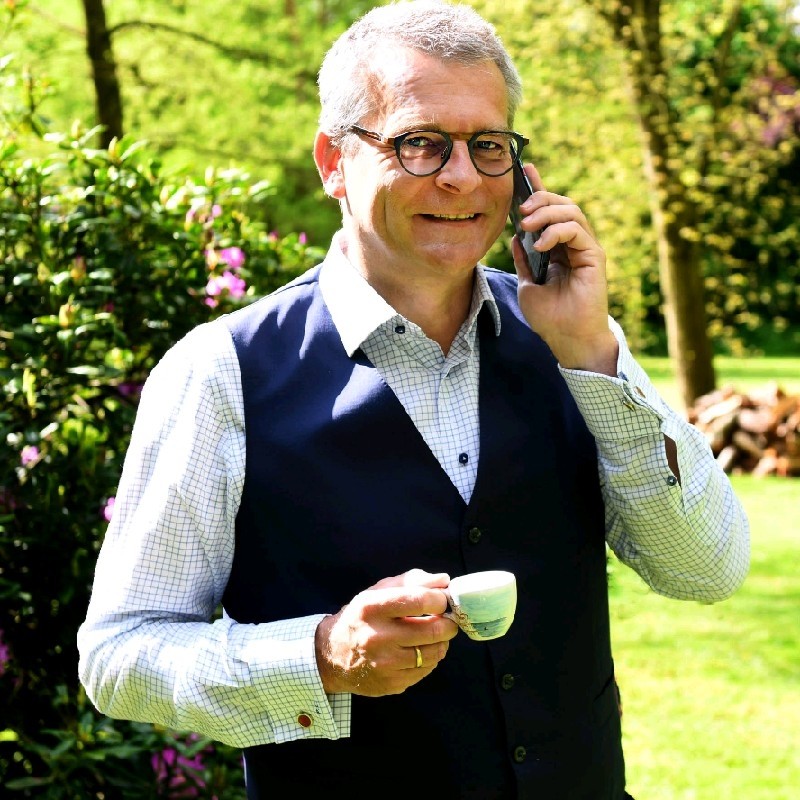
Pieter Casneuf
Casneuf studied chemistry and biotechnology at Ghent University and general management at Vlerick. From 2018 onward he took board and advisory roles at StoryChief and The Little Guest Hotels Collection, sat on the board of Netwerk Ondernemen from 2019 to 2023, chaired Foodpairing from 2021 to 2024 and Royal Hermes Hockey club Ronse from 2022 to 2024, and joined the boards of Bizzy, Revend, Crodeon Technologies and Winwinner in 2023. He joined the Syros management board in 2021 and is its CEO.
Pieter Casneuf is CEO of Syros, a Belgian producer of chilled and frozen avocado-based products for European supermarkets, restaurant chains and meal box companies. Syros sells under its own name to the professional market and under the Wonky brand to consumers, and also develops private label products. Its head office and production are in Wingene, with a second facility in Ostend. Westfalia Fruit announced its acquisition of Syros in January 2025, and Casneuf has sat on the Syros management board since 2021. Before Syros he was CEO of ADAM Software, a Ghent digital asset management company that Aprimo acquired on March 16, 2017. After the deal he became senior vice president and general manager of Aprimo Smart Content Solutions. At the end of 2005 he and Dirk Noppe set up the holding company PCDN, named after the founders' initials, in the context of ADAM Software. PCDN today holds stakes in Bizzy Fintech, Little Guest, P2P Invest and WinWinner Crowd. He is an advisor to StoryChief and has held board seats at StoryChief and The Little Guest Hotels Collection since 2018 and at Bizzy, Revend, Crodeon Technologies and Winwinner since 2023. He is Entrepreneur in Residence at the Vlerick Business School Entrepreneurship Academy, holds a Master of Science in Chemistry and Biotechnology from Ghent University and a Masters in General Management from Vlerick, and blogs under the pseudonym Nonkel Pier.
Insights & takeaways
The through-line
Across these posts, Pieter Casneuf keeps returning to one warning: entire professions built on bookkeeping-style work are about to be disrupted, and most people inside those organizations do not yet feel the urgency. He voices this most directly about the fiduciaire (accounting/trust) sector, asking "Zijn alle fiduciaires alert en wakker?" and predicting that "binnen 18 tot 24mnd" every fiduciaire still focused on bookkeeping could be swept aside . Over the course of these posts the diagnosis widens from a sector-specific alarm into a general theory of how AI transforms organizations, with the same underlying belief: technology-driven change is inevitable, denial is common, and the work of actually rebuilding is harder than people expect .
On fiduciaires and disruption
Casneuf's sharpest and most repeated warning targets the fiduciaire world. He questions whether the industry is paying attention, "Zijn alle fiduciaires alert en wakker?" , and pictures a "slagveld" driven by the "zelfde disruptors, zelfde omslag" that hit other sectors, while insiders reassure themselves "Ons overkomt dat niet" . He puts a timeline on it: "Ik ben bang dat we binnen 18 tot 24mnd elke fiduciaire kunnen opscheppen die nog bezig is met boekhouden" . He acknowledges the counterarguments he hears but dismisses them with "welkom in de wereld van vandaag en morgen" .
On AI transformation
When he turns to organizations generally, Casneuf frames AI adoption as an operational and structural problem, not a tooling one. Asked why big organizations don't see gains immediately, his answer is that "it is hard work and you have to rebuild the organisation" across "people, their skillset, their willingness to learn," "processes, the redesign of it and the flattening of information, structure and the access to it," and "the systems, DATA first, AI driven, HUMAN" . He contrasts scale effects directly: "The smaller your organisation, the more immediate your AI impact translates to Superlinear productivity. The bigger your organisation is, the slower but more transformational it will be" . He is blunt about the cost of that shift, calling it "Transformation is a bitch. But so hard needed" .
On listening and simplicity
Alongside the disruption talk, Casneuf holds a simpler, almost counterweight belief in practical, customer-driven improvement. His advice for learning from top performers is to "Let your customer talk and listen," adding that "Sometimes the simplist things are the best and easiest to set up" .
Takeaways
- Fiduciaires still centered on bookkeeping face disruption within 18-24 months, per his own estimate .
- AI gains in large organizations are slower because they require rebuilding people, processes, and systems together, not just deploying tools .
- Smaller organizations should expect faster, more "superlinear" productivity gains from AI than large ones, which instead face deeper transformation .
- Growing organizations need increased security, governance and QA as legacy systems become harder to reconcile with new AI-driven realities .
- The simplest practice for improvement is direct: let customers talk and actually listen .
Career
Roles
BizzyBoard MemberJan 2023 – Present
Crodeon TechnologiesBoard MemberJan 2023 – Present
- WinwinnerBoard MemberJan 2023 – Present
StoryChiefBoard MemberJan 2018 – Present
- The Little Guest Hotels CollectionBoard MemberMar 2018 – Present
RevendBoard MemberJan 2023 – Jul 2024
- Royal Hermes Hockey club Ronse/RenaixChairmanMay 2022 – Nov 2024
FoodpairingChairmanOct 2021 – Mar 2024
- Syros NVMember of the Management BoardApr 2021 – Jun 2025
- Netwerk Ondernemen#240factoryBoard MemberMay 2019 – May 2023
ONTOFORCEChief Executive OfficerDec 2019 – Apr 2021
- Find.meChairman Of The BoardJan 2018 – May 2022
- OxynadeChairman Of The BoardNov 2018 – Jan 2020
- AprimoSVP Global Alliances and Smart Content SolutionsMar 2017 – Apr 2021
- AprimoSVP Global Alliances and Smart Content SolutionsDec 2017 – Jan 2020
- AprimoGeneral Manager Smart Content SolutionsMar 2017 – Nov 2017
- ADAM SoftwareCEOJan 2010 – Mar 2017
- ADAM SoftwareUS Business DevelopmentJan 2007 – Mar 2017
- ADAM SoftwareExecutive PartnerOct 2004 – Mar 2017
- DOMOBusiness Unit managerJan 2002 – Jun 2004
- AdValvas GroupCEOSep 1998 – Sep 2001
- ADVALVAS BELGIUMCEO1995 – 2001
- OFUBManaging directorSep 1990 – Sep 1998
Education
Vlerick Business School#3schoolMBA, General management1989 - 1990
- Molecular Biology Laboratory - Univ GhentDrs, Genetic research applied to cancerologySep 1987 - Sep 1989
Ghent University#2schoolLic, Chemistry-BiotechnologySep 1984 - Jun 1987
- Broeders van Liefde
From public career histories · 27 entries