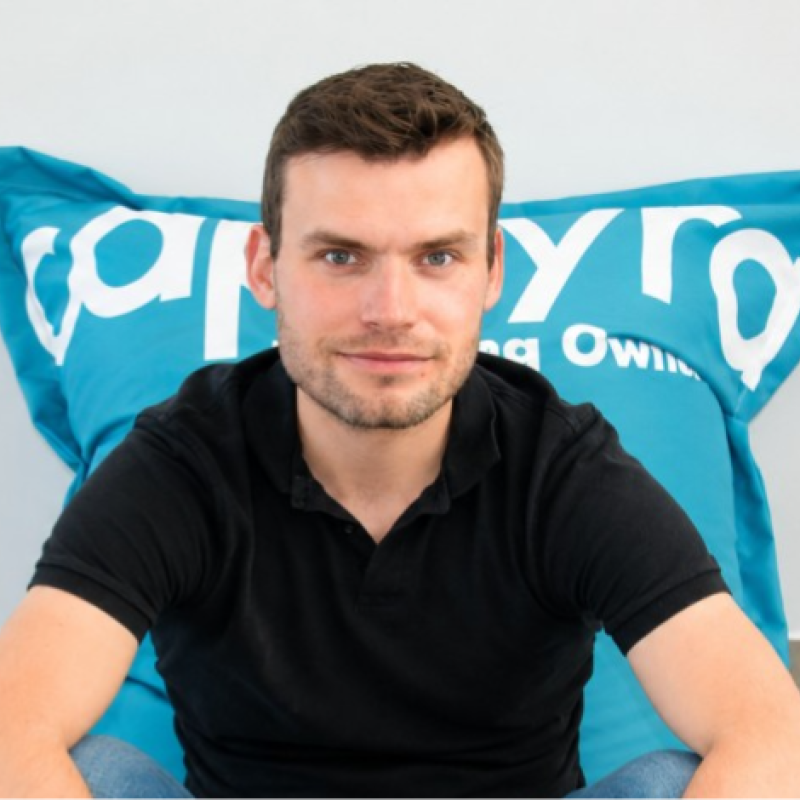
Ruben Tacq
Ruben Tacq is the CEO and CTO of capsyra, the company he founded in December 2024. He is based in Brugge, and since November 2021 he has also been the founder of IDEAhouse bv. From May 2019 to January 2025 he was the owner of Homatec.
Between May 2023 and September 2024 he led master data and integration at Trustteam, an employer he had previously worked for as a project manager and analyst from August 2014 to August 2016. In between he spent several years at e-BO Enterprises, joining as a project manager in August 2018 and moving on to business consultant and then senior business consultant until May 2023. Before that he was a technical solutions architect at Itineris, and earlier a functional analyst at Elster EnergyICT. He taught project management at Syntra West from January 2015 to June 2016.
Earlier roles included several research and teaching assistant positions at Groep T, an internship at beCHARGED and a junior manager role at RubyCom Ieper.
He studied electronics and ICT and then internet computing and entrepreneurship at KU Leuven - Group T Leuven Campus, and offshore wind energy at Ghent University in 2020 and 2021.
Insights & takeaways
The through-line
Across every post, Ruben Tacq keeps returning to one conviction: storage is not the same as preservation, and trust in critical data cannot depend on a single vendor, platform or company staying alive . That idea starts as a technical insight and hardens over the year into a business model, a regulatory argument, and eventually an AI strategy. Early posts frame Capsyra as an idea turned into a PoC and then a running business ; later ones tie that same conviction to concrete milestones (accelerators, partnerships, funding, an AI verification program) that show the thesis being tested against the market rather than just repeated . The constant is the question he keeps asking in different forms: when the company that created a record is gone, who guarantees it is still there, authentic and verifiable .
On data trust and preservation
Tacq treats "storage" and "preservation" as fundamentally different problems. "Storage is no longer enough. Critical data needs preservation, with authenticity, integrity and long-term verifiability built in from the start" . He frames this as a governance question as much as a technical one: "Where does the data live? Which version was valid at that moment? Which rules applied? Was the record changed? Can the proof still be verified independently?" . The stakes, in his framing, are that "the vendor, platform or company you trusted today may not be there tomorrow" , and that some files "are quiet for years. Until the day they become evidence" . He generalizes this into a category-defining claim, borrowed explicitly from Peter Thiel's Zero to One: "Cloud storage was built for operational data. Not for long-term legal, financial and historical certainty" , and "the world has enough places to store data. What it lacks are trusted mechanisms to make selected data survive" .
On the business model
Tacq is explicit that Capsyra's pricing model is a direct consequence of its thesis, not an arbitrary choice, and that it has met resistance. "Your model doesn't quite fit. Why move customers from OPEX to CAPEX?" is the question he says he's heard repeatedly, and his answer is that "for critical records, preservation isn't a monthly service. It's a long-term obligation" . He points to regulation as external validation of this stance, citing the Digital Product Passport requirement that "a copy stay available through an independent provider, so the passport survives even if the manufacturer becomes insolvent" and noting "independence isn't a nice-to-have there. It's written into the law" , alongside the Cyber Resilience Act's multi-year availability obligations .
On acceleration and ecosystem
Tacq describes growth less as funding milestones and more as access to the right people and pressure-testing. "Acceleration is not just advice, visibility or introductions. It is having the right people work alongside you" . He credits the A6K program with helping "pressure-test our positioning, sharpen our go-to-market and connect with the right ecosystem partners," describing this as arriving "at a turning point for us: the moment when we need to turn a strong conviction into a sharper market path" . He extends this to physical and civic ecosystems too, noting how "Charleroi is transforming its industrial heritage into a strategic hub for tech, cybersecurity, defence, aerospace and advanced industries" and framing digital sovereignty as being "not only about where data is processed or stored, but also about control, reliability and proof" . Partnerships get the same values-based treatment: "Great partnerships are not only built on complementary technology, but also on shared values, trust and the willingness to take the leap together" .
On building a startup
Tacq repeatedly narrates company-building through everyday, non-corporate scenes rather than announcements. "Startup growth doesn't always come with big announcements. Sometimes it looks like a freshly prepared desk, a new laptop, and someone new joining the mission" . He explicitly says the job is broader than the product: "Building a startup isn't only about building the technology. It's also about learning how to bring it to the right market, with the right message, at the right time" . And he uses a personal, physical metaphor to describe the pace of iteration: after skipping to a harder route on a zipline course and realizing "it was perhaps too big a leap," he "stepped back, continued at a slower pace and gradually worked my way up," concluding that "building a startup often feels exactly like that" .
From the stage
On the Celsius Dating Podcast, Tacq goes beyond the company narrative into personal territory not present in the written posts: he discusses balancing entrepreneurship with raising two children, and shares his views on marriage as less important than it was previously 13. He also uses the interview to restate Capsyra's core pitch in plainer terms, describing it as digital archiving that gives companies fixed upfront costs, GDPR compliance, and data security that persists even if the company itself fails 13.
Takeaways
- Capsyra's core bet is that storage and preservation are different problems, and that authenticity and independent verifiability must be built in from the start, not layered on later .
- Its CAPEX-based pricing is a deliberate response to the idea that preservation is a long-term obligation, not a monthly service, and Tacq points to the Digital Product Passport and Cyber Resilience Act as regulatory backing for that stance .
- He values accelerator and ecosystem involvement (A6K, Start it Accelerate) specifically for sharpening market positioning and go-to-market, not just for funding or visibility .
- He frames AI adoption (Claude's Cyber Verification Program) not as a tradeoff against control but as a way to keep records "verifiable, portable and independent from any single platform" .
- Outside the company narrative, he's candid in interview format about balancing fatherhood with founding a startup and about his evolving views on marriage 13.
Career
Roles
CapsyraFounder and CEODec 2024 – Present
- IDEAhouse bvFounderNov 2021 – Present
- TrustteamMaster Data and Integration LeadMay 2023 – Sep 2024
e-BO EnterprisesSenior Business ConsultantJan 2022 – May 2023
- HomatecOwnerMay 2019 – Jan 2025
Itineris#192factoryTechnical Solutions ArchitectAug 2016 – Aug 2018
- Syntra West#119factoryTeaching Project ManagementJan 2015 – Jun 2016
- TrustteamProject Manager / AnalystAug 2014 – Aug 2016
Elster EnergyICT#533factoryFunctional AnalystJul 2013 – Aug 2014
- Groep T#193factoryAssistant Unit InformationFeb 2013 – Jul 2013
- beCHARGEDInternship at beCHARGEDAug 2012 – Aug 2012
- Groep T#193factoryStudent Worker - ResearchSep 2012 – Jan 2013
- Groep T#193factoryTeaching Assistant Computer Systems and databasesSep 2012 – Dec 2012
- Groep T#193factoryStudent Worker - ResearchJul 2012 – Jul 2012
- Groep T#193factoryTeaching assistant OOPJan 2012 – Jun 2012
- Standaard BoekhandelStudent worker: Employee / DriverAug 2010 – Aug 2010
- Bellewaerde ParkEmployee for the AttractionsAug 2009 – Aug 2009
- RubyCom IeperJunior ManagerJul 2007 – Jul 2013
Education
Ghent University#2schoolOffshore Wind EnergyOct 2020 - Jun 2021
KU Leuven - Group T Leuven Campus#51schoolMaster & Post Graduate, Internet Computing and Entrepreneurship2011 - 2013
- Technisch Instituut ImmaculataSecundary, Technical Science2003 - 2007
From public career histories · 24 entries
Media & appearances
1- 13podcastCelsius Dating · 8 months ago · 22:45 · 34 views
Ruben Tacq discusses his company Capsyra, which provides digital archiving solutions for businesses. He explains that Capsyra addresses problems with cloud-based SaaS environments by offering a way for companies to properly archive their data with fixed upfront costs, GDPR compliance, and data security that persists even if the company fails. He also briefly discusses balancing entrepreneurship with raising two children and his views on marriage as less important than it was previously.