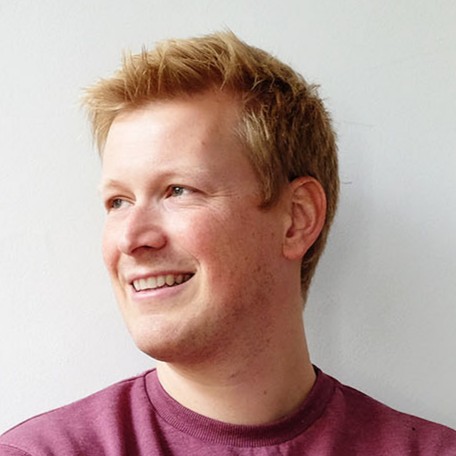
Sander Wuyts
Sander Wuyts is CEO and co-founder of ImmuneWatch, a company he co-founded in September 2021, and is based in Antwerp. Since February 2021 he has also been a co-founder of Kultured.
From September 2019 to August 2021 he was a postdoctoral fellow at EMBL, having spent the first half of 2019 as a postdoctoral researcher at the University of Antwerp. Between July 2014 and February 2019 he carried out doctoral research at the University of Antwerp and, from January 2015, at the Vrije Universiteit Brussel. In mid-2016 he undertook a research stay at the Università degli Studi di Trento.
Wuyts studied bio-science engineering with a specialisation in cell and gene technology, taking a bachelor's degree at the University of Antwerp from 2009 to 2012 and a master's degree at KU Leuven from 2012 to 2014. He completed his secondary education in Latin-Science at Sint Ritacollege.
Insights & takeaways
The through-line
Across these posts, Sander Wuyts describes a deliberate shift from bench scientist to business builder. He says plainly that when he started ImmuneWatch he "was still very much a researcher. Head down in the analysis," but that "is not really my day anymore" . What has replaced it is a preoccupation with turning TCR sequencing from a research curiosity into something clinically and commercially usable: he keeps returning to the idea that raw repertoire data is only valuable once it is translated into "actionable immune signals" and "a real answer about what your T cells are responding to" . The throughline is translation, of technology into product, of academic depth into commercial capability, and of dense TCR data into a clinical story clinicians and biopharma partners can act on.
On moving from researcher to operator
Wuyts is explicit about how his own role changed. He now spends "most of my time on two things: the team, and the ImmuneWatch brand and business development" , describing a single day that mixes a podcast recording, a customer discovery call, and other business tasks rather than lab work . He frames this as a positive evolution, noting his "calendar looks less like a lab notebook and more like a mix of everything at once (which is a good thing 😊)" . He also reflects on how far this has taken him from his academic starting point, calling an invited talk at Cambridge "another thing that I did not really expect to happen 5 years ago when I transitioned from academia to startup life" .
On building commercial strength around deep science
Wuyts is candid that spinning out of a university lab gives "a lot of deep scientific knowledge" but only "a thin layer of commercial experience," and describes actively working to fix that imbalance . His solution was structural: opening the board to outsiders, bringing in people with "over a decade in commercial roles in immune repertoire profiling" and a co-founder who "built" one of "Belgium's most successful spin-outs" at the same university . This same instinct for combining scientific depth with market development runs through the QIAGEN partnership, where ImmuneWatch handles "clonotype clustering, antigen annotations and the full repertoire analysis" while QIAGEN covers the wet-lab side , and through his framing of ImmuneWatch's tools (ClusTCR, DETECT) as products born directly out of repetitive service work: "doing the same thing over and over again is boring, we decided to automate some of these steps" .
On what TCR sequencing can reveal
A recurring conviction is that TCR sequencing unlocks information that would otherwise stay hidden. He writes that "there's so much stuff hiding in your PBMCs" and that sequencing can answer "what's my T-cell diversity, are they expanding, what are they reacting to" . He backs this with concrete results: running DETECT on 150+ repertoires from a type 1 diabetes study, insulin "emerged as the dominant antigen with 30,000+ TCRs scoring against it," alongside signal from "classic T1D autoantigens ZnT8 and GAD65" . In an oncology collaboration with TREOS BIO, he highlights that TCR annotation showed "vaccine-specific T cells had trafficked into the tumour," and that the immune response had spread to "targets not in the vaccine at all: KRAS mutations, RNF43, NY-ESO-1, MART1" . He also aligns his mission with the broader field, agreeing "completely" with a Nature Reviews Immunology paper's claim that paired TCR sequencing is "generating antigen-specific TCR datasets that can serve as durable reference libraries" , adding that this is "exactly the kind of tech we are building to power the next generation of therapies" .
On lowering the barrier to entry for labs
Wuyts frames access to TCR sequencing as a barrier problem, not just a science problem. He describes the workflow from "sample to a real answer" as "a daunting task stitching together several wet-lab technologies" , and positions the QIAGEN grant, funding "the full TCR sequencing and analysis workflow, free, for up to 4 projects" split between academic and biopharma applicants , as a direct response to that. He is visibly enthusiastic about the reach of this effort, joking he made "a little flag" to mark the announcement and noting with surprise that QIAGEN "put us on their homepage" , something he says "was not on my 'expectations list'" when he started the company .
From the stage
In a podcast interview, Wuyts discusses a topic entirely absent from his written posts: Nick Goldman's proof of concept at the European Bioinformatics Institute showing that computer files, encoded in binary, could be translated into DNA sequences using a four-base (A, C, G, T) encoding system and physically printed onto DNA molecules, illustrating how data can be hidden inside DNA itself 16.
Takeaways
- ImmuneWatch's founders deliberately added outside commercial expertise to the board, including someone with over a decade of commercial experience in immune repertoire profiling and a co-founder of a successful Belgian spin-out, to offset the lab's deep-science-but-thin-commercial-experience starting point .
- The QIAGEN partnership offers a concrete, no-cost path for labs to test TCR sequencing: full RNA extraction, library prep, sequencing, and ImmuneWatch's clonotype clustering and antigen annotation, for 2 academic and 2 biopharma projects per round .
- ImmuneWatch's DETECT tool has produced clinically interesting findings in real studies: insulin as the dominant antigen in a T1D cohort with over 30,000 scoring TCRs , and evidence of vaccine-driven, tumor-trafficking T cells whose targets spread beyond the vaccine antigens in a colorectal cancer trial .
- Wuyts sees ClusTCR and DETECT-based products, like the new ImmuneWatch Analyser, as emerging directly from repetitive patterns in service work rather than being planned top-down .
- His personal role has moved almost entirely away from hands-on analysis toward team-building and business development, a shift he describes as intentional and positive .
Career
Roles
ImmuneWatchCEO and Co-founderSep 2021 – Present
- KulturedCo-FounderFeb 2021 – Present
- EMBLPostdoctoral FellowSep 2019 – Aug 2021
University of Antwerp#27factoryPostdoctoral ResearcherFeb 2019 – Aug 2019
- Università degli Studi di Trento - University of TrentoResearch stayJun 2016 – Jul 2016
Vrije Universiteit Brussel#13factoryPhD Researcher (IWT bursaal)Jan 2015 – Feb 2019
Education
KU Leuven#1schoolMaster of Science (M.Sc.), Bio-Science Engineering: Cell and Gene Technology2012 - 2014
- Sint Ritacollege#358schoolLatin-Science2003 - 2009
From public career histories · 10 entries
Media & appearances
1- 16interviewJulius Moorman · 2 months ago · 11:34 · 75 views
Sander Wuyts discusses how Nick Goldman from the European Bioinformatics Institute created a proof of concept demonstrating that computer files encoded in binary (zeros and ones) could be translated into DNA sequences using a four-base encoding system (A, C, G, T) and physically printed onto DNA molecules.