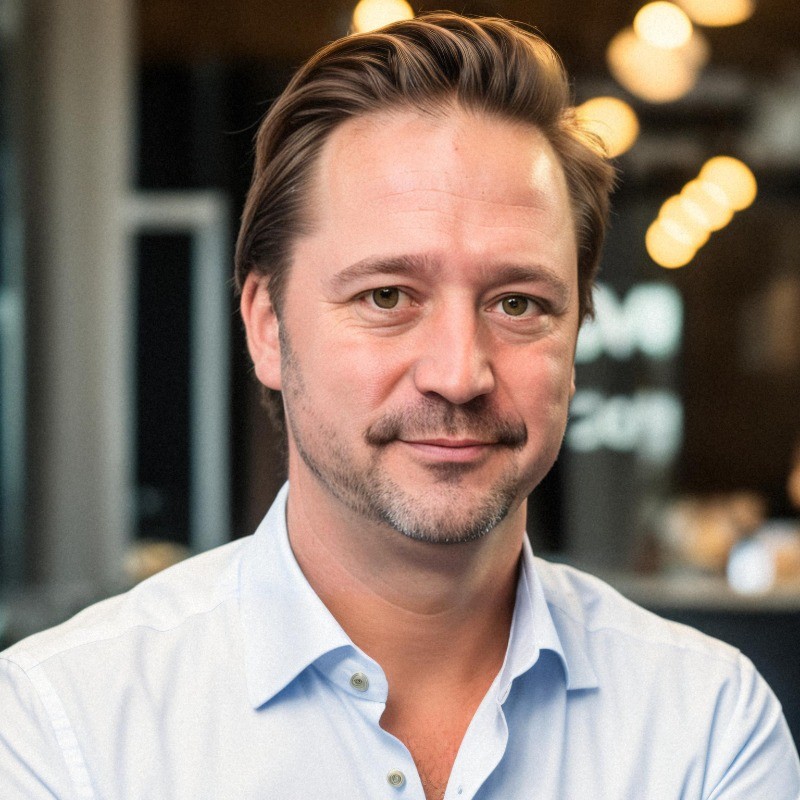
Vincent Defour
Vincent Defour is co-founder and chief executive of Trendtracker, a role he has held since October 2019. He is based in Ghent, and states expertise in market intelligence, SaaS and analytics.
He founded VIDE Consulting in July 2017 and remains with it. Before that he spent a decade at Möbius Business Redesign, from January 2007 to July 2017, as a strategy and transformation consultant and head of innovation.
Defour studied industrial engineering at HOWEST Hogeschool West-Vlaanderen from 1999 to 2001. He later completed a master class as an expert in ICT management at Vlerick Business School in 2009, followed in 2010 by a master class in enterprise content management at the University of Antwerp.
Insights & takeaways
The through-line
Across Vincent Defour's posts, one preoccupation keeps resurfacing: change no longer arrives as a single force that a company can absorb into its existing structure, but as several forces compounding at once, and that compounding is what actually breaks old operating models . Early material frames this in general terms, but as the year progresses it sharpens into a specific claim about where the decision moment itself is moving, from a person in an aisle or a patient in a clinic to an AI agent or platform sitting between them and the choice . The other constant is a bet on foresight as infrastructure rather than a one-off report: Defour repeatedly pitches "real-time strategic intelligence" and shared evidence bases against "static reports and slow strategic cycles" .
On compounding shifts
Defour's core diagnostic move is to insist that forces reshaping an industry "no longer arrive one at a time" and that "each is manageable alone" while "together, they rewrite the operating model" . He argues the hard part was never spotting individual shifts, since "most leaders already can," but reading "how they combine, and decid[ing] where to act first" . This is the explicit premise behind the Food and Beverage work: "Nine forces, scored, and where to act first" , and the same framing recurs for FMCG and retail, where he describes "nine shifts compounding at once" .
On AI moving the decision moment
A second theme is that AI is not just speeding up existing processes but relocating the point where decisions get made. In commerce, he notes "an agent does the comparing and filtering first, sometimes the buying too, before a person is even in the loop," which means "the moment of influence" no longer "belong[s] to the shopper" but to "whatever system the shopper delegates to" . In pharma and biotech, he makes the parallel claim that "the commercial decision moment... is quietly moving to platforms, retail health and AI agents" , and describes AI becoming "the operating infrastructure that runs R&D, manufacturing and commercial at the same time" rather than merely accelerating discovery .
On institutional memory
Defour treats forgetting as a competitive weakness. Using the discontinued Berkshire Hathaway parametric travel product as his example, he argues that when "the pilot ends," "the insight disappears with the budget line" and "the next wave of strategists inherits the same blank page" . His conclusion: "institutional memory is a competitive advantage most companies don't know they're losing" .
On building foresight capability
Beyond diagnosis, Defour frames his own work as building durable capability rather than delivering one-off deliverables. Describing the Business Upper Austria partnership, he says the goal was helping "an entire industrial region move away from scattered, time-consuming research toward a shared evidence base" so teams "can align earlier and act with more confidence" . He states the wider mission as wanting to "redefine how strategy is done with AI" and move "beyond static reports and slow strategic cycles toward real-time strategic intelligence, dynamic decision-making, and actionable foresight" . This same logic drives his hiring posts, which look for people who can turn "scattered information into clear, structured output" as junior members grow "into more senior analyst or advisory roles" , and who seek a "Senior Expert, Strategy and Foresight" .
From the stage
In the Trendtracker interview with Leander Mombalio of Lassus, Defour explores AI's role in football strategy specifically, a domain his written posts do not touch. The discussion covers Lassus acting as "a bridge between sports and technology sectors," and applies his usual AI-and-decision-moment lens to a new setting, examining how AI delivers faster, deeper insight for sports organizations and shapes both on-field performance strategy and business decisions such as fan engagement and sponsorships 11.
Takeaways
- Map compounding forces rather than single trends when advising a client, since "several converging at once" break operating models that survive isolated shifts .
- Watch where the decision moment migrates in your category: agents and platforms are increasingly doing the comparing, filtering, and sometimes buying before a person is involved .
- Treat AI in R&D-heavy industries as infrastructure running R&D, manufacturing, and commercial simultaneously, not just a discovery accelerator .
- Build a mechanism to retain what pilots and experiments teach even after the pilot ends, or the organization relearns the same lessons repeatedly .
- When building foresight capability, prioritize a shared evidence base that lets teams "align earlier and act with more confidence" over ad hoc, scattered research .
- Hire for the ability to convert scattered information into structured, client-ready output, with a clear path from junior analyst into advisory roles .
Career
Roles
TrendtrackerCEOOct 2019 – Present
- VIDE ConsultingFounderJul 2017 – Present
- Möbius Business Redesign#518factoryStrategy & transformation consultant - head of innovationJan 2007 – Jul 2017
Education
University of Antwerp#5schoolMaster, Master Class Enterprise Content Management2010 - 2010
Vlerick Business School#3schoolMaster, Master Class Expert in ICT Management2009 - 2009
HOWEST Hogeschool West-Vlaanderen#12schoolIndustrial Engineer1999 - 2001
From public career histories · 6 entries
Media & appearances
1- 11interviewTrendtracker · 1 year ago · 39:03 · 166 views
Vincent Defour introduces his guest Leander Mombalio from Lassus consulting agency and discusses how AI-powered strategic intelligence is reshaping football strategy across European leagues and clubs. The conversation covers Lassus's role as a bridge between sports and technology sectors, their integration of AI to deliver faster and deeper insights for sports organizations, and applications of AI in both performance strategy and business decisions like fan engagement and sponsorships.