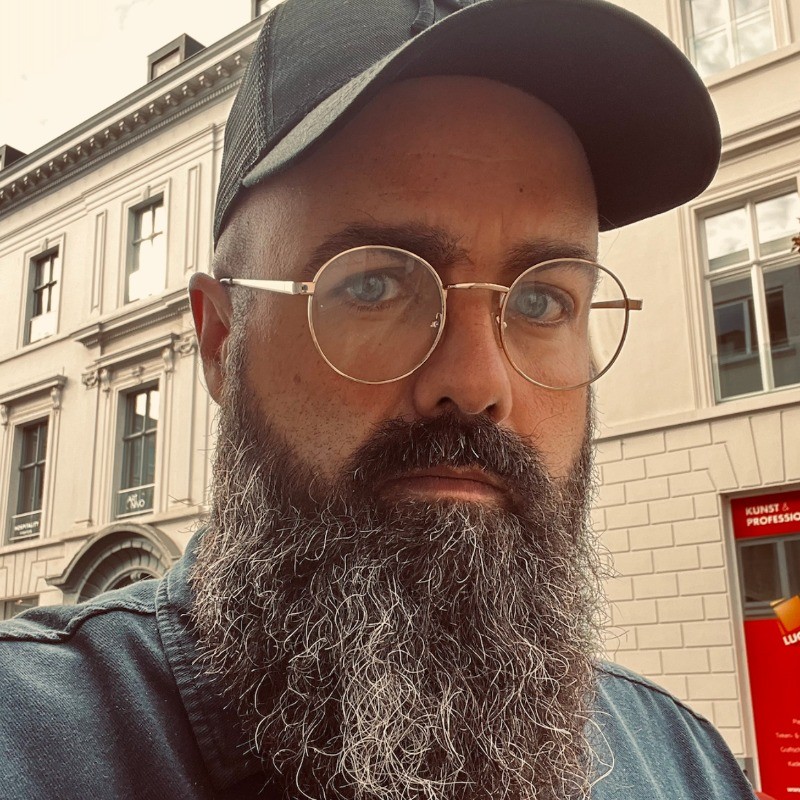
Wim Reygaert
Wim Reygaert is Co-Founder of Oisoi Studio.
Insights & takeaways
Wim Reygaert's public voice centers almost entirely on one project at a time, and lately that project has been Painting PC, the studio's first move beyond VR-only releases. He frames this as more than a product launch: "This is an important milestone for our young studio" . That framing recurs throughout his posts, where individual releases are consistently tied back to the identity and growth of Oisoi Studio, whose tagline he repeats like a mantra: "Never a dull moment at Oisoi Studio" . The effect is of someone who treats each product beat, wishlist milestone, or user reaction as a data point in an ongoing, semi-public narrative about his company's trajectory.
Numbers matter a great deal to him, and he tracks them almost obsessively in real time. Wishlist counts climb across his posts in a way that reads like a running commentary: 15,000 at eight days out , 20,000 with "that escalated quickly" , "Thirty thousand people have wishlisted Painting PC - at two days before launch" , and finally "more than 37.000 wishlists" at release alongside a spot in Steam's "Popular Upcoming" list "together with big titles like Assassin's Creed and Echoes of Aincrad" . He is candid about the emotional toll of watching these metrics, describing launch night as "Almost midnight" after "staring at stats for hours" . This willingness to narrate the anxious, granular reality of a launch, rather than just the triumphant headline, is one of his more distinctive traits.
Despite the metrics focus, Reygaert repeatedly signals that what actually validates the work for him is unscripted user response, not sales figures. He highlights a player review about rediscovering a love for art after depression at length, then defensively insists on its authenticity: "And no, you cynics, we didn't pay this person" . He does the same with an anonymous player's pigeon-in-a-security-vest painting, calling it something that "made the whole project make sense in a way we couldn't have planned for," while stressing "I have no idea who they are or what their background is" . Read together, these posts show a person who wants outside proof that the tool is doing what it's supposed to do, giving people a low-stakes, playful way back into creativity, and who treats that proof as more meaningful than any chart position.
He also uses lighter, almost throwaway posts to humanize the studio and keep a conversational thread going with his audience. A brief multiplayer exchange about "two left hands and two spraycans" and a one-line reaction, "Well, that escalated quickly" , or simply "That's just... crazy." , show a comfort with brevity and informality that contrasts with the more considered milestone posts. This mix of tones, breezy asides next to reflective launch-night writing, suggests someone who sees LinkedIn as a running logbook of the studio's daily texture, not just a channel for polished announcements.
Community and team credit show up as a clear value as well. When four interns leave, he doesn't just thank them generically; he calls them "some of the smartest, nicest and most talented people I've met in the last year" and frames the internship in terms of mutual benefit, hoping they left "a bit more knowledgeable about and resilient to the professional world out there" . This pairs with his direct outreach for playtesters ahead of launch, offering "a free key of the game, in exchange for your opinion on its current state" , indicating a practice of treating both staff and early users as active participants in shaping the product rather than passive recipients of it.
Earlier, in the CNBC interview about Vision Pro, Reygaert's thinking centered on access and market growth rather than on his own product's features in isolation. His stated ambition was to "get many people using the headset to showcase the benefits of XR technology," aiming his app at a broad audience rather than a niche one 10. He was matter-of-fact about the economics, noting Apple "takes a standard 30% fee like other app stores" 10, and he framed his studio's growth (to eight people within a year of launching "a small but popular app") as part of a wider industry story 10. Notably, he expressed optimism about competitors, saying he welcomed "larger players like Microsoft and Samsung entering the XR space to help grow the market" 10, a view that treats competition as additive rather than threatening, since a bigger XR market benefits everyone building for it.
Taken together, the throughline from the Vision Pro interview to the Painting PC launch posts is a belief that broad accessibility, whether to a new hardware platform or to the act of painting itself, is the real goal, with commercial metrics serving as evidence of reach rather than ends in themselves. His comments on Vision Pro were about lowering the barrier to XR adoption 10; his comments on Painting PC are about lowering the barrier to creative expression, exemplified by the depression-recovery review he chose to spotlight . The concrete takeaway for anyone reading his public record is that Reygaert treats wishlist counts and app-store rankings as useful signals of momentum, worth tracking and sharing in granular detail , but treats individual user stories and playful creative outputs as the actual proof that the work matters .
Media & appearances
1- 10interviewCNBC Television · 3 years ago · 3:20 · 3,751 views
Wim Reygaert discusses his app that virtualizes painting for Apple Vision Pro, targeting a broad audience, and emphasizes wanting to get many people using the headset to showcase the benefits of XR technology. He explains that Apple takes a standard 30% fee like other app stores, notes his studio has grown to eight people since launching a year ago with a small but popular app, and expresses optimism about larger players like Microsoft and Samsung entering the XR space to help grow the market.