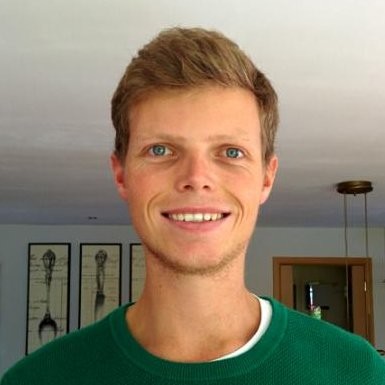
Yoran Brondsema
Yoran built Curvo as a response to the complexity and cost of traditional investing, targeting a generation that wants simple, automated, index-based portfolios. He is also known for his writing on personal finance and investing in Belgian context.
As CTO of Curvo, Yoran leads product and engineering for the platform. He combines technical depth with a strong public voice on passive investing and financial independence, earning him an audience beyond the startup ecosystem.
Yoran co-authored "De hangmatbelegger," a Dutch-language guide to passive investing that sold 15,000+ copies and won "Woord van het Jaar 2024." A French edition, "Gagner en bourse sans se fatiguer," followed in 2024. He combines product and engineering work at Curvo with a public voice on ETFs and financial independence for younger generations.
Insights & takeaways
Yoran Brondsema's central conviction, repeated across nearly every post, is that ordinary people can build serious wealth without following markets, picking stocks, or paying high fees, as long as they invest broadly, automatically, and for the long term. He calls this philosophy "hangmatbeleggen" (hammock investing), a term he and his co-author Tim popularized enough that Van Dale named it Woord van het jaar 2024 in Vlaanderen . The idea is simple on its face but, in his telling, psychologically hard to execute: buy a globally diversified basket of index funds or ETFs, contribute on a fixed schedule, and then largely leave it alone. He treats volatility not as a flaw in the system but as the price of admission, writing that "volatiliteit is geen boete... Het is de prijs die je betaalt voor een rendement op de lange termijn," comparing it to a theme park entry fee where "de rollercoaster hoort erbij" .
A recurring move in his writing is the historical worst-case scenario used to defuse fear. He points to someone who invested €10.000 right before the dotcom crash in 2000, watched a diversified portfolio fall 9%, then 11%, then 31%, and still ended up with €44.000 by staying invested . He uses Japan's 1989 peak, after which the index took over thirty years to recover, to argue for two specific defenses: investing globally rather than in a single country, and investing periodically rather than all at once, so that downturns become buying opportunities rather than permanent losses . These aren't abstract lessons for him; they're the mechanism by which he tries to convert market fear into concrete behavior.
He is equally attentive to the mechanics of how people actually behave with money, not just the math of returns. In comparing two hypothetical savers, Robert and Ilse, he shows that Ilse, who raised her monthly contribution with every raise, ends up with far more capital than Robert despite each of her euros performing worse individually, because "euro voor euro deed Robert het beter. Maar Ilse eindigt met veel meer vermogen, en dat is wat telt" . This ties into his observation that raises often vanish into lifestyle inflation, "een duurdere auto of een groter huis" , and into his practical stance on emergency funds: never invest money you might need soon, because a market drop combined with a sudden expense forces you to sell at the worst possible moment, and he backs this with his own story of an accidental €1.500 van-rental repair bill .
Brondsema is also a debunker by instinct, applying quantitative skepticism to both the finance industry and its critics. He dismantles a finfluencer's promise of turning €300 into a million in four years by showing it would require a 660% annual return, "dertig keer beter... dan Buffett" every year, and offers his own two-part test: if a return sounds too good to be true, it is, and per Charlie Munger, "Show me the incentive and I'll show you the outcome" . He applies the same rigor to critics of index investing itself, addressing the claim that passive money artificially inflates giants like Apple by pointing out that daily trading volume scales with company size and that institutional traders, not "hangmatbeleggers," set prices . He extends this comparative approach to concrete products, showing that identical contributions into a tak-21 verzekering, a classic pensioenspaarfonds, and a tak-23 wereldwijde indextracker fund produce wildly different outcomes, €71.000 versus €132.000 versus €580.000, using real numbers to answer the recurring question of whether pensioensparen still makes sense .
His view of the Belgian financial and pension landscape is pointed and self-referential. He highlights the gap between statutory pensions by employment status, noting that a civil servant's net pension is more than double a self-employed person's, and that the self-employed figure sits below the poverty line, adding personally, "Ik ben er zelf een, dus dat cijfer kwam even binnen" . His conclusion from this is not despair but agency: since the state pension is indexed but essentially fixed and uncontrollable, the only lever available is what you build yourself, which is why he says he has "al jaren elke maand automatisch belegd" . He reads the broader shift away from Belgian savings accounts, still holding a record 313 miljard euro but growing more slowly than before, as evidence that more Belgians are moving toward ETFs and the long term, a shift he frames as healthy as long as emergency funds still stay in cash .
His engagement with technology mirrors his investing philosophy: lower the barrier to entry so more people can act without needing deep expertise. He draws a direct line from FrontPage and WordPress through Squarespace, Wix, and Shopify to tools like Claude Code, arguing that each wave let non-technical people build more themselves, freeing programmers to focus on harder problems, and citing his co-founder Thomas building and running his own book-sales site with AI as proof . This same instinct toward accessibility and inclusion shows up in his support for Thomas Ketchell's English-language "ETF Investing in Belgium," aimed at expats who are otherwise underserved despite Brussels being "de tweede meest kosmopolitische stad ter wereld" , and in his warm but discerning review of Jonas Vermeulen's "Het nieuwe sparen," where he notes shared ground in ETF-based hangmatbeleggen while distinguishing his own work from Vermeulen's stronger emphasis on financial independence through the FIRE Community .
Taken together, his output reads as a sustained argument that investing success is less about skill and more about behavior, structure, and time horizon: automate contributions, diversify globally, keep emergency cash separate, ignore both hype and doom, and let the strategy compound quietly rather than reactively. His own trajectory, from writing "De hangmatbelegger" to preparing "Hangmatbelegger voor het leven" for release on 25 augustus with a launch event in Gent on 10 september , follows the same pattern as the advice he gives, repeated and expanded on rather than reinvented.
Education
MSc, Embedded Systems, Eindhoven University of Technology (2009 - 2011)
BSc, Computer Science, KU Leuven (2006 - 2009)
Career
CurvoCo-FounderSep 2019 – Present
- SutoriCo-founder & CTOMay 2013 – Present
- Yoran BrondsemaFrontend Web DeveloperApr 2013 – Jun 2013
- CaptovateWeb DeveloperAug 2012 – Sep 2012
- LuminaryFrontend Web DeveloperNov 2012 – Feb 2013
- Reload Group Everything WebWeb DeveloperNov 2012 – Feb 2013
- Prodrive B.V.Master thesisJan 2011 – Sep 2011
- Prodrive B.V.Embedded Software EngineerApr 2010 – Oct 2010
From public career histories · 11 entries
Media & appearances
3- 16interviewMichiel van Vugt en Je Geld en of Je Leven · 2y ago · 30:32 · 1,084 views
Yoran Brondsema discusses his book "The Hammock Investor" (De Hangmatbelegger), which promotes passive investing for people with limited time, arguing that successful investing does not require constantly following financial news or actively picking stocks. He explains how the book came about when a publisher approached him after discovering his startup Curvo, which makes investing accessible to young people, and how he decided to co-author the book with Tim rather than having two similar books released simultaneously in the small Dutch-speaking market.
- 17talkCurvo · 4y ago · 1:02:36 · 837 views
- 18interviewSebastien Aguilar - The FIRE Belgium Show · 5y ago · 1:59:58 · 1,513 views
Yoran Brondsema discusses how he co-founded Sutori, an online education platform, and is now building Curvo, an index investing platform designed to make index investing accessible to people in Belgium and beyond. He explains how to use backtesting to analyze portfolio performance using historical data and demonstrates what returns and volatility investors can expect from different portfolios. He also shares his personal journey from studying computer science and embedded systems to becoming an entrepreneur who works roughly one day per week while pursuing passive investing strategies.