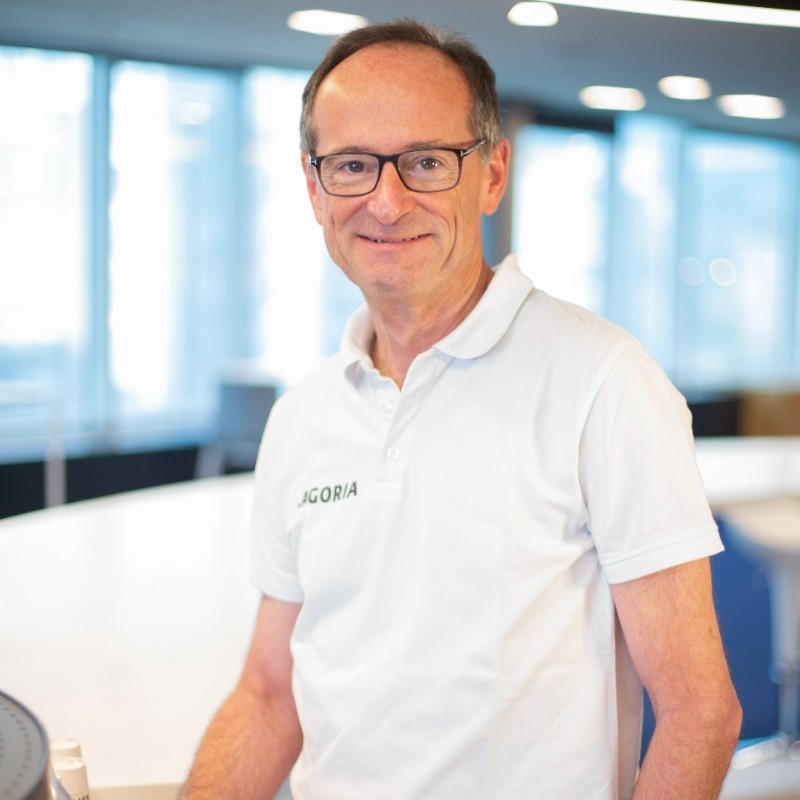
Bart Steukers
The main segment features Bart Steukers, CEO of tech federation Agoria, discussing Belgium's defense industry. He maps the sector as three concentric circles: ~80 classic defense firms (FN Herstal, Sonaca, Sabca) with €2B revenue and 5,000 jobs, expanding to ~500 companies and 13,000-16,000 jobs when including cyber, AI, drones and technical textiles, with potential to double by 2033. Steukers highlights the Ostend maritime ecosystem around Exail Robotics' autonomous mine-hunting underwater drones, the Ukraine war's compression of innovation cycles to 8 weeks, and the historic financing problem where banks refused loans to companies with even 10-15% defense activity. He pleads for European coordination of defense value chains, better AI literacy across the population, and reskilling as automation reshapes manufacturing jobs.
Insights & takeaways
Bart Steukers's public thinking centers on a single conviction: speed of innovation now determines both military and economic survival, and Belgium risks being too slow to notice. His clearest illustration is Ukraine, where he repeatedly points out that "de gemiddelde tijd die er nu tussen gaat voor dingen die in Oekraïne gebruikt worden is 8 weken" 23, down from three to five years a decade ago. For Steukers this isn't a niche military statistic but a structural shock to how economies organize themselves, because it exposes how cheaply disruption can now be bought: "je kan eigenlijk met een drone die niet zo geweldig veel geld hoeft te kosten, kan je vliegtuigen uitschakelen die miljoenen kosten. Dus ook heel het economisch model achter defensie is aan het veranderen" 23. He treats this as a live case study in what happens when innovation cycles compress, and argues Belgium and Europe more broadly have to internalize that lesson well beyond the battlefield.
On Belgium's defense-tech ecosystem specifically, he is bullish but precise. He maps it as three concentric circles, from roughly 80 classic defense firms up through 500 companies touching cyber, AI and drones, to some 16,000 jobs once knowledge institutions are included, and he is willing to put a number on the upside: "wij schatten dat die sector eigenlijk zou kunnen verdubbelen tegen roughly 2033" 23. That optimism is conditional, though. He flags that until only two or three months before his remarks, Belgian companies with even modest defense activity were being refused bank financing on ESG grounds, pushed toward less desirable funding sources, a policy failure only now being corrected 23. He also situates the current openness around defense collaboration against the shadow of the Agusta bribery scandal of the late 1980s, arguing that decades of enforced separation between Belgian defense and industry were less healthy than today's transparent cooperation 23.
Steukers is equally clear-eyed about Belgium's structural limits. Because only 4% of Belgian industrial companies have more than 250 employees, he insists Belgian firms cannot realistically build standalone national defense value chains; instead they need to secure positions inside the supply chains of large consortia like Rheinmetall 23. He extends this into a broader European argument: if every country makes its own procurement and innovation choices independently, Europe wastes enormous resources duplicating supplier development that should instead be coordinated so Belgian, German, Italian and Spanish companies interlock. Uncertainty, in his view, is the real enemy of business decision-making, a point he makes bluntly: "als er één ding is wat bedrijven niet willen, dan is het echt onzekerheid. Dat is echt het aller allerslechtste" 3.
His deepest personal worry, though, is not industrial but civic: that Belgium won't mobilize broadly enough around these questions. "Dat is mijn grootste vrees voor België is dat we niet allemaal en masse met dat onderwerp bezig zijn eigenlijk" 3. This concern threads through his labor-market analysis too. Drawing on Agoria's yearly studies, he notes that so far "tot nu toe voor elke job die verdwijnt zijn er steeds drie nieuwe bijgekomen. Het zijn niet dezelfde, hè" 2, and treats that caveat as the crux: the net job creation is real, but only reskilling makes it usable for actual workers. He assigns clear responsibilities here, employers must map future skill needs and employees must act on them, and identifies Belgium's specific weak spot not as a shortage of digital specialists, where the country remains comparatively strong, but as shallow AI literacy across the general population, citing China teaching AI in primary school as, in his framing, entirely justified 23.
Talent and innovation function in his thinking as the two forces that anchor companies geographically. He states this almost as a formula: "als talent en innovatie aanwezig zijn, dan gaat ons bedrijf over het algemeen drie keer nadenken al voor het zijn bedrijf te verplaatsen naar een ander deel van de wereld" 23. He sees this dynamic already forming around Ostend's maritime security cluster, where firms, security companies and academic institutions are clustering together, and he frames it with a self-reinforcing logic: "talent trekt talent aan, innovatie trekt talent aan" 23, predicting this could become one of Belgium's genuine strengths in the near term.
If there is a single refrain that ties his positions together, it's the near-chant he repeats when asked what matters most: "innovatie, innovatie, innovatie, innovatie" 23. Paired with his pragmatic dismissal of dwelling on past policy failures, "het verleden kan je niet corrigeren. Op de toekomst kan je wel werken" 2, this gives his overall stance a forward-looking, unsentimental character. He is not interested in relitigating why Belgium was slow on defense financing or industrial collaboration; he wants attention pointed at compressing timelines, fitting into European supply chains, and building the broad-based skills and AI literacy that let displaced jobs turn into new ones rather than into stagnation.
- The average time from start of innovation to battlefield deployment in Ukraine is now 8 weeks, compared to 3-5 years a decade ago — creating an enormous stimulus for defense innovation.
- The economics of warfare are shifting: a cheap drone can destroy aircraft worth millions, forcing NATO and others to rethink territorial defense.
- Belgium's defense market is three concentric circles: ~80 classic defense firms (€2B revenue, 5,000 jobs), ~500 companies including cyber/AI/drones (€4B, 13,000 jobs), and 16,000 jobs including knowledge institutions — with potential to double by ~2033.
- Until two or three months ago, Belgian companies with even 10-15% defense activity were refused bank financing for ESG reasons, forcing them toward undesirable financing sources — this is only now changing.
- The Agusta bribery scandal of the late '80s forced decades of artificial separation between Belgian defense and industry; today's open, transparent collaboration is healthier than companies operating in the shadows.
- Belgium's defense industry is an SME industry — only 4% of Belgian industrial companies have more than 250 employees — so Belgian firms must secure positions in the supply chains of large consortia like Rheinmetall rather than build national value chains.
- Europe risks massive waste if each country makes its own military innovation choices; defense value chains must be coordinated so a Belgian company fits with German, Italian and Spanish partners rather than every country duplicating F-35 supplier development.
- Agoria's yearly studies show that for every job lost to digitalization, three new (different) jobs have appeared so far — making reskilling the decisive factor, with employers responsible for mapping future skill needs and employees responsible for acting on them.
- Belgium still has a relatively high proportion of digital experts, but its weakness is broad AI literacy across the population — China teaching AI in primary school is 'completely justified'.
- Innovation and talent are the strongest anchors keeping companies on Belgian/European soil: a company will think three times before relocating if its innovation happens locally.
- An ecosystem around maritime security is forming in Ostend (Exail, security firms, academic institutions), and because talent attracts talent, it could become one of Belgium's strong points.
- In Ukraine, the average time from start of innovation to battlefield deployment has dropped from 3-5 years to just 8 weeks, creating an enormous hunger for defense innovation.
- The economics of defense are changing: a cheap drone can destroy aircraft worth millions, forcing NATO and others to rethink territorial defense.
- Belgium's defense market consists of three concentric circles: ~80 classic defense companies (€2B revenue, 5,000 jobs), ~500 companies including cyber/drones/AI (€4B, 13,000 jobs), and with knowledge institutions ~16,000 jobs — a sector that could double by 2033.
- Until 2-3 months ago, Belgian defense companies with even 10-15% defense activity were denied bank financing due to ESG rules, pushing them toward undesirable funding sources — this is only now changing.
- The Agusta bribery scandal of the late 80s/90s forced a strict separation between Belgian defense and industry for decades; the current open, transparent collaboration is preferable to companies operating in the shadows.
- Europe must coordinate defense procurement so member states' equipment interoperates and Belgian SMEs (only 4% of Belgian industrial companies have >250 employees) fit into value chains with large consortia like Rheinmetall, rather than each country duplicating supply chains for e.g. F-35 parts.
- Agoria's yearly studies show that for every job destroyed by digitalization, three new (different) jobs have been created so far — including in manufacturing and near-dark factories in Belgium.
- Companies stay anchored in Belgium/Europe when both talent and innovation happen locally — a company will think three times before relocating if its innovation base is here.
- Belgium's biggest weakness is not digital experts (proportionally still strong) but broad AI literacy across the whole population, where China already teaches AI in primary school.
Career
- Agoria#147factoryCEOApr 2021 – Present
- AGORIA REAL ESTATEBoard MemberApr 2021 – Present
- OrgalimBoard MemberDec 2021 – Present
Sirris#164factoryBoard MemberApr 2021 – Present
- VBO-FEBBoard MemberApr 2021 – Present
- DIGITALEUROPEBoard MemberJun 2017 – Present
BeCentral#354factoryCo-FounderSep 2016 – Present
- The Climate Reality ProjectClimate Reality LeaderSep 2015 – Present
- INVEST FOR JOBSBoard MemberApr 2021 – Apr 2021
- VDAB#46factoryBoard MemberJul 2020 – Dec 2024
- The Beacon - Smart HubBoard MemberDec 2019 – Mar 2021
- Belgian Cyber Security CoalitionBoard MemberJan 2018 – Dec 2022
- ITS.beChair Of The Board Of DirectorsMay 2017 – Mar 2021
- Agoria#147factoryDirector ContextApr 2016 – Apr 2021
- LSEC - Leaders In SecurityBoard MemberMay 2016 – Jul 2020
- Business Angels Network Vlaanderen - BAN VlaanderenInvestor, coach and entrepreneurDec 2015 – Jul 2020
- Unisys#100factoryGeneral Manager Continental EuropeFeb 2011 – Jun 2015
- Unisys#100factoryManaging Partner TCIS Emea2010 – 2010
- Unisys#100factoryManaging Partner, Global Industries Continental EuropeMar 2007 – Apr 2011
- Unisys#100factoryManaging Partner, Public Sector Continental EuropeSep 2004 – Mar 2007
- IBM#7factoryEmea Public Sector Executive1986 – 2004
Université catholique de Louvain#4schoolMaster of Business Administration (MBA), Financiën (Finance)1984 - 1985
KU Leuven#1schoolHandelsingenieur, Financiën (Finance)1980 - 1984
From public career histories · 23 entries
Media & appearances
2- 2podcastVirtual · 11 Jun 2025
Agoria CEO Bart Steukers explains how Belgium's defense-tech ecosystem (underwater drones, cyber, aerospace) could double by 2033, why Ukraine's 8-week innovation-to-battlefield cycle changes everything, plus a lukewarm review of Apple's WWDC 2025.
- 3podcastVirtual · 11 Jun 2025
Agoria CEO Bart Steukers explains how Ukraine compresses military innovation cycles to 8 weeks, maps Belgium's growing defense-tech ecosystem (2,200 Agoria members, ~500 defense-related companies, potential to double by 2033), and argues Belgium must claim its place in European defense value chains — after the hosts dissect a disappointing Apple WWDC.