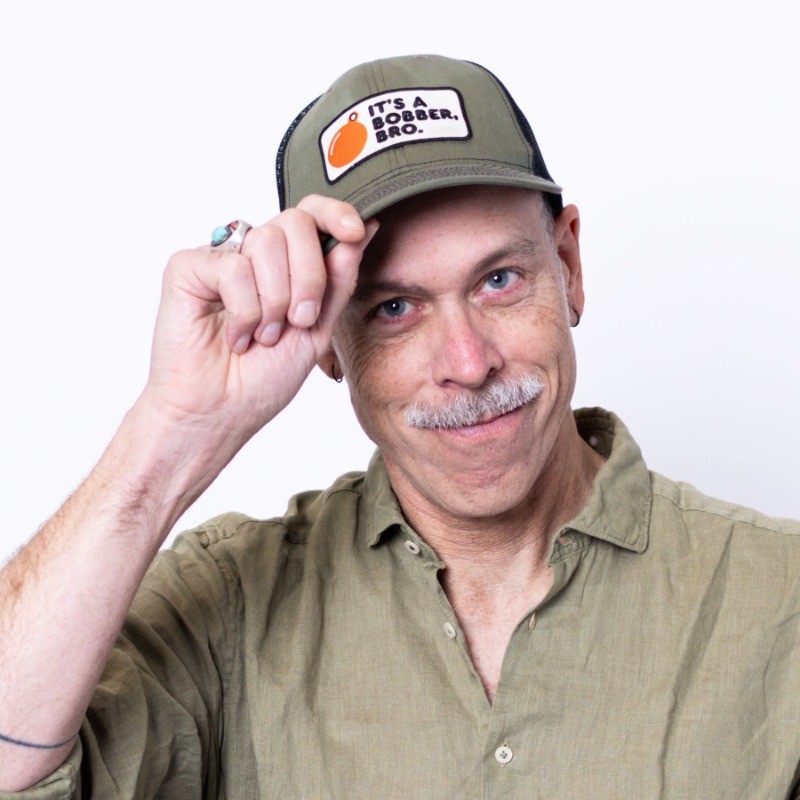
Clark Scheffy
In this two-part SuperNova conversation, Clark Scheffy, Managing Director at IDEO, argues that creativity is essential to imagining and building a better future, and warns that obsessive data-driven optimization is a bigger threat to innovation than AI. He describes AI as a collaborator that raises the floor of creativity but not the ceiling, and shares how he personally uses a firm-walled ChatGPT instance to develop presentations. Scheffy explains IDEO's 'post-ego' collaborative culture, its 'make others successful' principle, and the distinction between human-centered and customer-centric design. In the second part, he shares practical leadership advice from his keynote 'Human, Messy and Not Yet Real': nurture culture like a garden rather than architect it, carve out protected space for failure inside established companies, lead with questions, and expect cultural change to take about 18 months.
Insights & takeaways
Clark Scheffy's central argument is that the real threat to innovation isn't artificial intelligence but the creep of data-obsessed optimization into every corner of business thinking 1. He's emphatic that "we need to be careful about seeing data as the answer rather than just a measure" 1, pointing to how companies push KPIs with penalties or incentives without ever asking what actually drives the underlying behavior, and end up simply annoying customers instead of solving anything real 1. This is the throughline of his thinking: data and analytics are useful instruments for measuring what's happening, but they crowd out the exploratory, speculative work of asking "what might the future be," which is where genuine innovation comes from 1.
On AI specifically, Scheffy's position is more nuanced than alarmist. He believes AI raises the floor of creative work without necessarily raising the ceiling: "If you're a mediocre designer, AI is catching up to you very, very quickly. If you're a very good designer, it might be good to have AI on your team" 1. For him this isn't a reason to fear the technology but a reason to engage with it directly, since "any creative who is not already playing with AI and trying to understand it is missing on opportunity" 1. He frames the relationship in collaborative rather than adversarial terms, saying plainly, "I tend to think of AI as a collaborator, not as a threat" 1.
Design, in his account, is fundamentally social rather than solitary. "Design for me is very much a team sport," he says, and this belief shapes how IDEO is structured internally 1. He describes a "post-ego" culture where nobody holds tight ownership of ideas, which allows specialists, like a food designer brought in for four hours, to plug into a project instantly, something he considers rare among creative organizations 1. Consistent with this, IDEO deliberately avoids individualized incentive systems, on the reasoning that rewarding individual success at the expense of others undermines the collaborative behavior that lifts the whole business 1. When building teams, he favors mixing experienced people with enthusiastic newcomers over staffing only veterans, because the newcomers' energy adds something the tenth-time-around experts can't 1.
Scheffy also pushes back on how "customer" gets used as an abstraction in most organizations. Human-centered design, as he practices it, means spending real time with people to understand their needs upstream, before they're ever converted into customers to be measured and monetized 1. This connects to his broader, almost activist framing of creativity: "Creativity is the act of imagining the future in many ways, and if we do not imagine the future in which the world is saved, I don't think we will save it" 1. He grounds even large-scale ambitions like sustainability in human terms, noting "at the end of the day, you want to save the planet, you're going have to save the people" 1.
He's candid about the difference between designers and artists when it comes to inspiration. An artist can wait for a muse; a designer working for paying clients cannot. "I can't wait for the wave, I have to create the wave," he says, describing creativity on demand as a discipline of constant making, sketching, and questioning rather than something that arrives spontaneously 1. He also acknowledges the structural pressures facing innovation efforts inside established, publicly held companies, arguing that internal innovation groups need "air cover" so they can honestly report that they tried a hundred things, most of which failed, without being punished for it 1.
On organizational culture, Scheffy is explicit that it cannot be engineered quickly or top-down. "Cultures aren't built so much as I think they're nurtured... we call gardening, not architecture," he says, and adds that "culture doesn't happen overnight, it's not a structural change" 1. His practical prescription involves creating physical gathering spaces people actually want to use, establishing rituals like weekly prototype-sharing sessions, and having leaders lead with questions as often as answers 1. He puts a number on the timeline too, suggesting real cultural change takes roughly eighteen months, and advises leaders to document the current state of things and track month-by-month what people are doing differently, rather than expecting visible change within a week 1.
Taken together, these positions cohere around a single conviction: that exploration, human contact, and slow cultural tending are what generate durable innovation, while over-reliance on metrics and short-term structural fixes suppress it. Even his framing of IDEO's own identity reflects this design lineage and philosophy, describing the firm as "the world-leading design firm going back to the first mouse for Apple 40 years ago" , situating his current arguments about AI, culture, and human-centered design within a long continuous practice rather than a reaction to any single technological moment 1.
- The biggest threat to innovation isn't AI but obsessive data-driven, analytical optimization approaches to business that crowd out exploratory 'what might the future be' problem solving.
- Data is a measure, not the answer: companies that push KPIs with penalties or incentives without asking what drives the underlying behavior often just annoy their customers instead of solving the problem.
- Research suggests AI raises the floor on creativity but hasn't demonstrably raised the ceiling — mediocre designers are being caught up fast, while top designers should use AI as a team collaborator rather than fear it.
- IDEO's 'post-ego' culture, where nobody holds tight ownership of ideas, lets specialists (like a food designer for 4 hours) plug into projects instantly and is rare among creative organizations.
- IDEO deliberately has no individualized incentive systems, because individual success at the expense of others discourages the 'make others successful' collaboration that raises the whole business.
- 'Customer' is an abstraction; human-centered design means spending real time with people to understand their needs upstream, before they ever become customers to measure and monetize.
- Unlike an artist, a designer can't wait for inspiration — clients pay for creativity on demand, so you have to create the wave through constant making, sketching and questioning.
- When building teams, mixing experienced people with newcomers who bring enthusiasm generates more energy than staffing only people who've done the task ten times before.
- Established companies with public investors face pressure that suppresses innovation; internal innovation groups need 'air cover' so they can report 'we tried 100 things, none worked, but this one has promise' without being punished.
- Culture should be nurtured like a garden, not built like architecture: create gathering spaces people actually want to use, establish rituals like weekly prototype-sharing, and have leaders lead with questions as often as answers.
- Cultural change takes roughly 18 months; leaders should document today's state and measure month by month what people are doing differently rather than expecting change by the end of the week.
Career
- Make a Thing HereIndependent ConsultantApr 2025 – Present
- Runyon DesignSenior Director, Design StrategySep 2025 – Present
- Stealth Startup Sports TechnologyHead of DesignSep 2025 – Present
- IDEOPartner, Managing DirectorNov 2023 – Apr 2025
- IDEOPartner, North America Managing DirectorJan 2021 – Apr 2023
- IDEOPartner, Managing DirectorJan 2014 – Dec 2021
- IDEOPractice LeadAug 2007 – Aug 2014
- California College of the ArtsLecturer, "Lifecycle - Empathy + Design For Complex Processes"Sep 2006 – Dec 2006
- IDEOIndustrial Designer / Project LeadSep 2005 – Aug 2007
- University of California, Berkeley#501factoryMedia Specialist and EditorJul 1998 – Aug 2005
- WileyProject EditorFeb 1997 – Jun 1998
- California College of the ArtsBFA, Industrial Design2001 - 2005
- University of California, Berkeley#59schoolBachelor's degree, English Language and LiteratureSep 1989 - Dec 1994
- University of California, Berkeley#59schoolBachelor's degree, English Literature and MusicMay 1994
From public career histories · 14 entries
Media & appearances
2- 1interviewSuperNova · 23 Jul 2024
IDEO Managing Director Clark Scheffy tells SuperNova why data-obsessed optimization threatens innovation, how AI raises the creative floor but not the ceiling, and how leaders can 'garden' a culture of innovation over an 18-month horizon.
- promoSuperNova · 30 Nov 2023
Short promo clip of Clark Scheffy (IDEO) announcing his talk on human-centered design at FTI SuperNova in Antwerp, March 21-22 2024.