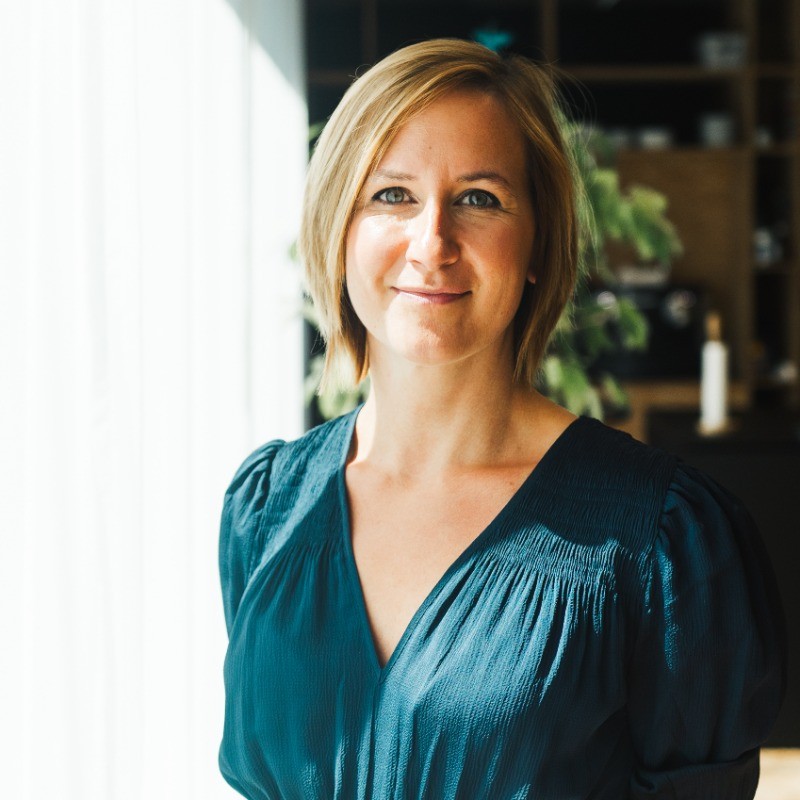
Leslie Cottenje
Leslie Cottenje co-founded Hello Customer, a customer experience SaaS company, scaled it to a Series A, and is now GM of Codit Belgium.
Leslie Cottenje built Hello Customer from zero as a co-founder, developing a SaaS platform that helps companies collect, analyze, and act on customer feedback at scale. The company raised a Series A, marking it as one of the more successful CX-focused software exits from the Ghent startup scene.
She was recognized as an Inspiring Fifty honoree, placing her among the more visible female founders in Belgian tech. After Hello Customer, she moved into an operational leadership role as General Manager of Codit Belgium, a Microsoft Azure integration and Digital Transformation partner within the Cronos Group ecosystem.
Insights & takeaways
Leslie Cottenjé's public thinking centers on one conviction that hardens over time: technology is only as good as the trust it earns, especially when the stakes are irreversible. Speaking about her year leading assessmentQ within Televic, she frames the whole enterprise in stark terms, describing "Digital Exams that cannot go wrong, at all!" and returning to that same line when she addresses conference audiences: exams that "impact lives and cannot go wrong, at all" . This is not incidental phrasing repeated for effect, it is the organizing idea behind everything else she says about her work.
Her account of joining Televic doubles as a small case study in adjusting her own instincts. She describes the move as "joining a global leadership network, spanning the four business units at Televic," which she says is "expanding my can-do and dream bigger mindset" . At the same time, she is candid that the company's orientation required a shift on her part: "It's mostly long term vision, and this company really also acts like it. Sometimes it requires adjusting on my part too, coming from growth at all cost" . That contrast, between a background steeped in rapid SaaS growth and a company built for the long term, recurs as a genuine tension she is working through rather than a lesson already learned. There is also a personal register to the move that she doesn't separate from the professional one, noting the HQ sits in "West-Flanders, my roots" and remarking on "having discussions in meeting rooms in West-Flemish probably for the first time in my career" .
On the question of artificial intelligence, she holds a consistent, cautious-but-not-dismissive position. She is direct that innovation for its own sake is not the goal: "It's not tech for the sake of tech, it's really exploring the ethics and the simple que[stions]" . That same balance shows up in her account of the eAA 2026 conference, where discussion ranged over "how to use AI to improve productivity and solve scale issues in exam creation, grading, vigilance, analysis" while "at the same time staying on the ethical side of things" . She treats AI as a real lever for solving scale problems in assessment, but only within a framework that keeps ethics and integrity as non-negotiable constraints, not afterthoughts.
The clearest articulation of her thinking is what she calls the Trust System, presented for the first time at the eAA conference. Her framing is explicit about what she is and isn't claiming to build: "Technology is the foundation, but what we really are building is Trust" . She structures this into three interlocking layers, "infrastructure, integrity and people," and locates the actual point of failure precisely at their seams, noting "it specifically is in the alignment that it often goes wrong" . This is a practitioner's model, drawn from what she says she has "seen go wrong" and "learnt to go right" over a year in the e-assessment space layered on top of "years of SaaS and customer experience" . She is careful to position the framework as additive to an already knowledgeable audience rather than a rehash, which signals how deliberately she thinks about what she is contributing versus what is already known in the field.
Her comments on the National Examinations Roundtable extend the same logic outward from her own company to the whole ecosystem of exam delivery. She describes convening "governments, awarding bodies and technology providers to discuss the challenges in organising National Exams at scale" , and singles out one conclusion as foundational above the rest: that doing this "right, secure and avoiding failure" requires working together across those groups . This collaborative framing, that no single actor, technology vendor included, can secure trust in assessment alone, is consistent with her Trust System's emphasis on alignment rather than any single layer being sufficient on its own.
Read across the full span of the material, from the entrepreneurial optimism captured in the 2016 Connexi clip, where she recalls drawing "heel veel inspiratie" from ambitious peers full of ideas and dreams , to the considerably more structured and stakes-aware language of 2026, there is a clear thro
Career
- Televic Education#369factoryGeneral ManagerJul 2025 – Present
Hello Customer#372factoryCo-FounderJul 2023 – Present
Vlerick Business School#60factoryEntrepreneur in ResidenceJan 2021 – Present
Codit#525factoryGeneral Manager BESep 2023 – Jan 2025
- GUBERNA - Instituut voor Bestuurders/Institut des AdministrateursBoard MemberMar 2020 – Jan 2024
- PureplexityCo-founder & Customer Experience ArchitectOct 2010 – Apr 2015
- Amelior#349schoolCertified, User Experience Design2011 - 2011
Erasmushogeschool Brussel#23schoolMaster, Translation Studies2004 - 2008
From public career histories · 15 entries
Media & appearances
1- promoConnexi · 29 Feb 2016
A 43-second promo clip where Leslie Cottenjé says she was surprised and inspired by the stories and ambition of fellow participants in a Connexi entrepreneurship program.