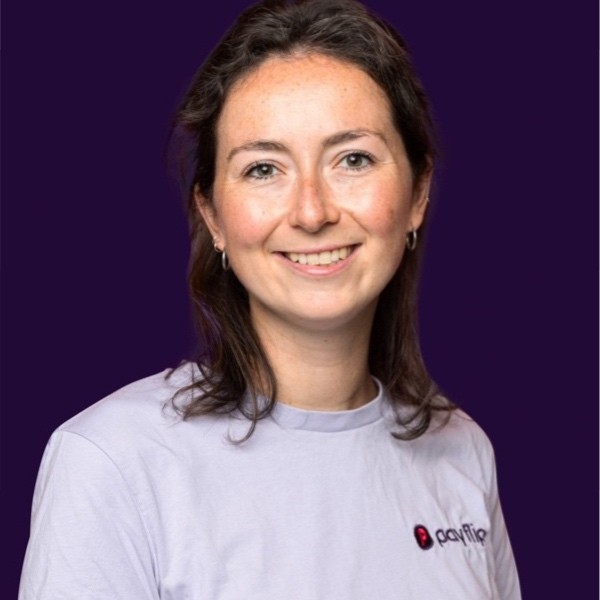
Maura Nachtergaele
Maura Nachtergaele is the co-founder and chief executive of payflip, a company she started in August 2019. She is based in Brussels.
From September 2019 to September 2020 she was Head of Impact at Funds For Good. Before founding payflip she worked at Baker McKenzie Belgium as a junior tax associate from September 2017 to August 2019, having been a summer trainee at the firm in September 2016. She was a legal assistant at Allen & Overy from October 2016 to May 2017 and a summer trainee there in August 2016. Earlier she was a trainee at Mazars Belgium from October to December 2015, a summer trainee at NautaDutilh in September 2015 and at Dumon, Sablon & Vanheeswijck in August and September 2014, and a repetitor with Legima studiekeuze, vakbijles en coaching rechtenstudenten from September 2015 to December 2016.
She studied law at Ghent University, taking a bachelor's degree and a Master of Laws, and spent 2014 to 2015 studying law and economics at the University of Copenhagen. She went on to complete an Executive Master en Gestion Fiscale at the Solvay Brussels School of Economics and Management and studied corporate finance at EHSAL Management School.
Insights & takeaways
Maura Nachtergaele's public statements circle around a consistent conviction: that employee compensation in Belgium is opaque, overpriced, and in need of modernizing, and that Payflip exists to fix exactly that. On LinkedIn she aligns herself with trade bodies and public figures against "de ontransparante en hoge kosten rond maaltijd- en ecocheques in België," positioning Payflip's model of "Géén Payflip commissies op transacties" as a direct, three-times-cheaper alternative for merchants, wrapped in an unapologetically national frame: "100% Belgisch. Because Belgium earns it." This is not a one-off marketing line but the surface expression of a mission she describes at length elsewhere: that "verloning blijft een beetje in die taboesfeer" and that making compensation "sexy" and "modern" is the founding purpose she and her co-founders set out with four years earlier 2.
Her account of Payflip's early years is built around deliberate slowness rather than speed. The company bootstrapped for two years by running a tax consultancy on the side, generating revenue on rulings and copyright remuneration schemes while simultaneously learning the market, before consciously killing that revenue stream to force a transition into a pure SaaS business 2. That transition, not a cash shortage, is what triggered the January 2023 funding round: financing as a safety net for a business-model shift rather than a survival necessity 2. Throughout, she frames the frugality of those years almost devotionally: "We leefden wel als franciscanen," a phrase that captures both the financial discipline and the sense of mission underneath it 2.
That discipline sits alongside an explicit rejection of growth-at-all-costs thinking. Asked about scaling fast, she is blunt: "Wij willen eigenlijk niet groeien at all cost. Zoiets als hypergrowth, dat zegt mij niets, niet als professional en niet als bedrijf." 2 For her, the compensation landscape in Belgium is too complex to rush; taking time to shape the vision properly matters more than velocity, and she treats hypergrowth as a source of avoidable damage rather than a badge of ambition 2.
Her account of raising the €1.25M round with Smartfin, KBC and PMV is notable for how unromantic she keeps it. Hiring an experienced interim CFO with an investor network was a deliberate move to open doors to family offices and investment bankers, and it taught the founders to skip account managers and go straight to the people who actually write checks 2. She also credits the standard VC advice, "talk to investors before you need them," with paying off literally: Smartfin's Thomas Depuydt had been in touch long before the raise, so a term sheet materialized quickly once the round opened 2. Yet when it came to choosing a lead investor between two nearly identical offers, the deciding mechanism was not analysis but a coin flip, and even that wasn't final: "Filip heeft mij omhoog gegooid en dan letterlijk kop of munt. En was het de ene partij geworden en dat voelde net niet goed, dus dan hebben we zelf de munt eruit gedraaid." 2 The anecdote is her clearest statement that, at the margin, gut feeling overrides even careful process.
She is equally candid about what she'd change. Looking back on Payflip's early pricing, set at €79 per employee per year, she regrets a kind of national modesty: "Ik denk dat een Amerikaan dat onmiddellijk ging verkocht hebben aan het triple wat dat wij deden." 2 It's a specific, self-critical admission that Belgian politeness cost the company money, and it pairs with a broader piece of advice she gives herself and others: "Minder perfectionistisch zijn... You're just missing out on fun." 2 Together these remarks suggest someone actively correcting for an instinct toward over-caution, in pricing and in general disposition.
On what the funding actually bought Payflip, she's unsentimental: beyond the cash itself, the round's value was maturity signaling, media visibility, and above all budget to hire the head-of-sales and head-of-engineering profiles the company needed, hires who cared about salary rather than which investor's name was on the cap table 2. It's a deflationary way of describing a fundraise, consistent with her broader tendency to strip hype out of decisions that are often mythologized.
Finally, she keeps a notably sober view of her own role as CEO. Rather than treating the founder seat as permanent, she says the founders regularly ask themselves whether they remain the right people for their positions, and that she would step aside if someone else could add more value to Payflip 2. Combined with her comment that "It's a good time to be in HR" 2, the overall picture is of a founder who sees Payflip's opportunity as real and timely, but who insists on pairing that optimism with self-scrutiny, patience, and a refusal to romanticize growth, funding, or her own indispensability.
- The founders lowered their own barrier to entrepreneurship by watching roommate Ella build an STD-testing startup at their kitchen table — seeing 'what's under the hood' made starting a company feel achievable.
- Payflip bootstrapped for two years via tax consultancy (rulings, copyright remuneration schemes) which simultaneously generated revenue and taught them the market before switching to pure SaaS.
- Deliberately killing the consultancy revenue stream to become a full SaaS company was the trigger to raise external funding in January 2023 — funding as safety net for the business-model transition, not as a necessity.
- Hiring an experienced interim CFO with an investor network specifically for the fundraise opened doors to family offices and investment bankers, and taught them to bypass account managers and go straight to the banks' investment bankers.
- The VC advice 'talk to investors before you need them' proved true: Smartfin's Thomas Depuydt reached out via LinkedIn long before the raise, so a term sheet came quickly when the round opened.
- They chose their lead VC by flipping a coin between two nearly identical offers — and when the outcome felt wrong, they picked the other one, proving the decision was ultimately gut feeling.
- In hindsight she would price less apologetically: they were too 'polite' about pricing an imperfect early product (€79/employee/year initially), whereas 'an American would have sold it at triple'.
- She explicitly rejects growth-at-all-costs and hypergrowth because it creates avoidable damage; Payflip took time to shape its vision in a complex compensation landscape where rushing would backfire.
- The funding round's main value beyond cash was a maturity boost, media exposure and above all budget to hire critical head-of-sales and head-of-engineering profiles — the hires cared about salary, not the investor's name.
- She keeps a sober view on her own CEO role: the founders regularly ask whether they remain the right people in their seats, and she would step aside if someone else adds more value to Payflip.
Career
PayflipCo-founder & CEOAug 2019 – Present
- Funds For GoodHead of ImpactSep 2019 – Sep 2020
- Baker McKenzie BelgiumJunior Tax AssociateSep 2017 – Aug 2019
- Allen & Overy#138factoryLegal AssistantOct 2016 – May 2017
- Allen & Overy#138factorySummer TraineeAug 2016 – Aug 2016
- Baker McKenzieSummer TraineeSep 2016 – Sep 2016
- Legima studiekeuze, vakbijles en coaching rechtenstudentenRepetitorSep 2015 – Dec 2016
- Mazars BelgiumTraineeOct 2015 – Dec 2015
- NautaDutilhSummer TraineeSep 2015 – Sep 2015
- Dumon, Sablon & VanheeswijckSummer TraineeAug 2014 – Sep 2014
- EHSAL Management School#25schoolCorporate finance2019 - 2020
Solvay Brussels School of Economics and Management#6schoolExecutive Master en Gestion Fiscale2016 - 2019
Ghent University#2schoolMaster of Laws (LL.M.)2014 - 2016
- Københavns Universitet - University of Copenhagen#143schoolLaw/Economics2014 - 2015
- Leiepoort Campus Sint-Hendriks DeinzeLatijn-Wiskunde2005 - 2011
- Pine Manor CollegeSummer School, English Language and Literature2013
From public career histories · 17 entries
Media & appearances
1- 2podcastThe Harbour · 06 Jun 2024
Payflip co-founder Maura Nachtergaele explains how she went from tax lawyer to bootstrapping a flexible-compensation SaaS to €600-700K ARR before raising a €1.25M round with Smartfin, KBC and PMV — choosing her VC via a coin flip that revealed her gut feeling.