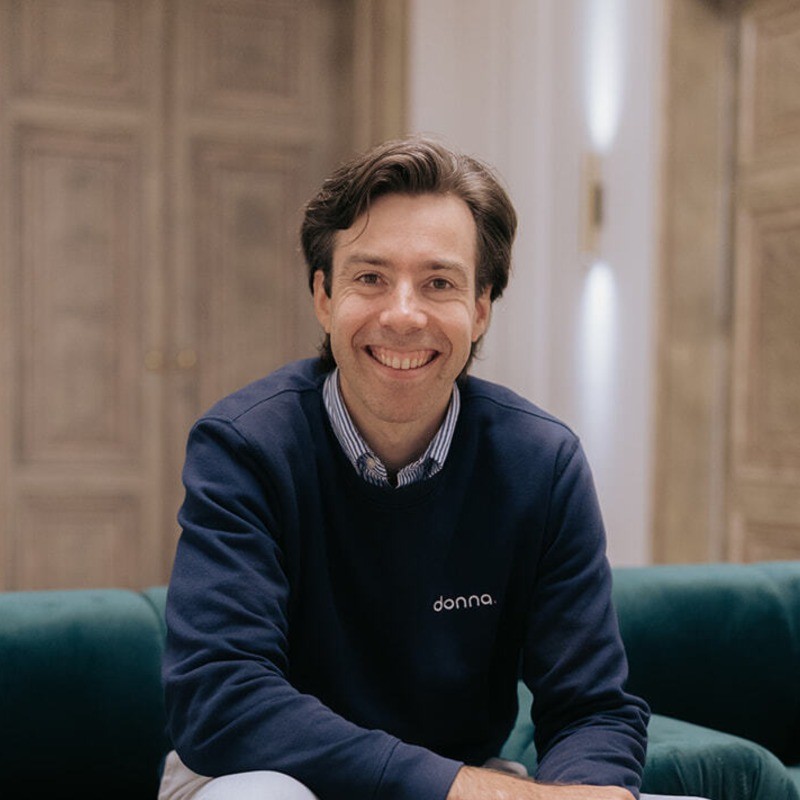
Nicolas Christiaen
Nicolas Christiaen is co-CEO of donna, based in Ghent. He founded the company in February 2024. He has also sat on the advisory board of Angelwise since June 2023 and has been entrepreneur in residence at Miles Ahead since February 2023, and between September 2022 and June 2024 he was a venture partner at AMAVI Capital.
From February 2013 to August 2022 he was CEO and co-founder of Cashforce, which was acquired by TIS (Treasury Intelligence Solutions) in June 2022. He then served as chief commercial officer of TIS from June 2022 to October 2023. In 2015 he took part in the Techstars NY Accelerator Program.
Earlier, he was a management consultant and interim manager at NetN3 from 2010 to 2012 and a business and IT process analyst at PwC from 2009 to 2010, following an analyst role at the Vlaamse Tennisvereniging, an internship at Barco and a student recruiter position at Ebbinge & Company.
He holds a master's degree in civil engineering from Ghent University and completed the Venture Management & Leadership program at RealAcad, Stanford University, in 2011.
Insights & takeaways
Nicolas Christiaen's public voice today is almost entirely about Donna, and the throughline across his posts is a single, repeated diagnosis of a problem he considers universal: field sales teams everywhere lose their best material because "a CRM that never hears about any of it" . He frames Donna not as a feature but as an answer to that specific gap, told through the same language of frontline productivity in post after post. Whether he's describing customers in Mexico or Japan, or Orange's B2B sales teams in Europe, the pitch stays consistent, briefing reps before meetings and capturing detail after, "in whatever language they sell in" . That consistency suggests a founder who has settled on a narrow, well-rehearsed thesis and is now scaling the retelling of it across geographies and audiences rather than searching for a new angle.
The BBC appearance and the VivaTech circuit show Christiaen leaning into the idea that the problem is genuinely global and language-agnostic, even joking about his own limits against the product's: "Donna could easily handle the conversation in Arabic, for me it was slightly more of a challenge" . That's a small but telling admission, he positions the product as more versatile than himself, using self-deprecation to underline the universality claim rather than to hedge it.
On the customer-proof side, he treats case studies as the real selling tool, stating plainly that "nothing sells a solution like sharing real client stories" . He doesn't lean on abstract claims of ROI; instead he lets client voices carry the argument, quoting a CIO who said sellers "were begging me to never take this away again" and a sales operations manager praising the smoothness of integration . This is a consistent pattern in how he communicates: rather than asserting Donna's value himself, he assembles third-party testimony and lets it do the persuading, whether that's a client quote, a BBC segment, or a joint session with Orange's innovation leaders .
When he steps back from product marketing, as in his reflection on the "One Million Club," his emphasis shifts to people and duration rather than metrics. He's explicit that "what stands out most to me isn't the milestones - it's the people," and that after two and a half years the real foundation has been colleagues who "care deeply, challenge each other, and keep pushing things forward" . His closing line, that "you can never have too many great people around the table," reads as a genuine operating belief rather than a throwaway platitude, especially paired with his direct callout of specific colleagues . Building a company, in his framing, is explicitly "a long game" , a phrase that recontextualizes the rapid-fire announcements and product launches elsewhere as steps within a much longer arc he's consciously pacing himself against.
Earlier in his career narrative, on the Harbour podcast about his prior exits, Christiaen is far more tactical and unsentimental. He describes first-round valuations as fundamentally arbitrary, "super random," even from the VC's own perspective, a number that's less a valuation than "een soort stab, of een dart" 5. His practical takeaway from that randomness was to fixate not on the headline number but on the percentage given away, treating founder dilution of roughly 20 to 30 percent as the real negotiating variable 5. This is a recurring pattern in how he thinks about deal structure generally: strip away the theater of numbers and focus on the mechanism underneath, whether that's equity percentage, board composition, or ownership thresholds.
That same instinct shows up in how he structured the Cashforce cap table, deliberately keeping bank investors as board observers rather than board members, and holding their ownership below 25 percent, "playing with 24%" specifically to dodge consolidation rules and keep the door open for competing banks to invest and distribute 5. He describes turning a bank investor's own relationship managers into a de facto sales force, since "BNP Paribas relationship managers all carried Cashforce" 5, as the moment the cap table became a distribution channel, a strategic reframing of investors as commercial partners rather than passive capital. He's candid, too, about the human side of decision-making under pressure, recalling a board member telling him directly, "Nico, het is nu aan u. Jij moet beslissen" 5, and about his own reasoning for selling Cashforce: mapping competitors, judging the treasury market too conservative and slow-growing, and sensing the cap table and broader market both approaching a ceiling, so he sold "exactly at momentum" 5.
The concrete takeaway he offers founders is procedural rather than inspirational: keep first-round contracts simple and reject complex mechanisms like ratchets 5, separate valuation theater from the real percentage negotiation 5, and treat investor relationships as potential distribution assets, not just funding 5. He also describes a communications tactic he's since carried into Donna's launches, deliberately combining a product video with a funding announcement to compound momentum, paired with a waitlist and a ready product experience to convert inbound interest immediately 5. Read together with his current Donna-era posts, this shows a founder whose style has shifted in tone, from tactical dealmaking commentary to warmer statements about people and global resonance, but who consistently privileges concrete mechanisms and real testimony over abstraction, whether he's describing a cap table or a customer's reaction to his own product.
- A first-round valuation is essentially random even for the VC; the real logic is the percentage split — founders give away roughly 20–30% and negotiate within that range, not on business fundamentals.
- Keep the first funding round contract simple: they deliberately rejected ratchets and complex mechanisms in the seed deal.
- Bank investors were structured as board observers (not board seats), with no exclusivity and ownership kept below 25% (they played with 24%) to avoid balance-sheet consolidation and to keep other banks willing to invest and distribute.
- Having your bank investor become your commercial distributor (BNP Paribas relationship managers all carried Cashforce) turned the cap table into a distribution channel and triggered interest from Bank of America, Barclays, ABN AMRO and KBC.
- He decided to sell Cashforce by mapping the competitor landscape, realizing the treasury market was conservative and slow-growing, the cap table sat near a maximization point for everyone, and the market was starting to cool — selling exactly at momentum.
- They deliberately launched Donna's video and the funding round announcement together to compound momentum, and combined it with a waitlist and a ready product experience for inbound leads.
Career
DonnaCEO & FounderFeb 2024 – Present
- AngelwiseAdvisory Board MemberJun 2023 – Present
Miles AheadEntrepreneur in ResidenceFeb 2023 – Present
- AMAVI CapitalVenture PartnerSep 2022 – Jun 2024
- TIS (Treasury Intelligence Solutions)CCOJun 2022 – Oct 2023
- TechstarsTechstars NY Accelerator Program (Class participant)Jul 2015 – Oct 2015
- Cashforce (acquired by TIS in June 2022)CEO & Co-Founder at Cashforce (acquired by Treasury Intelligence Solutions in June 2022)Feb 2013 – Aug 2022
- NetN3Management Consultant / Interim ManagerAug 2010 – Mar 2012
- PwC#16factoryBusiness & IT process analystAug 2009 – Jun 2010
Barco#41factoryMechanical Design Flow InternJul 2008 – Aug 2008
- Ebbinge & CompanyStudent RecruiterApr 2008 – Dec 2008
- Vlaamse Tennisvereniging (Flemish Tennis Association)AnalystNov 2007 – Apr 2008
RealAcad, Stanford UniversityVenture Management & Leadership program2011 - 2011
Ghent University#2schoolMaster, Civil Engineering2004 - 2009
- Sint-Lodewijkscollege#57schoolMathematics & Sciences 8 hours1998 - 2004
From public career histories · 15 entries
Media & appearances
1- 5podcastThe Harbour · 14 Nov 2024
Donna co-CEOs Jonas Deprez (ex-Daltix) and Nicolas Christiaen (ex-Cashforce) recount their exits — Daltix to Colruyt Group via corporate venturing, Cashforce sold at market peak after bank investors BNP Paribas and Citi — and the lessons (co-founders, shareholder agreements, advisors) they now apply at AI sales assistant Donna.