
Overview
CISUTAC aims to increase circularity and sustainability in textiles and clothing in Europe. The initiative addresses the challenge that less than 50% of used clothes are collected and only 1% are recycled into new clothes, with a focus on improving sorting for reuse and repair, and promoting efficient management of post-consumer textile waste.
In the news
- Standardisation is often seen as a technical hurdle. In practice, it is one of the most useful tools for turning circular ambitions into market-ready products. The transition to circular textiles in Europe is increasingly shaped by regulation, market expectations, product safety requirements, data transparency and harmonised standards 📋 Businesses need reliable ways to demonstrate that products are safe, durable, repairable, recyclable, traceable and compliant with European requirements. Yet, they still face fragmented
- The CISUTAC final video is live! 🎬 As the project's dissemination partner, Textile ETP crafted the script for this film, working to translate 4 years of research and innovation into a story that anyone can connect with. The filming and editing were in expert hands of Daan Oskam and Jaimy Soares! From zipper repair stations to thermo-mechanical PET recycling to decision-support tools, the CISUTAC video show how the consortium proved that circular textile solutions can be real, scalable, and available today. 👇 Watch the full
- Our final CISUTAC video is live! Over the past 4 years, the CISUTAC consortium has worked to move circularity in textiles from concept to practice, and this film brings that journey together. From a semi-automated zipper repair station developed with Kringwinkel Groep, Gentle Systems, and Decathlon, to thermo-mechanical PET recycling at Centexbel, to decision support tools and future scenario planning from RISE Research Institutes of Sweden, the project has demonstrated that real solutions exist, at scale, today. But CISUTAC was
- 𝐓𝐰𝐨 𝐰𝐞𝐞𝐤𝐬 𝐭𝐨 𝐠𝐨 𝐮𝐧𝐭𝐢𝐥 𝐄𝐂𝐎𝐒𝐘𝐒𝐓𝐄𝐗 𝐂𝐨𝐧𝐟𝐞𝐫𝐞𝐧𝐜𝐞 ⏰ From 22–24 September, the textile innovation community will meet in Antwerp, Belgium, for the fourth edition of the ECOSYSTEX Conference, hosted in partnership with the University of Antwerp. This year's theme, Circular textiles beyond recycling, brings together researchers, industry, innovators and policymakers to explore the next steps towards a truly circular textile ecosystem. 𝐖𝐡𝐚𝐭’𝐬 𝐨𝐧 𝐭𝐡𝐞 𝐩𝐫𝐨𝐠𝐫𝐚𝐦𝐦𝐞? ♻️ Two days of keynote
- Used textiles and textile waste are becoming a central issue for the European textile ecosystem. The mandatory separate collection of textile waste from 2025, the introduction of EU-wide Extended Producer Responsibility schemes for textiles, the Ecodesign for Sustainable Products Regulation, the Digital Product Passport and the forthcoming Circular Economy Act are all changing the way textiles will be designed, collected, sorted, reused, repaired and recycled ♻️ At the same time, the current system remains under pressure.
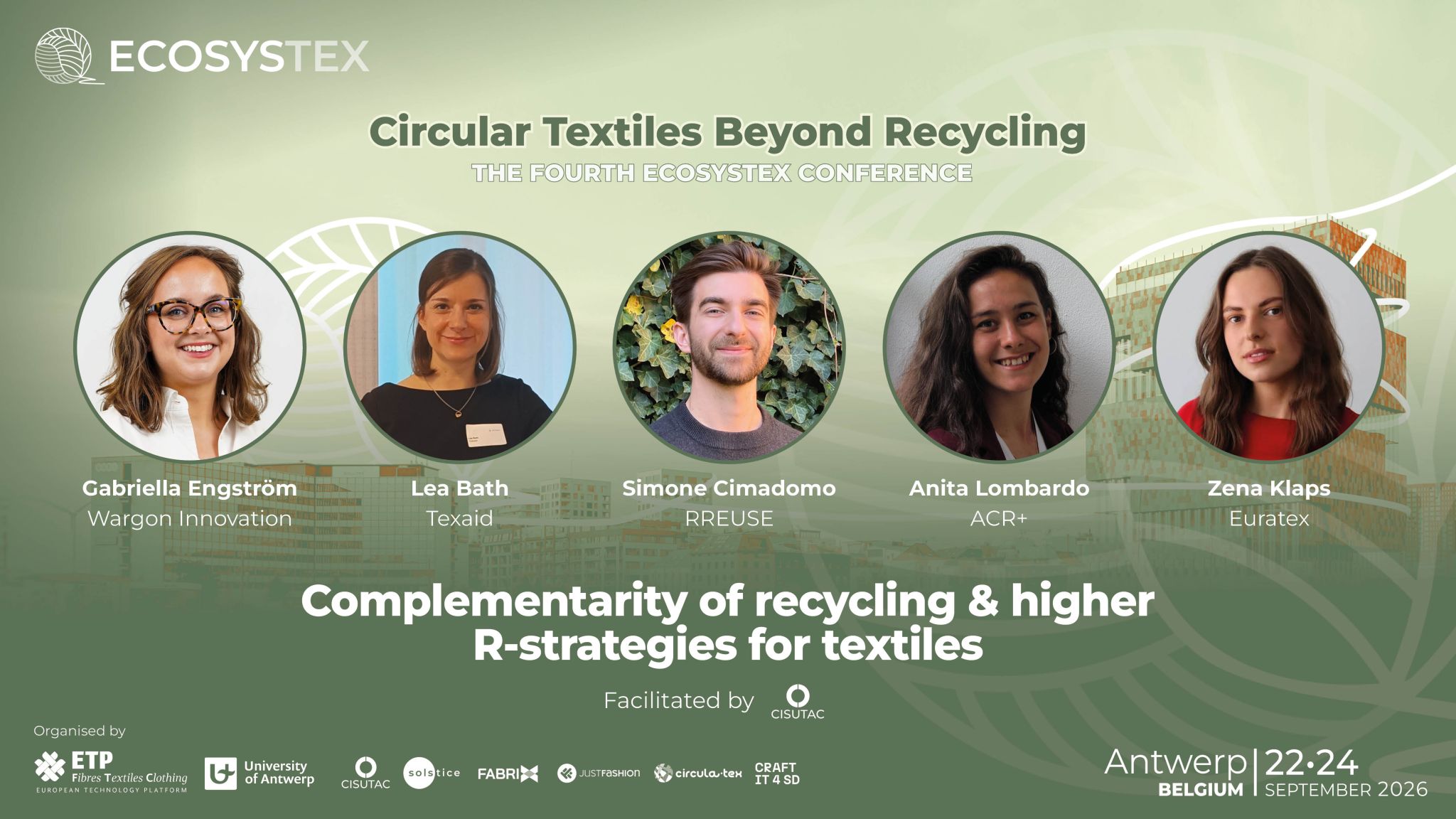
- Discover today the last 4 speakers for the CISUTAC final event as part of the ECOSYSTEX Conference, which will take place on 22-24 August in Antwerp, Belgium. CISUTAC final event will end with a panel discussion on the complementarity of recycling and higher R-strategies, moderated by Gabriella (Bella) Engström from Wargön Innovation, and featuring: 🧵 Zena Klaps from EURATEX - European Apparel and Textile Confederation 👖 Lea Caroline Bath from TEXAID 👕 Simone Cimadomo from RREUSE - Reuse and Recycling European Union Social
- Just under three weeks to go before CISUTAC final event at the 4th ECOSYSTEX Conference! 📆 Taking place on 22-24 September 2026 in Antwerp, Belgium, the confeence will highlight the final results of CISUTAC, and overall look at circular textiles beyond recycling, asking what circularity looks like once you stop treating recycling as the finish line. The programme also includes contributions from the EU institutions: an introduction to the updated CORDIS results pack "The Future of Textiles: Achieving a Circular Economy" by
- Ecodesign is becoming one of the central pillars of the EU transition towards sustainable textiles. Decisions made during the design phase influence the entire lifecycle of textile products, including durability, repairability, reuse potential, recyclability, chemical safety and environmental performance 👕 At the same time, Europe faces growing challenges linked to overconsumption, textile waste, declining product quality, increasing pressure on collection, sorting and recycling systems, and persistent technological gaps in the

Something wrong or missing? Send an update. Fixed within 24 hours.