
Overview
Contour Lab is an AI Fashion Personalization solution for fashion brands and retailers. Powered by the Fashion Passport, it turns customer insights into confident discovery, higher conversion, fewer returns, and stronger loyalty across multiple channels.
Key people



In the news
- The biggest opportunity ánd killer of e-commerce has been the wide choice of products. But it’s clear now that more choice has not made shopping better or easier. On the contrary, the product overwhelm is real and it has made it harder even. Online, product offerings are unlimited and everything is available at your fingertips. It makes you compare more, but the commitment is much lower. The emotional connection to brands weakens because there’s always another option that’s just one click away. The behavior of a shopper in-store

- Hmm, a triggering question from Detlef Beiter.. Is a traditional webshop still needed, if every customer could have her/his store that feels like it built for them? With the rise of agentic commerce and current search behavior through AI, i believe we have already surpassed the existence of traditional webshops as we have known them for the last decade. Webshops as such will still exist for a while, but the nice part is: you CAN already offer a customer that personal shopping system Detlef's talking about. Through our Contour
- In this AI era, it has been a lot about humans vs the algorithms. Even though i’m a firm believer of humans first and AI only as a way to make people more effective and efficient, being in this space has also given me the insight that sometimes the human capability does have its limits. Let me give you an example: your best shop advisor or stylist is extraordinary. But her knowledge lives in her head. A hundred customers before the detail starts to blur. Now multiply that across 50.000 shoppers and 100.000 products. So it’s a high

- One of my favorite parts of building a brand strategy has always been (still is) the positioning and the targeting part. Sitting together with the team, coming up with the names of these marketing personas that are the equivalent of target audiences. Who they are, where they live, what their lifestyle is like, their style and what media they consume actively, etc. It makes it very clear who you want to attract as a brand. Based on my experience of the last couple of years, one thing became obvious to me: even the right marketing
- Does it scare you that technology might catch up on or even surpass you?" That was the question that Suyin Aerts asked me on the podcast Dat is wel Speciaal. Yes! It is on our minds every single day… It’s funny when i think about it, but when we started Contour Lab, ChatGPT did not even exist yet. We just had a very clear mission: help every type of woman (and now men too off course) feel fantastic in her own skin: which means with the body she has, not the body she wishes she had. Some things you can just now change, and why

- Research from McKinsey latest study indicates 61% of European consumers already use AI for product discovery. 84% already use AI in their daily lives. Everything changed so fast in the last years, so it’s kind of surprising many fashion brands are still offering a filter bar to their visitors. But the ones that are experimenting with out-of-the-box ways of personalisation and innovative ways of filtering are already out of the testing-phase and have implemented those as part of their day-to-day operations. And the proof of data is
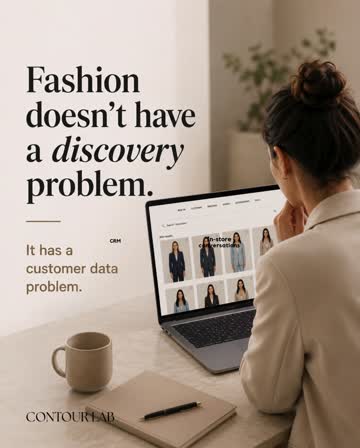
- From my own experience in fashion & retail: good shop advisor in a store asks good questions. You might have noticed that online, it’s rare that someone asks you anything. It’s a real challenge, and when you have 100.000 products on your website, that challenge becomes a real problem. We’re asked us million times in the beginning, and still, how do you recreate that guided, personalized moment that happens organically in a physical store, when the customer is sitting alone in front of a screen with no one to turn to? Our answer:
- Digital targeting in fashion is getting more expensive and less precise. For years, audience-building on Meta and Google relied on third-party data: from behavioral signals purchased off of platforms, demographic look alike audiences collected from browsing history across the web. 𝗕𝘂𝘁 𝘁𝗵𝗲𝗿𝗲 𝗶𝘀 𝗰𝗼𝗼𝗸𝗶𝗲 𝗱𝗲𝗽𝗿𝗲𝗰𝗮𝘁𝗶𝗼𝗻 𝗻𝗼𝘄, 𝗽𝗹𝗮𝘁𝗳𝗼𝗿𝗺 𝗽𝗿𝗶𝘃𝗮𝗰𝘆 𝗰𝗵𝗮𝗻𝗴𝗲𝘀, 𝗮𝗻𝗱 𝘁𝗶𝗴𝗵𝘁𝗲𝗻𝗶𝗻𝗴 𝗿𝗲𝗴𝘂𝗹𝗮𝘁𝗶𝗼𝗻𝘀 𝘁𝗵𝗮𝘁 𝗵𝗮𝘃𝗲 𝗿𝗲𝗱𝘂𝗰𝗲𝗱 𝘁𝗵𝗲 𝗮𝗰𝗰𝘂𝗿𝗮𝗰𝘆 𝗼𝗳 𝘁𝗵𝗲𝘀𝗲


Something wrong or missing? Send an update. Fixed within 24 hours.