
Overview
EROSS SC is a European project developing space vehicles capable of controlled re-entry of space debris, robotic manipulation, satellite life extension, in-orbit refueling, and inspection. The project completed a Preliminary Design Review milestone and focuses on building a European value chain for on-orbit servicing and reliable capture of free-floating objects in microgravity.
In the news
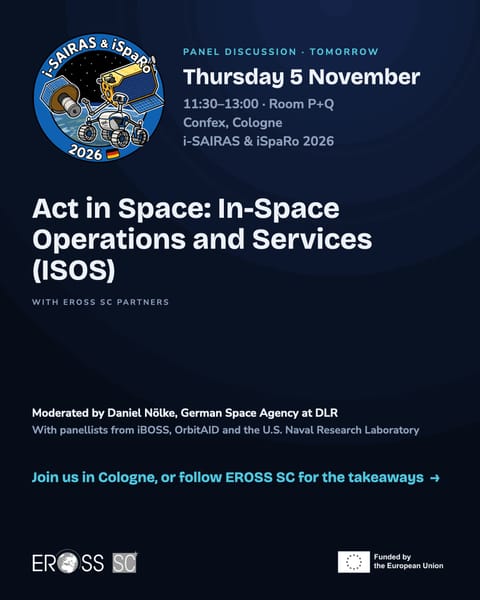
- Cologne, tomorrow, 11:30. This week, the space robotics community is gathered in Cologne for the joint i-SAIRAS & iSpaRo 2026 conference, organised with German Aerospace Center (DLR). Tomorrow’s panel, “Act in Space: In-Space Operations and Services (ISOS)”, puts in-orbit servicing centre stage, and two EROSS SC partners will be on it: 🎙️ Stéphanie BEHAR LAFENETRE, Thales Alenia Space 🎙️ Maximo A. Roa, KINETIK Space The panel is moderated by Daniel Noelke, Head and Coordinator ISOS/ISAM at the Deutsche
- EROSS SC is proud to be in Cologne. Meet us at I-SAIRAS & iSpaRo 2026 to try out the AR/VR Experience and discuss on-orbit services with our engineers!
- EROSS SC is proud to be in Cologne. Meet us at I-SAIRAS & iSpaRo 2026 to try out the AR/VR Experience and discuss on-orbit services with our engineers!
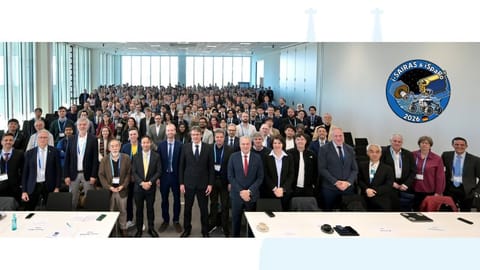
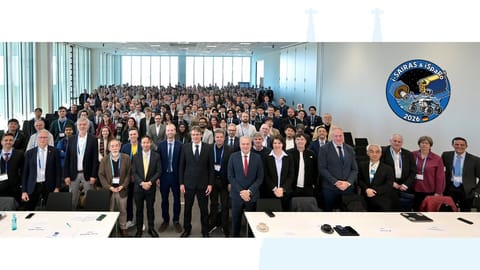
- i-SAIRAS & iSpaRo 2026 have officially kicked off in Cologne! More than 400 participants from the international space community have come together to exchange ideas, share expertise and explore the latest developments in space robotics, AI and autonomous systems. The opening sessions are now underway, marking the beginning of four days of scientific exchange, inspiring discussions and opportunities for international collaboration. For the first time, i-SAIRAS and iSpaRo are being held together, creating a unique platform
- The EU Space Act heads towards trilogue The EU Space Act is moving towards trilogue negotiations, with the European Parliament's industry committee voting on 10 November. Commission, Council and Parliament each have their own text, and they disagree on licensing deadlines, cybersecurity and access for non-EU operators. From the in-orbit servicing community, here are three things we hope the final text gets right: 1️⃣ Recognise servicing as its own activity. A mission that approaches, captures or refuels another spacecraft is not a
- 31,800 objects Every week, someone counts how crowded our orbit has become. Last week the figure stood at about 31,800 tracked objects, more than 10,000 of them Starlink satellites alone, and 15 active close approaches were flagged in a single snapshot. We tend to treat these numbers as background noise. They are actually a design brief. Most satellites in orbit today were never designed to be visited, repaired or removed. Changing that is easy and cheap at the drawing-board stage, and very hard after launch. At EROSS SC, we
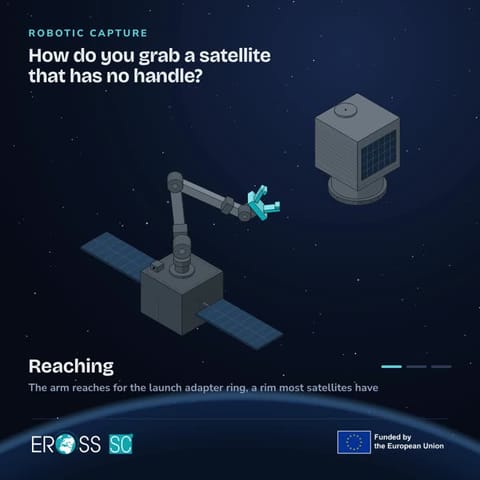
- Capturing what was never designed to be captured How do you grab a satellite that has no handle? That is the hard question behind the UK’s new active debris removal mission, awarded on 15 October. It is expected to capture two defunct satellites in a row, neither of which was ever designed to be serviced. There are no docking fixtures and no cooperative markers, and the targets may be tumbling. This is the shift the servicing sector has been waiting for. Requirements are no longer written for neat, prepared clients. They are written
- Behind the Scenes – Part 10: talking safety rules in Antibes–Juan-les-Pins. 🛰️ Building a servicing spacecraft is about more than engineering. It also means operating it safely, alongside everyone else in orbit. Last week, our colleague Emilien Genet (from Thales Alenia Space), who works on reliability for EROSS SC among other programmes, attended the 14th International Association for the Advancement of Space Safety Conference in Antibes–Juan-les-Pins. Under the theme “Together for a Safe Space Frontier”, the IAASS brought

Something wrong or missing? Send an update. Fixed within 24 hours.