
Overview
The Exploit4InnoMat (E4IM) project aspires to provide a sustainable solution across Europe for designing, upscaling, and validating new material concepts for the building envelope to achieve the EC target for near-zero energy buildings (nZEB). The core mission is to establish a sustainable Open Innovation Test Bed (OITB) across Europe supporting advanced material development.
In the news
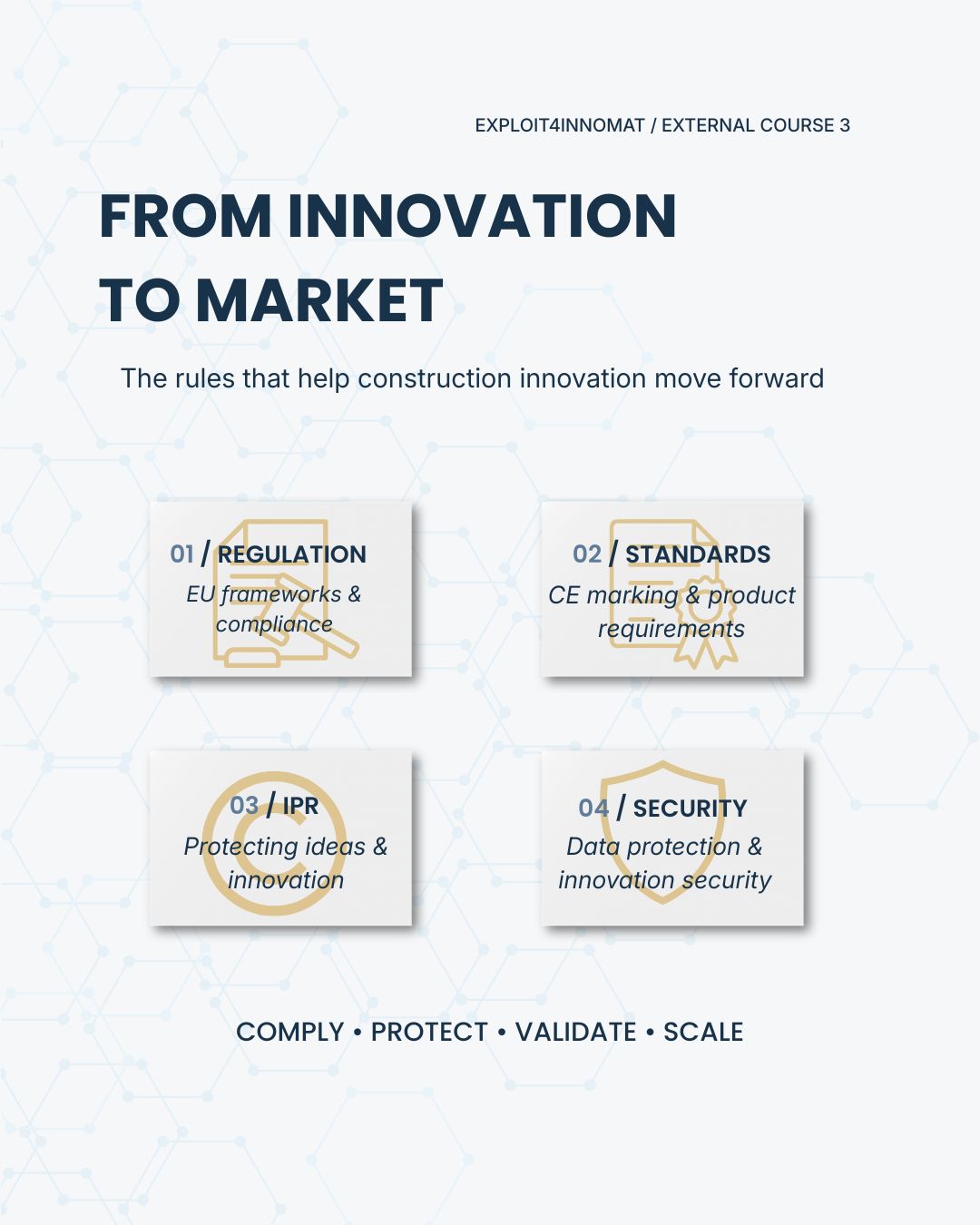
- From innovation to market,what does it take to move construction solutions forward? Exploit4InnoMat External Course 3 looks at the frameworks that help innovation progress responsibly and effectively across the construction sector. The course highlights key areas such as: 🔹Regulation: understanding EU frameworks and compliance requirements 🔹Standards: supporting product requirements and market readiness 🔹IPR: protecting ideas, knowledge and innovation 🔹Security: addressing data protection and innovation security Because
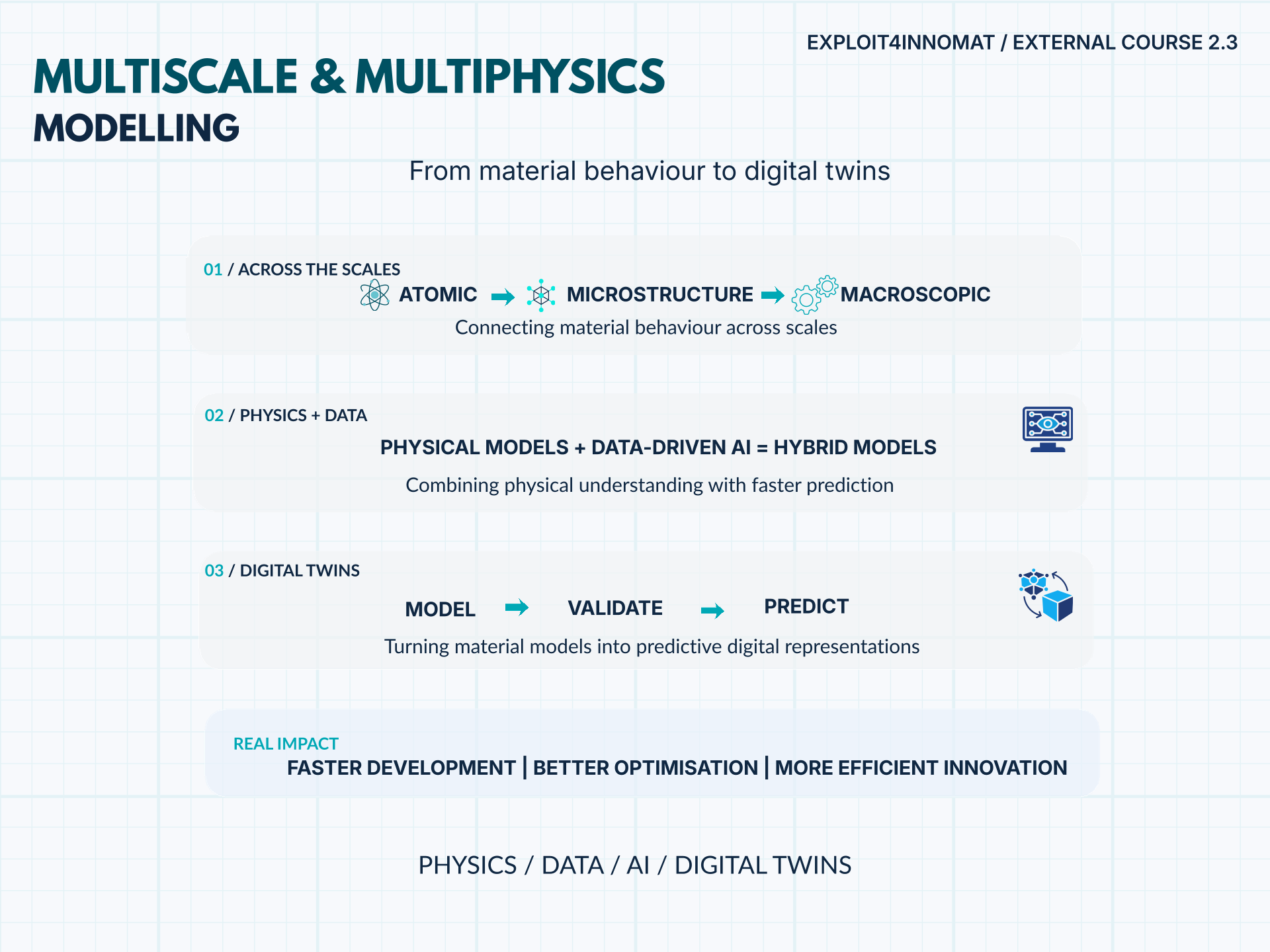
- From material behaviour to digital twins How can we connect what happens at the atomic and microstructural scale with real engineering performance? Exploit4InnoMat External Course 2.3 explores how multiscale and multiphysics modelling can bridge different levels of material behaviour and support more predictive, data-informed approaches to materials innovation. Key topics include: ✅Connecting behaviour across scales ✅Combining physical models with data-driven AI ✅Using hybrid models to improve prediction and interpretation
- From building information to energy performance How can digital building data support better energy performance decisions? Exploit4InnoMat External Course 2.2 explores the relationship between Building Information Modelling (BIM) and Building Energy Modelling (BEM) and how connected data can support the transition from detailed design information to energy analysis. The course highlights: ✅How BIM and BEM serve different, but complementary, purposes ✅The role of interoperability and data exchange ✅Key BEM inputs,
- Smart windows are not just ON or OFF! Within Exploit4InnoMat Pilot Line 4, PDLC (Polymer-Dispersed Liquid Crystal) smart windows are being investigated for their ability to dynamically change their optical state through applied voltage. Experimental work has shown that intermediate voltage levels can also enable intermediate transmittance levels, going beyond a simple diffuse-to-transparent switch. Why does this matter? Smart window technologies are being investigated not only in terms of optical performance, but also in relation to
- Bridging material science and digital innovation How can construction materials be assessed and understood before they are used in real building applications? Exploit4InnoMat External Course 2.1 : Introduction to Digital Modelling of Construction Materials and Their Properties explores how material information can be translated into structured digital data to support more informed decisions across the built environment. Key topics include: ✅Material characterisation for digital environments ✅Life Cycle Assessment (LCA) and
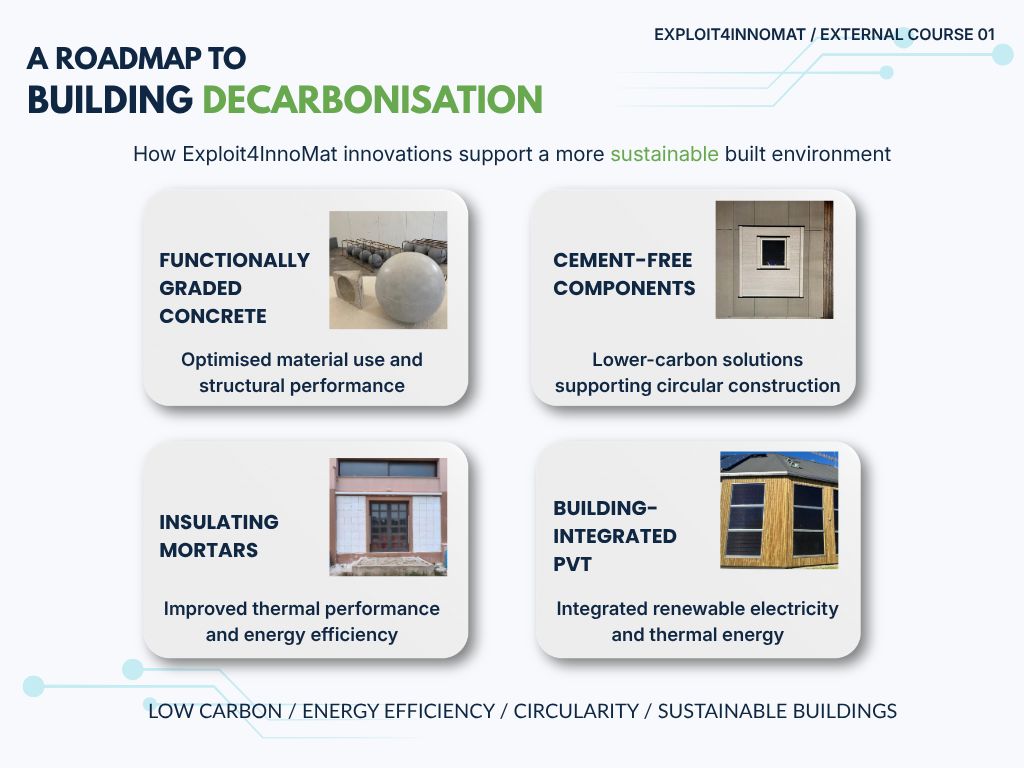
- How can innovation support the decarbonisation of buildings? In Exploit4InnoMat External Course 01, we explore a roadmap towards a more sustainable built environment from advanced construction materials to energy-integrated building solutions. The course looks at different pathways that can contribute to building decarbonisation, including: 🔹Functionally Graded Concrete 🔹Insulating Mortars 🔹Cement-Free Components 🔹Building-Integrated PVT systems Together, these solutions show how material efficiency, improved thermal
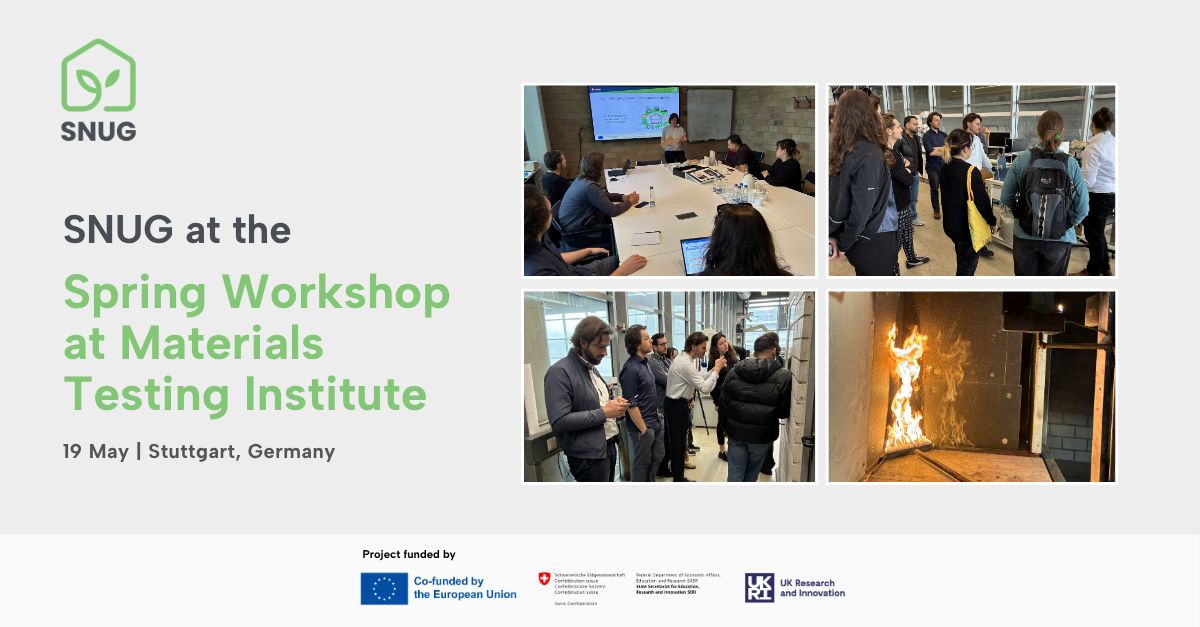
- 𝗥𝗲𝗳𝗹𝗲𝗰𝘁𝗶𝗻𝗴 𝗼𝗻 𝗮 𝗦𝘂𝗰𝗰𝗲𝘀𝘀𝗳𝘂𝗹 𝗦𝗽𝗿𝗶𝗻𝗴 𝗪𝗼𝗿𝗸𝘀𝗵𝗼𝗽 𝗶𝗻 𝗦𝘁𝘂𝘁𝘁𝗴𝗮𝗿𝘁! 🇩🇪 Our partners at the University of Stuttgart hosted a workshop at the Materials Testing Institute (MPA), bringing together experts to discuss the future of sustainable construction materials. Key Highlights: 🔬 𝗟𝗮𝗯 & 𝗙𝗮𝗰𝗶𝗹𝗶𝘁𝘆 𝗧𝗼𝘂𝗿𝘀: Participants got a behind-the-scenes look at the fire testing and mineral materials departments. 📜 𝗖𝗲𝗿𝘁𝗶𝗳𝗶𝗰𝗮𝘁𝗶𝗼𝗻 & 𝗦𝘁𝗮𝗻𝗱𝗮𝗿𝗱𝘀: In-depth discussions
- 2026 so far: progress across Exploit4InnoMat! Over the past months, the project has continued to advance across multiple fronts - from Pilot Line development and innovative building technologies to installation, monitoring and assessment under real-site conditions in Greece and Norway. At the same time, project knowledge has continued to reach wider audiences through external courses, events, conferences and digital content. Swipe through our mid-year recap for a snapshot of the progress made so far. More Pilot Line

Something wrong or missing? Send an update. Fixed within 24 hours.