
Overview
Liquisens turns existing water data into real-time intelligence by applying AI on top of current monitoring systems. The platform helps industrial and municipal operators across process water and wastewater detect events early, ensure compliance, and avoid costly shutdowns by transforming water management from reactive to predictive. It combines real-time monitoring, predictive analytics, and continuous optimization, connecting to existing sensors or deploying IoT tools to monitor water quality parameters.
Key people
In the news
- Liquisens Webinar: from plant data to a working prediction On Tuesday 22 September at 15:00 CEST, Steven De Schrijver, CTO and co-founder of Liquisens, and Bardia Ghazanfari, Water System and Data Engineer, host a 30-minute online session. Most plants still learn about a water quality deviation after it has happened. The standard compensation is a safety margin: extra chemicals, extra energy, extra reporting effort, carried every day of the year. The session shows how the data a plant already produces — SCADA, lab results, weather
- It is worth being clear about what we do not sell. We are not a sensor company. We do not ask you to install hardware to get value from the data you already collect. We are not a SCADA replacement. Your control system stays where it is and keeps doing what it does. We are not a digital twin vendor. We do not build a full hydraulic and biological simulation of your plant and ask you to maintain it. We are not a generic AI platform with a water page on the website. A model trained on one plant does not transfer cleanly to another, and

- Most plants know their effluent quality tomorrow. This is what knowing it now looks like. Left panel: predicted effluent quality for the next 24 hours. COD, total nitrogen, total phosphorus, suspended solids. Not measured. Estimated from the process data the plant is already generating. Middle panel: what to do about it. Dosing urea +3%. Phosphoric acid −2%. Aeration duration on motor 5 +5%. Buffer reservoir level −1%. Specific, bounded, and small. Right panel: what it is worth. €185 for the operating day, split into chemical,

- Liquisens Insights, Edition 7 is out Most wastewater plants have process people who understand the biology and the hydraulics. Many now have access to data people who understand models. What is usually missing is the person who can hold both at once. This edition looks at the water data engineer: what the role actually involves, why the work that decides whether a model succeeds happens long before any training run, and why domain knowledge is what separates a model that fits the data from a model that describes the plant. There

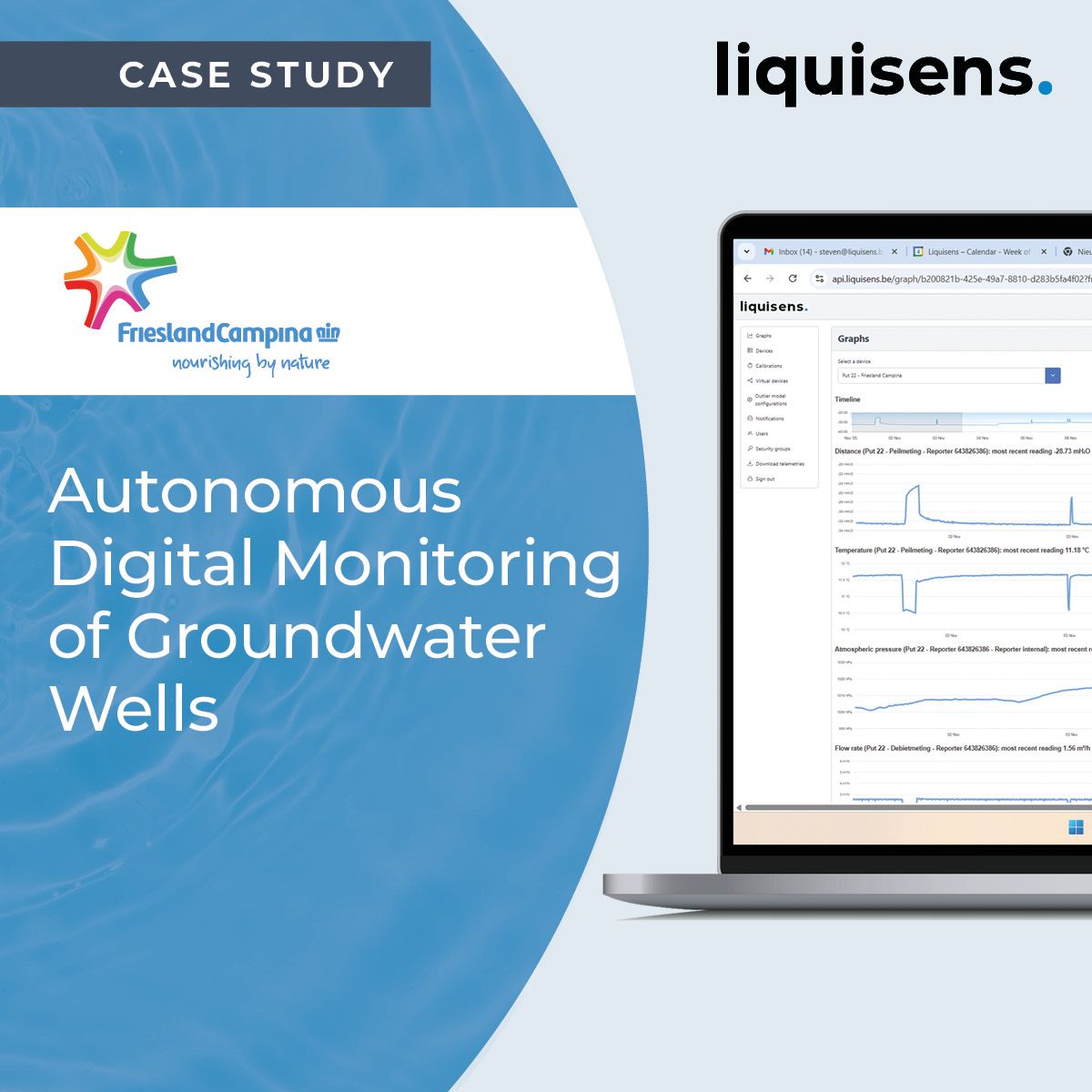
- Cables? Infrastructure works? Waiting on IT for 6 months? No thanks. Liquisens solved FrieslandCampina’s remote groundwater tracking problem without the heavy lifting. They hooked their smart software up to Reporter®, plugged in solar power, and walked away with real-time compliance. Big thanks to the Liquisens team for letting Reporter do what it does best: taking the hardware pain out of remote data. Read their post below for the full story.
- When compliance becomes a data problem FrieslandCampina operates multiple groundwater extraction wells. New regulations require hourly logging of groundwater levels and extraction flow rates, with immediate alerts when limits are exceeded. The challenge is practical. Many wells are remote, and connecting them to existing SCADA or IT infrastructure would require significant cabling, civil works, and cost. Together with Crodeon Technologies, Liquisens deployed autonomous monitoring units directly at the wells. The units are
- Meet the Team: Bardia Ghazanfari Bardia is a Water Systems Data Engineer at Liquisens, combining a background in civil engineering with advanced expertise in water resources and data analysis. With master’s studies in Water Resources Engineering at KU Leuven and Vrije Universiteit Brussel, he understands both the physical behaviour of water systems and the data needed to improve them. At Liquisens, Bardia turns raw SCADA, sensor, and laboratory data into practical tools that help industrial wastewater operators monitor water

- The most sustainable chemical is the one you never dose. In industrial water treatment, safety often means adding more. More biocide. More coagulant. Wider safety margins. That may protect the process, but it also increases cost and environmental impact. Predictive monitoring changes that trade-off. By turning existing sensor, process, and laboratory data into a real-time risk picture, operators can dose according to what the system is actually doing rather than continuously preparing for the worst case. At an industrial cooling


Alumni
- PSteven SchrijverCEO & co-founder
Something wrong or missing? Send an update. Fixed within 24 hours.