
Overview
Sandbag is a non-profit think tank based in Brussels that conducts evidence-based advocacy for ambitious climate policy. The organization provides data tools including an EU ETS Dashboard, CBAM Simulator, and EU ETS Simulator, and focuses on topics like the EU Emissions Trading System and Carbon Border Adjustment Mechanism.
In the news
- Don’t forget to sign up for our upcoming Webinar next Tuesday, 22 September at 3:00 p.m. CET. We'll be presenting an analysis of the carbon market and how it will be affected by each main element of: 🔹 The current EU ETS 🔹 The European Commission’s proposal 🔹 MEP Peter Liese’s proposal 🔹 Other design options Register now at the link in the comments. 🔗
- Today, the European Parliament voted to remove Article 27a from the CBAM. Article 27a would allow the Commission to remove goods from the CBAM’s scope when “severe harm” could be caused to the EU internal market. We advocated for the exclusion of this clause and warned against the risks it would create for the EU’s carbon market. Art. 27a could lead to frequent calls to exclude certain goods from the CBAM and prolong the phaseout of free allocation under the EU ETS, leading to dire uncertainty within both instruments. In
- Webinar: Options for the EU ETS 📅22 September at 3:00 p.m. CET On 17 July, the European Commission proposed to amend the EU ETS. A draft report will soon be published by the Parliament’s rapporteur in the ENVI Committee with potential additional changes. In a public webinar, we will present Sandbag’s analysis of the carbon market under different design options, and discuss proposals to mitigate its potential negative impacts. The session will cover: 💠impacts of the Commission’s proposals on the EU ETS market balance 💠 Peter
- Aviation has failed to stay within its ETS carbon budget for over a decade. For aviation, buying allowances is cheaper than reducing emissions. Decarbonisation is the least economical option. At the same time, aviation demand for emission allowances puts pressure on industrial sectors exposed to international competition. In our new brief, “Putting a seat belt on allowance use: how aviation could do its part,” we propose that airline access to emission allowances from other sectors should be gradually reduced. That would mean
- US Ambassador Puzder called the Carbon Border Adjustment Mechanism (CBAM) "a tariff by a different name." Our numbers tell a different story. In a Financial Times op-ed this month, US Ambassador to the EU Andrew Puzder argued that CBAM is economically indistinguishable from a conventional tariff, accusing Brussels of a double standard while criticising US Section 232 duties. ❗But the EU’s carbon price works on a different logic compared to a tariff. CBAM applies the same rule to everyone: cleaner production costs less, no matter
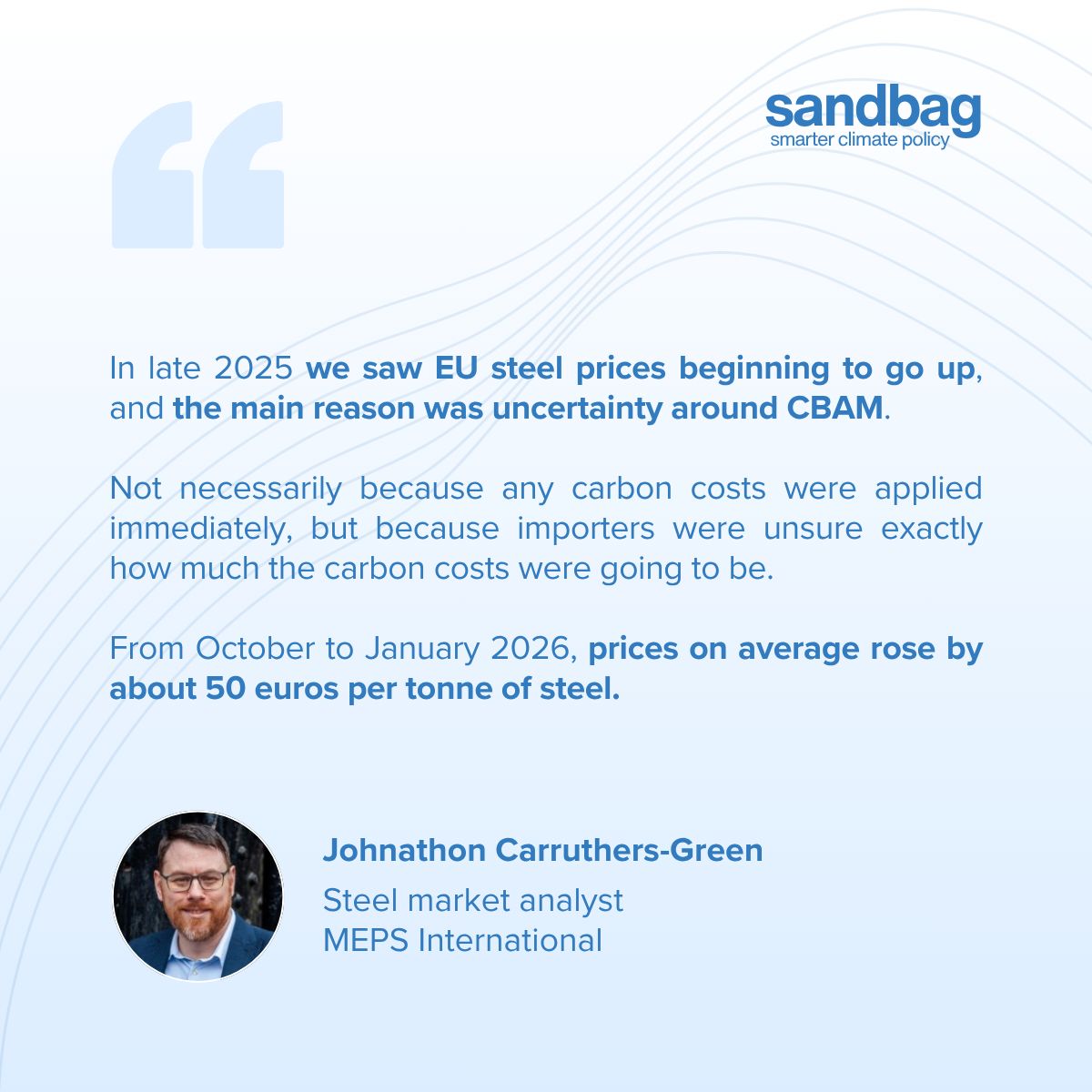
- EU steel prices are already rising because of the CBAM, increasing revenues for both importers and EU steelmakers. On 4 August, we hosted a webinar to launch Sandbag’s report ”The EU CBAM’s Real Impact on India”, with a panel discussion on the topic. Jonathon Carruthers-Green, steel market analyst at MEPS International noted that: “In late 2025 we saw EU steel prices beginning to go up, and the main reason was uncertainty around CBAM. Not necessarily because any carbon costs were applied immediately, but because importers
- Does the EU CBAM contribute to the business case of low-carbon steel in India? On 4 August we hosted a webinar to launch our report ”The EU CBAM’s Real Impact on India”, with a panel discussion on the topic. 🎯Regarding the incentive to decarbonise, Darshna Singh, Programme Associate at CEEW, noted that: “the European Union has been successful in creating an emerging premium market for low-carbon products. So for Indian exporters, the CBAM will definitely act as an incentive to differentiate their strategy in terms of how they
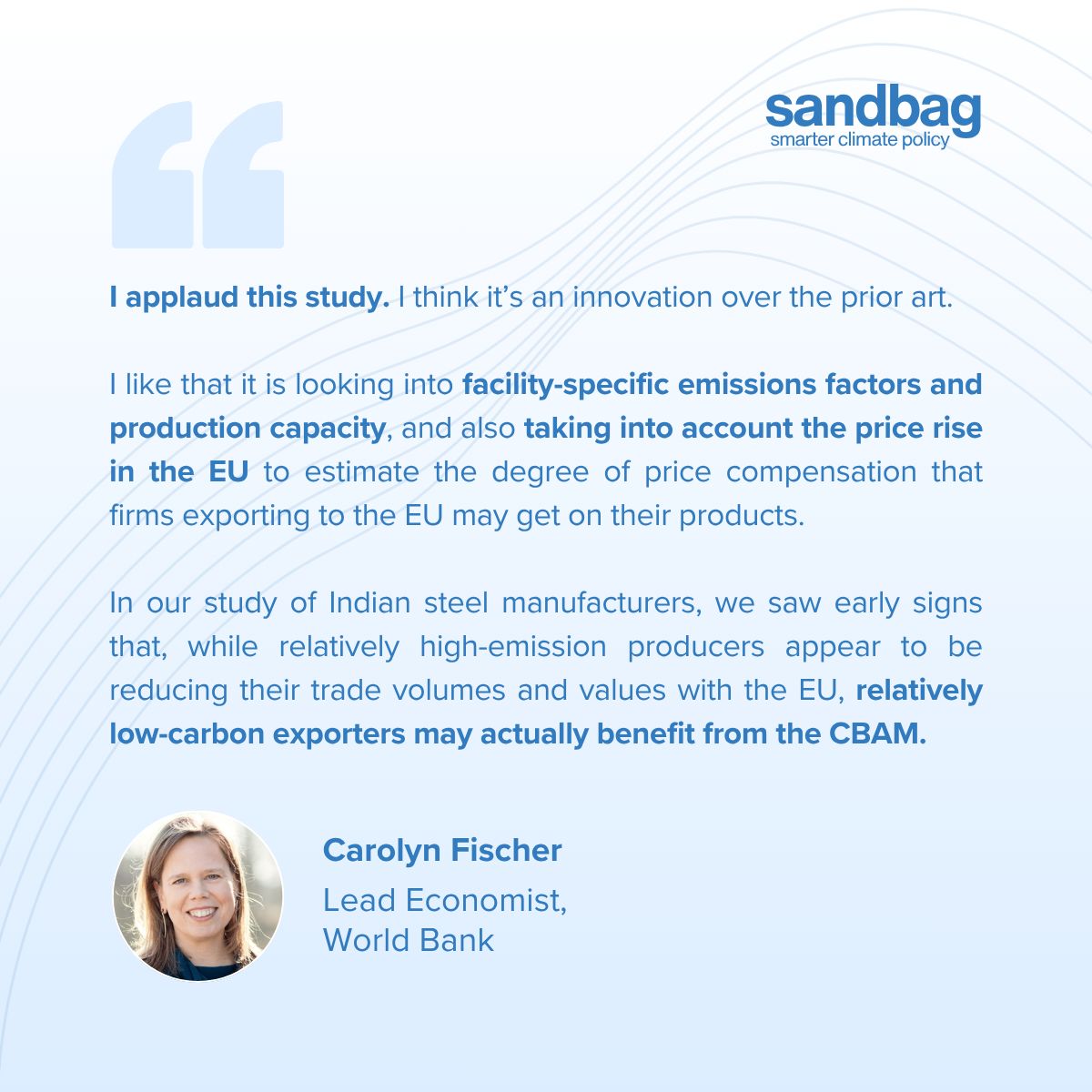
- India’s industry is already optimising its CBAM exposure. During our webinar to launch our report on the EU CBAM’s impact on India, World Bank lead economist Carolyn Fischer noted: “I applaud this study. I think it’s an innovation over the prior art. I like that it is looking into facility-specific emissions factors and production capacity, and also taking into account the price rise in the EU to estimate the degree of price compensation that firms exporting to the EU may get on their products.” Referring to her own research

Related profiles
Something wrong or missing? Send an update. Fixed within 24 hours.