
Overview
Soterics combines OT security consultancy, technology implementation, and managed services with two proprietary platforms (Vestoria and Vigilant) to serve industrial organizations across assessment, defense, detection, response, and sustained monitoring. The company offers strategic roadmaps, risk assessments, network monitoring, endpoint security, segmentation, incident response, and managed services.
In the news
- Your SOC has identified a potential threat. Production is still running. What happens next? In OT, detecting a signal is only the beginning. The real challenge is knowing, fast and with confidence: → what is actually affected → what the operational consequences could be → which response will contain the risk without creating disruption Because when context is missing, every decision takes longer. And during an incident, time is not neutral. In 2 days, Amine Besson will show how Vigilant turns fragmented threat signals into
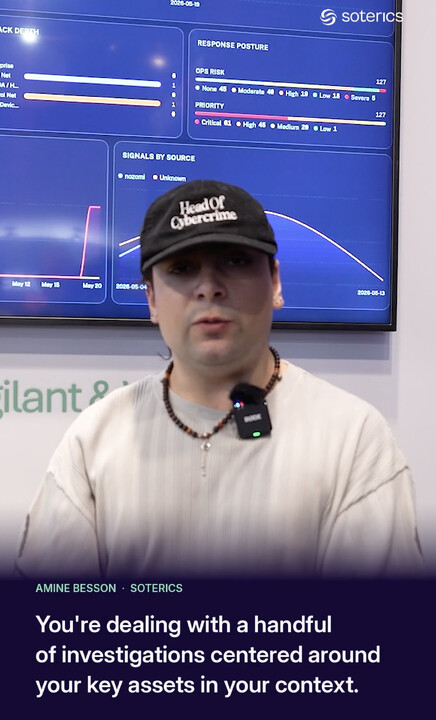
- An OT alert tells you that something happened. It does not tell you what it means for the operation. When a line is still running but a SOC flags a potential compromise, the questions that matter are different: → Which asset or process is actually affected? → Is this one isolated signal, or part of a wider situation? → What could the operational impact be? → What can the team safely do next? That is the difference between handling alerts and commanding a situation. In this short video, Amine Besson explains why OT teams need more
- Your SOC is not short of alerts. It is short of context. Detection tools do their job: they surface signals. But during an OT incident, your team still needs to understand : → Which asset or process is affected → Which signals belong to the same situation → What the operational impact could be →Which response is safe to take That is where Vigilant sits. It works alongside your existing NDR, SIEM and SOC to turn alert notifications into asset-centric, prioritised investigations, complete with OT and operational context, and safe
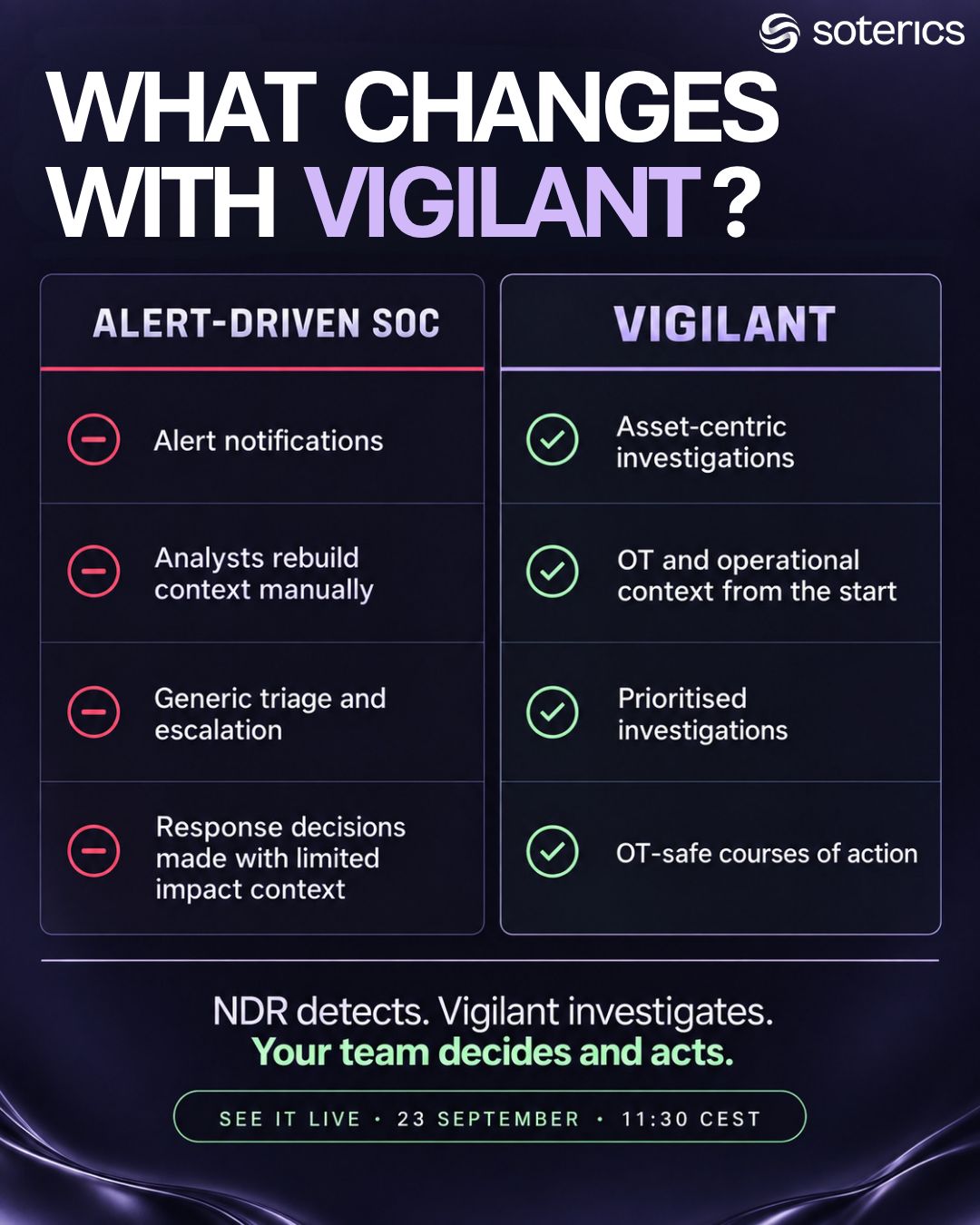
- Line 3 is still running. Your SOC says it's compromised. Now what? When an OT event happens, alert volume does not answer the questions that matter : → Which asset or process is actually affected? → What is the operational impact? → What should the team do next, and can it be done safely? Those are not detection questions. They are decision questions. As Amine Besson puts it: threat signals are not the bottleneck. Taking decisions is. Alert handling was never the job. OT teams need a clearer, shared understanding of the situation
- Alert handling was never the job. OT security teams are not here to manage an endless queue of disconnected alerts. They are here to understand what is happening, determine what matters, and support the right decision before operations are affected. 📅 On 23 September, join Amine Besson for our live webinar: “Alert Handling Was Never the Job: Situational Command for OT Security” Through live simulations, Amine will compare two approaches: → A legacy, alert-driven SOC built around a monolithic SIEM → A situation-driven model
- OT resilience is not created by technology alone. As Nick Peeters explains, it depends on how effectively people, processes and systems work together when something unexpected happens. This systemic understanding is essential to building security programmes that work in real industrial environments.
- Security alerts affecting industrial environments continue to multiply. The recent advisory concerning the active targeting of Siemens S7 controllers highlights an important reality : for an industrial organisation, knowing that a threat exists is not enough. It must be able to determine quickly : Which assets are affected. Where they are located. Which industrial processes depend on them. What the potential operational impact could be. And which actions can be taken without compromising production or safety. Most organisations
- OT security programmes are long-term. Budgets are usually annual. The model connecting the two has to be flexible. In industrial environments, not every site has the same exposure, readiness or operational constraints. Yet OT security is often approached as though the entire estate must be transformed at once: A wide initial scope. A large upfront investment. Multi-year commitments. Complexity before value. The result? The first meaningful step can be delayed, even when the priority risks are already known. This is the


Something wrong or missing? Send an update. Fixed within 24 hours.