
Overview
Starion is headquartered at Rue des Etoiles 140 in Libin, Wallonia, with an additional Belgian office in Diegem and operations in Luxembourg, the Netherlands, the United Kingdom, and Germany. The company traces its roots to RHEA Group, founded in the early 1990s, and emerged as an independent entity in April 2024 following a partial demerger of RHEA into two new businesses: Starion, focused on space and systems engineering, and Nexova, focused on Cybersecurity.
The company covers the full satellite lifecycle, from concept design through development, operations, and end-of-life disposal. Its product portfolio includes CDP4-COMET, a model-based systems engineering (MBSE) tool with a SysML v2 variant in development, Astral for mission operations, and SAFEPLACE, a crisis-management platform that supports wildfire and flooding response. Service areas span Earth observation, digital engineering, applied AI and machine learning, and quantum-safe communications. Starion is also active in Cybersecurity for space assets, an area treated as critical infrastructure by the European Space Agency and national space agencies.
On 30 April 2026, Sopra Steria announced that it had completed the acquisitions of Starion and Nexova, positioning the combined group as a European leader in space and Cybersecurity. Starion continues to operate from its Libin headquarters under the Sopra Steria umbrella.
Funding history
- Demerged from RHEA Group as an independent entityApril 2024
- Acquired by Sopra SteriaApril 2026terms undisclosed
In the news
- Connecting Talent, Innovation and Mission Success at IAC2026 🌍 This October, CS GROUP, HE Space Operations and Starion will be joining forces at the International Astronautical Congress (IAC) 2026 in Antalya. Together, we support every stage of the space mission lifecycle, bringing expertise in engineering, operations, cybersecurity, digital solutions, recruitment and contracting services. United by a common ambition to advance Europe's success in space, we help customers tackle complex mission challenges while connecting
- Continuing our long-term work with EUMETSAT, our experts will be presenting two papers at the EUMETSAT Meteorological Satellite Conference 2026 taking place in Darmstadt from 21-25 September): 🌍 Thursday 24 September at 15:30 – Prem Maheshwarkar, Atmospheric Product Development Scientist: ‘New improvements in PMAp and extensive calibration of operational product and climate data record’ ☁️ Friday 25 September at 12:30 – David Huerta Valcarce, Data Processing Software Engineer: ‘Cloud architecture for the new generation of advanced
- VIPER enters Phase 2 as Starion advances reusable AI for space and other computer vision domains. Starion Italia has launched the second phase of the VIPER project, an artificial intelligence (AI) image-processing framework designed to support a wide range of image-based applications. Asteroid detection and detecting illegal waste sites from space are two fundamentally different use cases. While these challenges share little in common operationally, they demonstrated that the same underlying AI architecture can be adapted to very
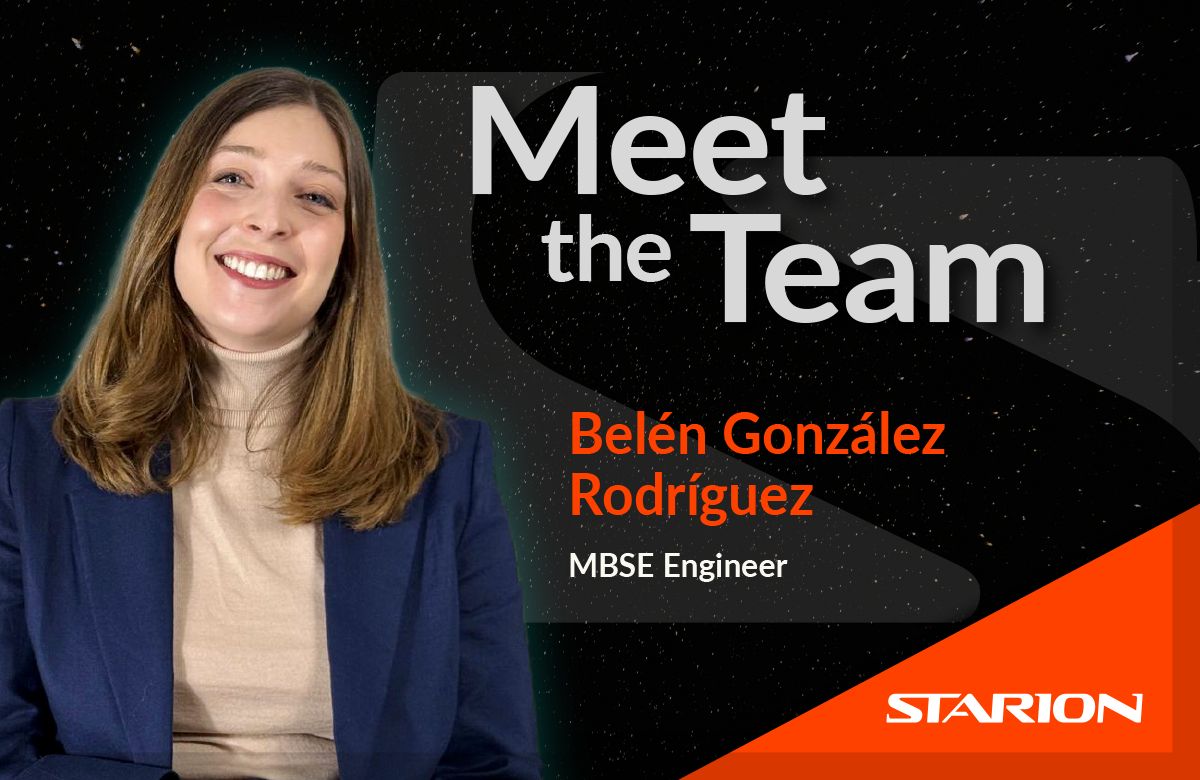
- Successful engineering is ultimately about people. 👤 Name: Belén González Rodríguez 💼 Role: MBSE Engineer 📍 Location: Madrid, Spain Belén uses system engineering, concurrent design and model-based system engineering (#MBSE) to help multidisciplinary teams across Europe turn complex ideas and requirements into clear, connected models. In our latest Meet the Team profile, she shares why trust, communication and collaboration are every bit as important as technology. Meet Belén: https://lnkd.in/edujAYNw
- At Starion, we've been directly involved with the BepiColombo mission for a long time, through the work of our science operations teams at the European Space Agency - ESA's European Space Astronomy Centre (ESA ESAC) in Spain. So we're going to be watching tomorrow's live feed from ESA's European Space Operations Centre (ESOC) very closely, because this is when BepiColombo's Mercury Transfer Module (MTM) will separate from the mission’s two science orbiters. Starion leads the coordination of specific science operations for several of
- As Europe looks to strengthen its preparedness for future risk scenarios, understanding the potential impacts of severe space weather is an important part of the picture. For this report, Starion was part of the study consortium led by PwC France, which sought to understand the impacts of "doing nothing" versus investing in a more resilient European space weather service architecture. Starion's primary responsibility was the Space Weather Impact Assessment, providing the technical analysis of how severe space weather events could
- Q. How do you get specialists to design a complex space system – or any other complex system – without getting lost in spreadsheets, presentations and disconnected documents? A. You give them a specially-designed suite of tools they can use to collaborate and create a shared model that is then used for the full life cycle of that system. That's the idea behind CDP4-COMET, Starion's collaborative model-based system engineering (MBSE) platform, used by engineers across space, defence and other sectors to accelerate design
- Congratulations to Starion's Francesco Gianotto on this recognition of his exceptional contribution to the work of the European Space Agency - ESA's Near Earth Objects Coordination Centre (NEOCC)! Francesco joins his Starion colleagues working at NEOCC who all have asteroids named after them: Marco Micheli, Dora Föhring, Laura Faggioli, Regina Rudawska and Maxime Devogele. Their work at the NEOCC detecting asteroids and assessing whether they present a risk to us on Earth is an essential part of global planetary defence

Open roles (5)
- Full Stack Engineer (Space Data)Wavre · Aug 19, 2026
- Migration and Security Compliance OfficerAug 5, 2026
- Senior HR OfficerAug 5, 2026
- Clean Space & Safety EngineerJun 25, 2026
- Applied Cryptography EngineerWavre · Jan 15, 2026
Something wrong or missing? Send an update. Fixed within 24 hours.