Overview
Steadiwear offers the Steadi-3 Plus, a hand tremor device designed for patients with Essential Tremor and Parkinson's Disease. The company provides resources for both patients and providers, including a validation study and comparison information.
In the news
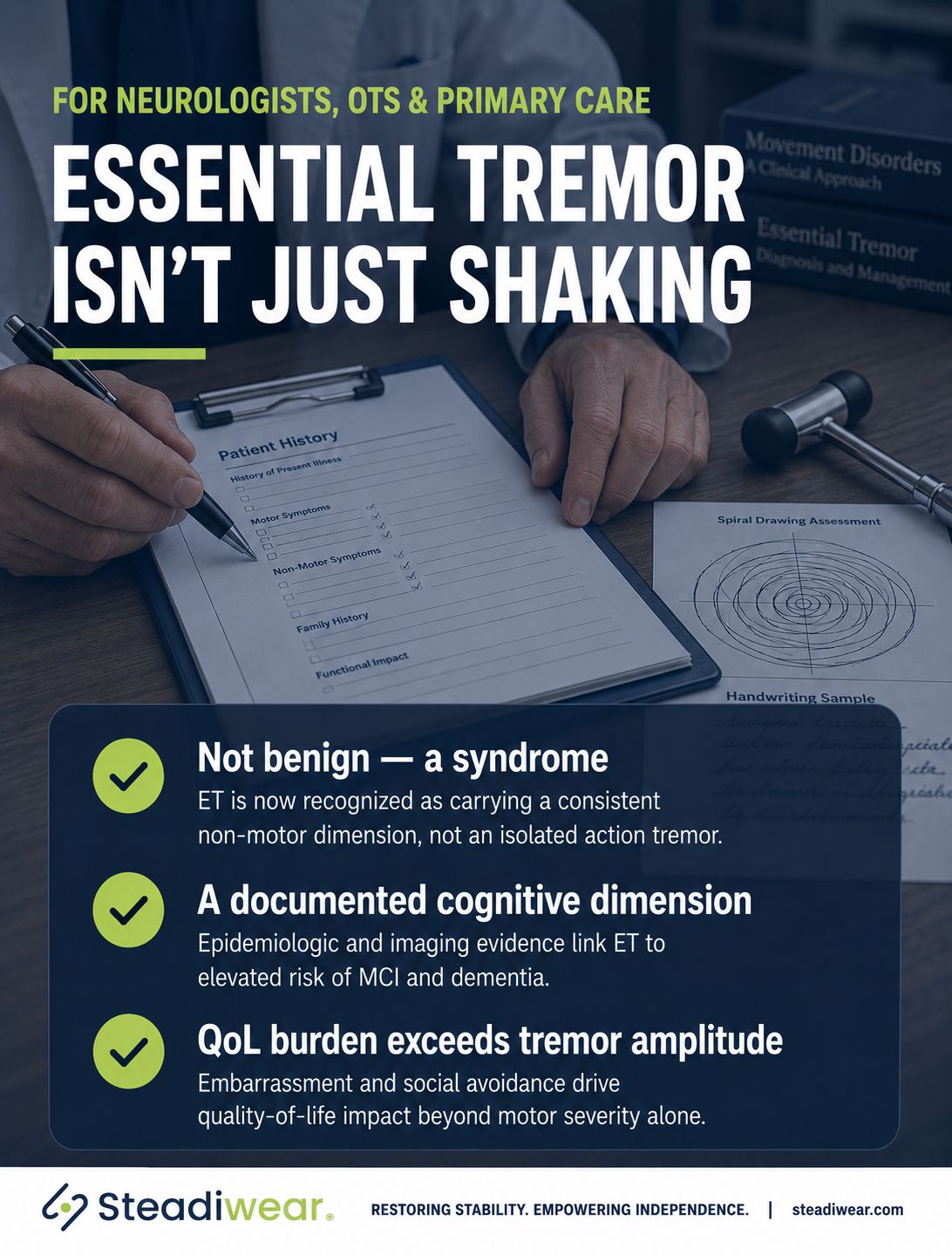
- Most clinicians were trained to think of essential tremor as a benign, monosymptomatic movement disorder. Two decades of evidence have quietly retired that model. Essential tremor is now better understood as a syndrome with a consistent non-motor dimension — one that standard tremor-severity scales don't capture: • Cognitive — epidemiologic, pathologic, and neuroimaging studies converge on a cognitive side to ET, including elevated risk of mild cognitive impairment and dementia (Cosentino & Shih, Int Rev Neurobiol, 2022). •
- Supporting someone with essential tremor is mostly small, quiet choices — and most of us get them wrong without meaning to. The instinct is to help: steady their hand, finish the task, tell them to relax. Each one is kind. Each one also quietly says "I've got this — you don't." What actually helps is smaller: • Ask first — "want a hand, or have you got it?" keeps the choice theirs. • Handle it quietly — no staring, no announcing. Normalcy is the gift. • Skip "just relax" — stress amplifies tremor; it's neurological, not nerves. •

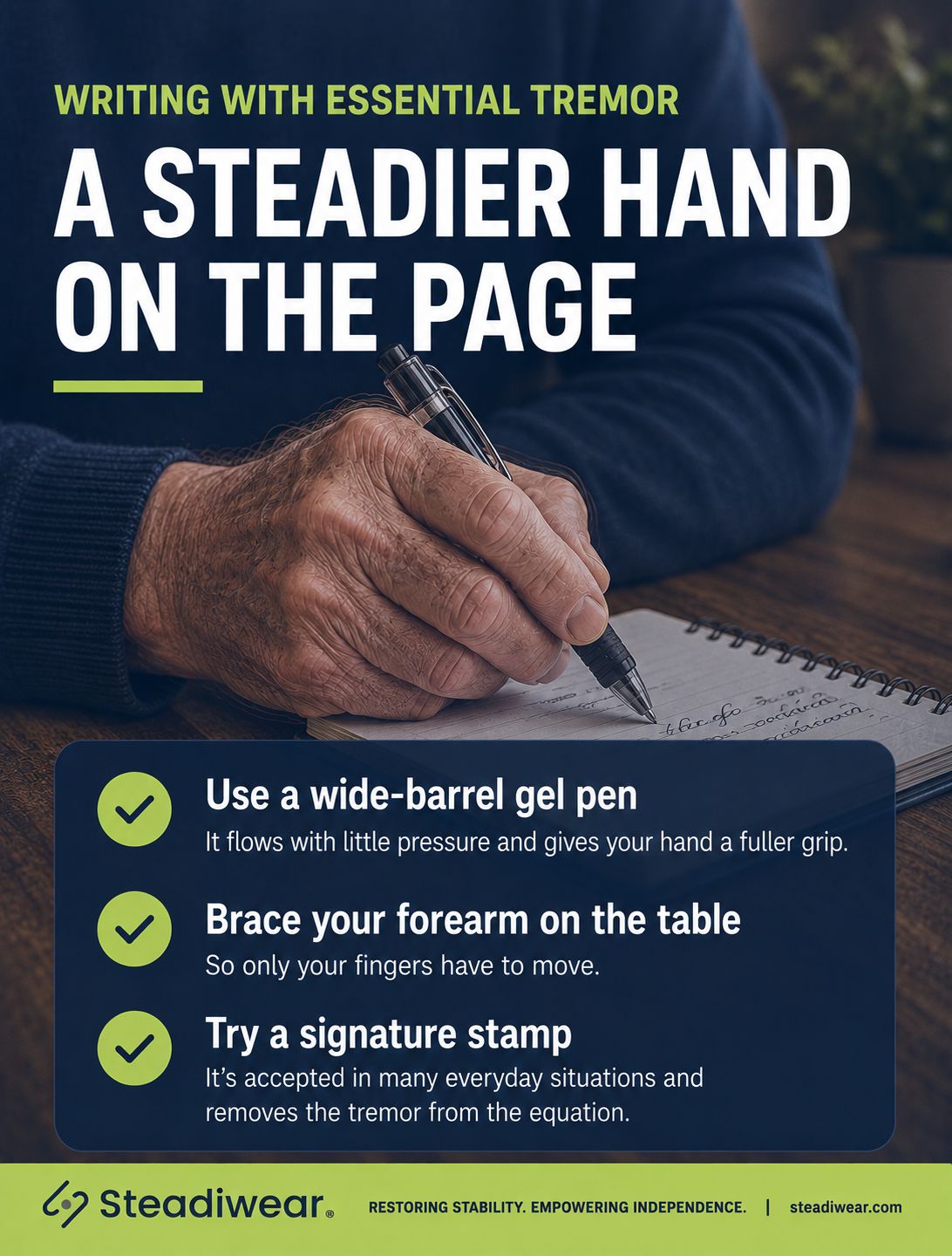
- Writing is often where essential tremor shows up first and worst as it demands the most precise, target-directed hand control of any daily task, which is exactly why clinicians use handwriting and Archimedes-spiral drawings to assess tremor. For the patients and clients OTs and clinicians support, a handful of strategies restore a lot of function: • Tool swap — a wide gel or rollerball pen that writes with minimal pressure, plus a non-slip surface, beats a thin ballpoint gripped hard. • Technique — bracing the forearm and writing
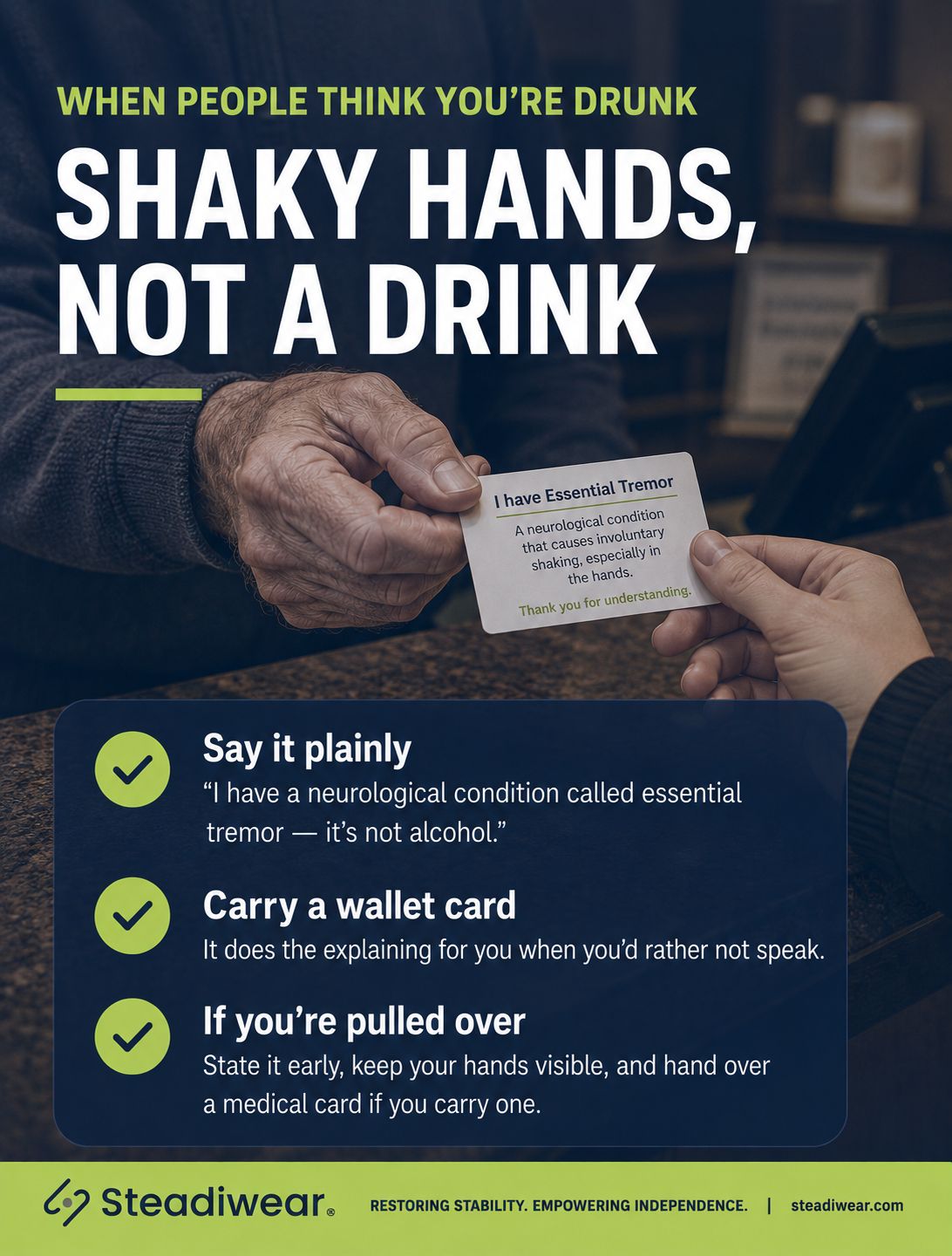
- To a stranger, essential tremor can look like something it isn't. Shaking hands —sometimes an unsteady voice or gait can get misread as intoxication, and being publicly misjudged becomes its own burden. It shows up clinically, too: social anxiety and social phobia are notably more common in essential tremor The coping strategies are practical and teachable — worth raising with patients directly: • A rehearsed line: "It's a medical tremor, not drink." • A wallet card stating "Essential Tremor — a neurological movement disorder,
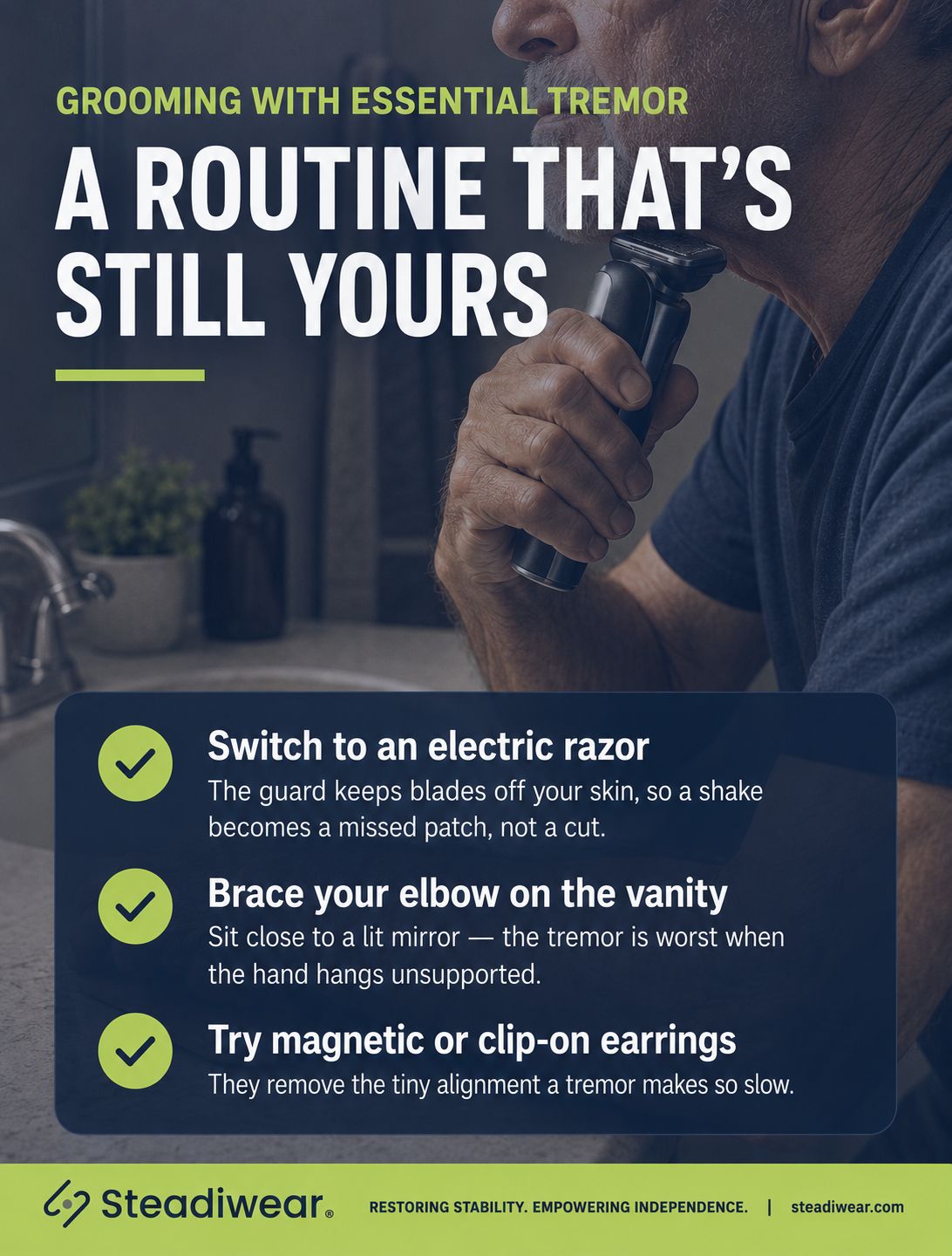
- Personal grooming is where a hand tremor is both hardest and most tied to the finest, most precise movements, performed right at the face, and it shapes how a person feels facing the world. In one patient survey, 85% of people with essential tremor reported difficulty with hygiene and grooming, an area with almost no dedicated guidance. Most of it is addressable with tool swaps that an occupational therapist can recommend: • Electric razors and toothbrushes, which perform the fine motion and keep blades off the skin. • Bracing the
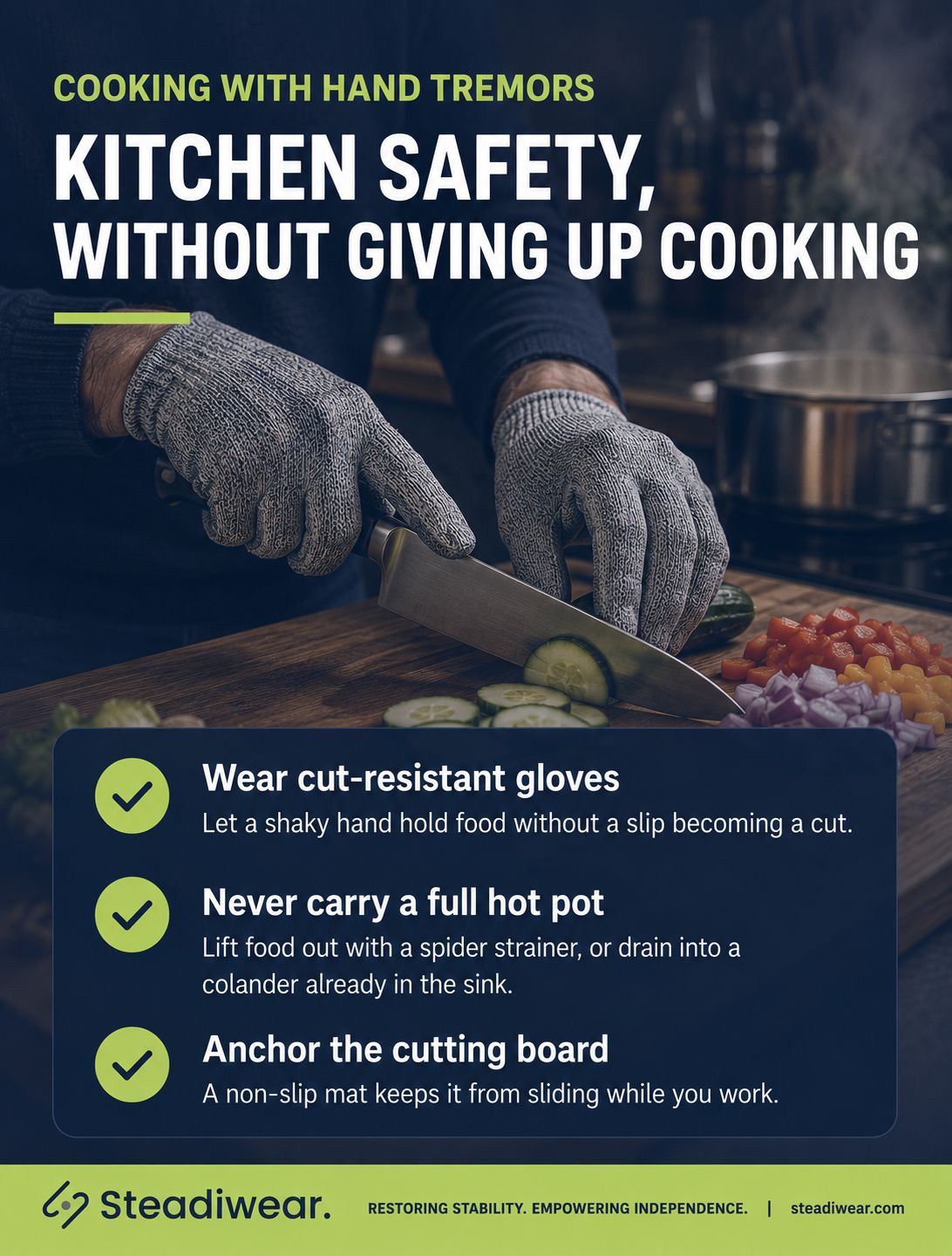
- Many people with essential tremor quietly give up cooking and the reason is mechanical. ET is an action tremor that worsens as the hand nears its target, which is exactly what a knife tip or a lifted pot demands. Most of the fix is environmental, not medical: • Cut-resistant gloves, a rocker knife, and a non-slip mat under the board keep sharp hazards away from a shaky hand. • Never carry a full hot pot — strain food out, or drain through a colander already sitting in the sink. • A food processor or pre-cut produce removes
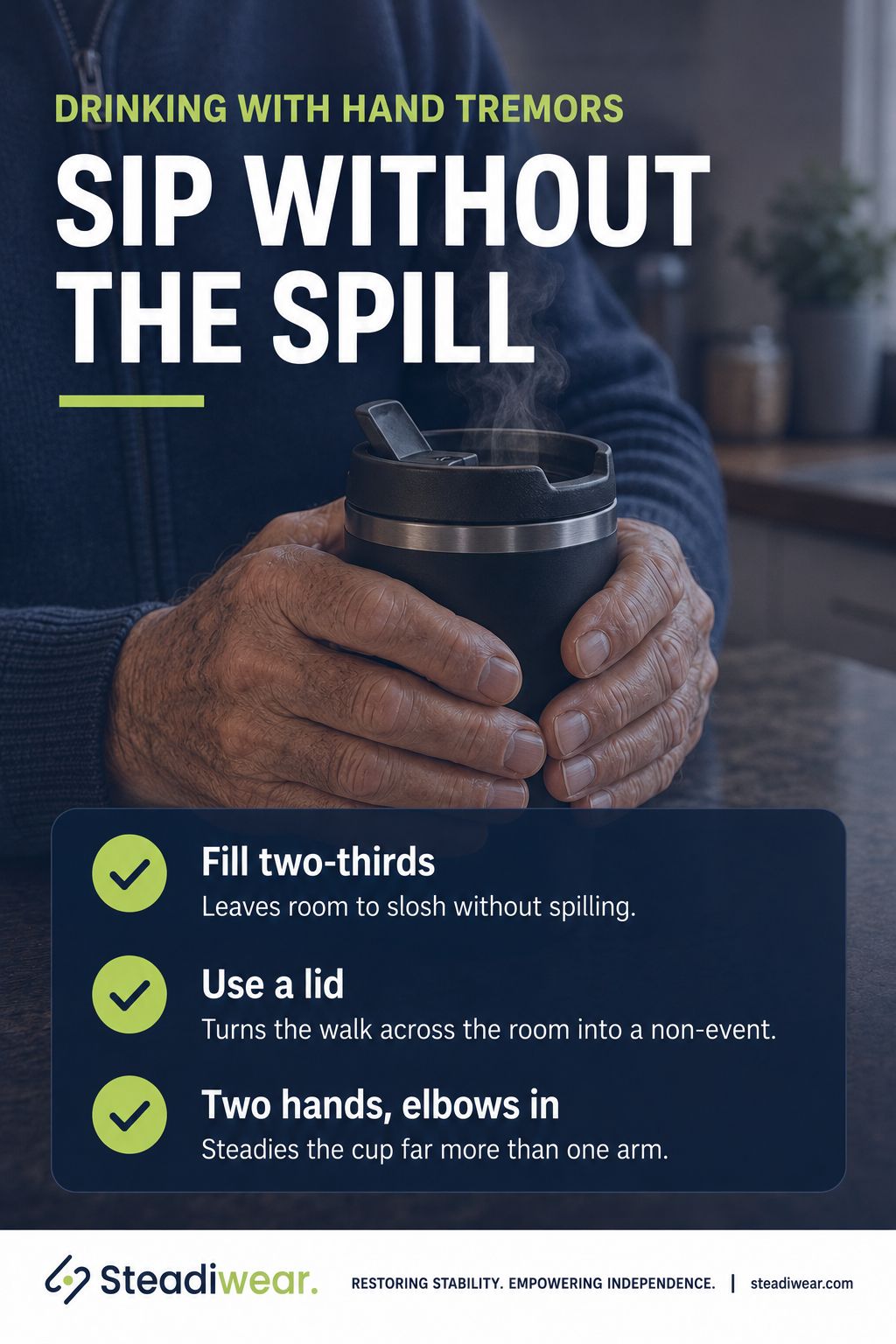
- Drinking from a cup is one of the most-reported daily difficulties in essential tremor, 95% of patients in one survey — yet it's rarely addressed head-on. The cause is mechanical: ET is an action tremor that intensifies as the hand approaches a target, so raising an open cup to the mouth turns every small wobble into a spill. Most of that difficulty responds to simple, low-cost strategies an occupational therapist can teach or a caregiver can apply: • A secure lid to contain spills mid-shake • A reusable straw to remove the
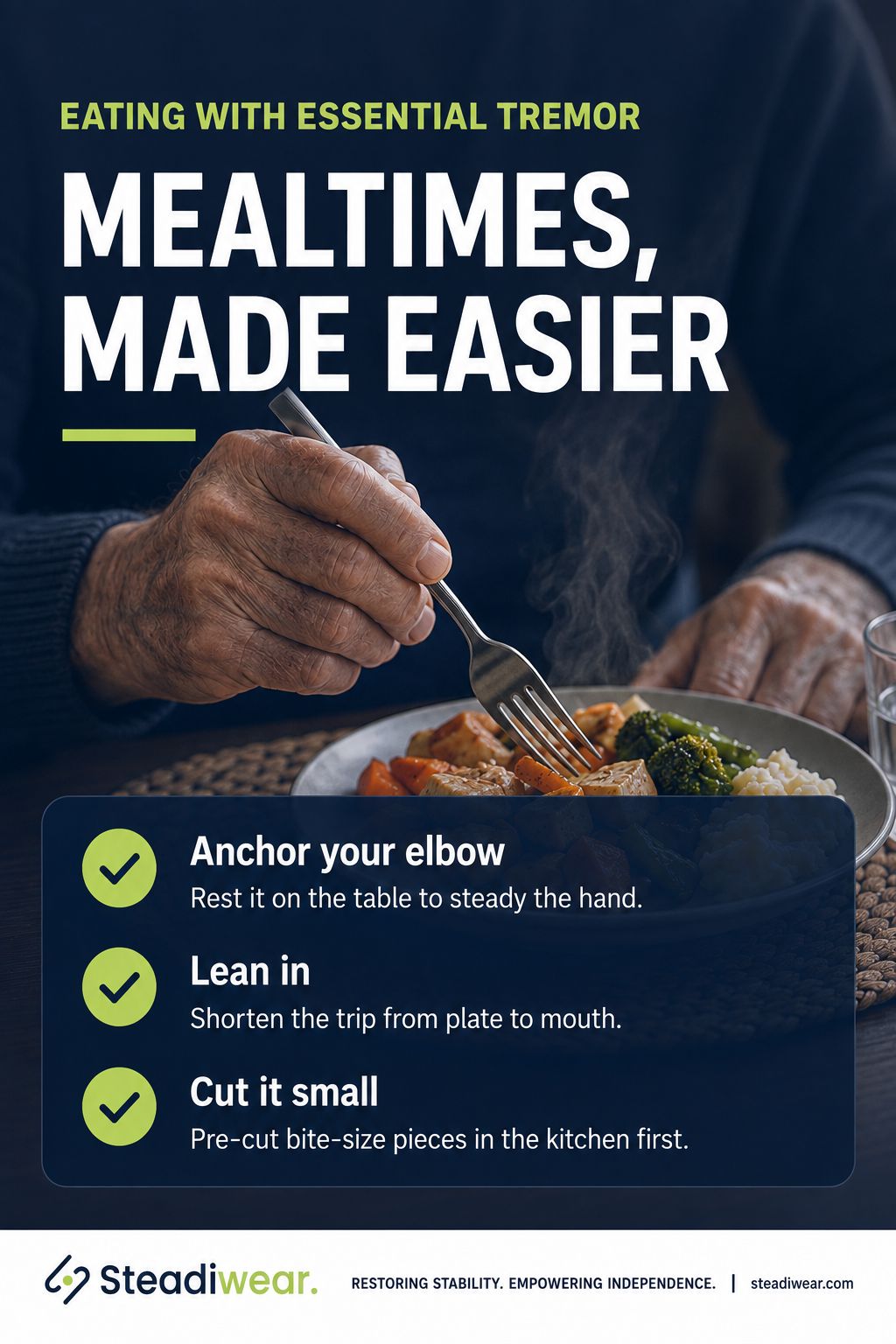
- Eating is one of the most disruptive daily challenges of essential tremor and one of the most overlooked. The tremor is typically worst in the final inches to the mouth, because essential tremor is an action tremor that intensifies with target-directed movement. The encouraging part: much of the difficulty is addressable with simple, free techniques an occupational therapist can teach - → Brace your elbow on the table to stabilize the hand → Lean in to shorten the reach from plate to mouth → Pre-cut food into bite-size pieces before
Something wrong or missing? Send an update. Fixed within 24 hours.