
Overview
SYNTHEMA is a cross-border hub that develops and validates AI techniques for anonymisation and synthetic data generation in rare haematological diseases. The company aims to generate reliable, high-quality synthetic data to create virtual patients for diagnostic enhancement, treatment assessment, and outcome prediction in haematology, addressing data silos scattered across European clinical sites and registries.
In the news
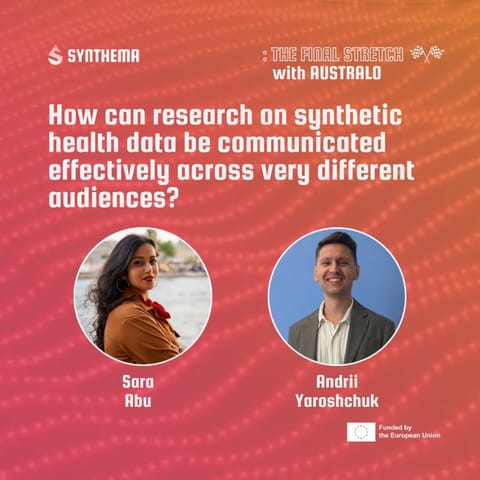
- Some of the hardest work in research communication begins when complex science has to make sense outside the project itself. As SYNTHEMA is in its final stretch, Sara Abu and Andrii Yaroshchuk, PhD from AUSTRALO reflect on what it has meant to communicate research on synthetic health data to audiences with very different levels of prior knowledge. The task was never simply to make topics such as federated learning, privacy-preserving technologies or synthetic data “easier”. It was to give people a clear way into the research without
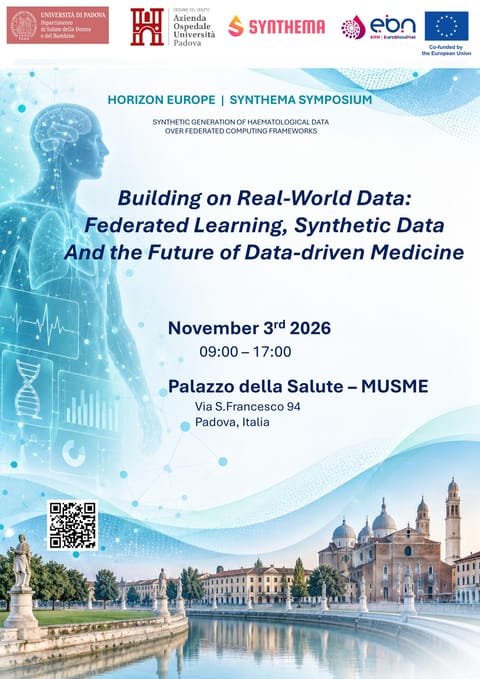
- Nearly four years of research, collaboration, challenges and achievements. And next week, we’ll finally have the opportunity to share it all with you in Padua! On 3 November, the SYNTHEMA consortium will come together for a symposium organised by the Università degli Studi di Padova (UNIPD) / University of Padua. We’ll share what we’ve been working on, what we’ve learned along the way and what our results could mean for medical research in Europe. We look forward to seeing you there and having some good discussions!
- Synthetic data can resemble real patient data statistically and still fall short of what medical research actually needs. For SYNTHEMA, reliability means going further. Synthetic patients need to preserve meaningful clinical relationships, remain medically plausible and perform reliably in the research tasks they were created to support. In the latest SYNTHEMA | The Final Stretch feature, Gastone Castellani from Alma Mater Studiorum – Università di Bologna explains how clinical and statistical validation help establish whether
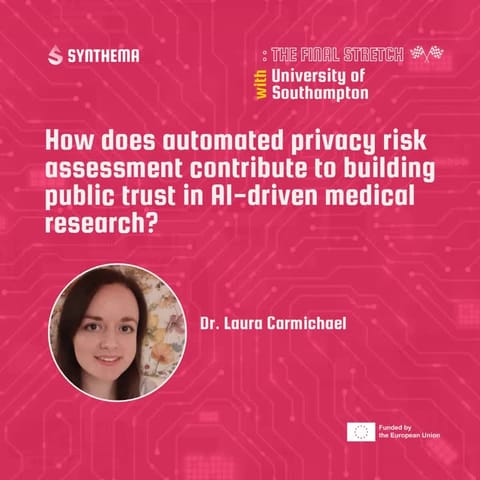
- Trust in medical AI is not something an automated tool can produce. Automated privacy risk assessment can help organisations identify and manage risks more systematically. But demonstrating that medical AI is worthy of trust also depends on transparency, public participation and clear rules around how data is used. In the latest SYNTHEMA | The Final Stretch feature, Laura Carmichael from the University of Southampton looks at where automation can support this process and why privacy assessment remains only one part of a much wider
- Today, we’re sharing two new SYNTHEMA training sessions. Nathan Lea (The European Institute for Innovation Through Health Data) covers regulatory compliance for AI-driven synthetic data in healthcare, while Dario Martinelli (AUSTRALO) offers practical guidance on making scientific communication clearer and more effective. Both sessions are now available on YouTube. More in our latest newsletter 👇
- We want faster research, but we demand transparency, validation, and a seat at the table.” That message came through clearly when Eduard J. van Beers from UMC Utrecht spoke with 41 patients during the Dutch National Rare Blood Disorders Day. In the latest SYNTHEMA | The Final Stretch interview, he reflects on how patients respond to synthetic data once they better understand how it works, and why transparency remains essential for building trust around its use in rare disease research. Watch the interview for the full perspective.
- Your professional perspective can help us strengthen the SYNTHEMA ethical framework for AI-generated synthetic data in rare haematological disease research. We are inviting clinicians, policymakers and regulators, hospital data managers, DPOs, IT governance professionals, researchers and data analysts to review the framework and share their feedback. ▶️ Watch the 5-minute video: https://lnkd.in/eWG9mue8 📝 Complete the anonymous survey, up to 15 minutes: https://lnkd.in/eaDawrUb Responses are anonymous and will only be reported in
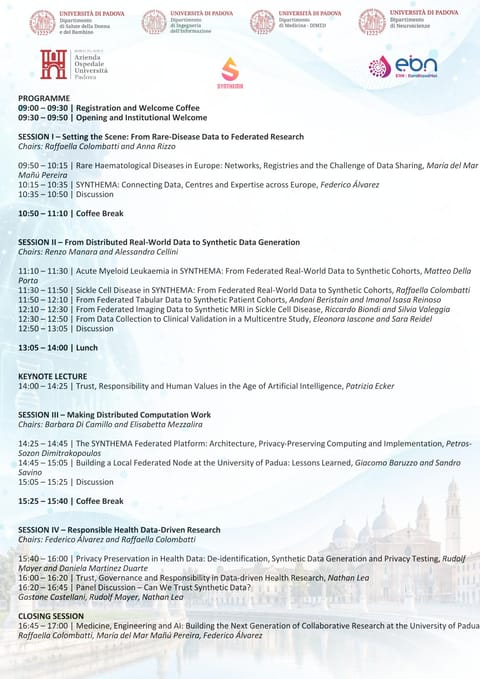
- As SYNTHEMA nears its conclusion, we are coming together in Padua to present and discuss the work, results and lessons developed across the project. On 3 November, the Università degli Studi di Padova (UNIPD) / University of Padua will organise a symposium dedicated entirely to SYNTHEMA, with researchers, professors, students and project partners taking part in the discussion. See the attached programme for the full agenda, including sessions on rare-disease data, synthetic data generation, federated research, privacy and responsible

Something wrong or missing? Send an update. Fixed within 24 hours.