
Overview
ToDrinQ is a EU-funded project that aims at developing a toolkit of technologies, systems and decision tools that will improve overall water systems operations and secure high quality drinking water. The project operates across five demo cases in Amsterdam, Athens, Val de Bagnes, Beaune, and Hradec Králové.
In the news
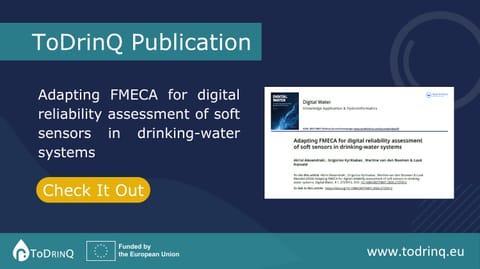
- New ToDrinQ research publication! The study, authored by Akrivi Alexandraki, Greg Kyritsakas, Martine van den Boomen and Luuk Rietveld, explores how Failure Mode, Effects and Criticality Analysis (FMECA) can be adapted to assess the reliability of soft sensors used in drinking-water systems. 🔍As machine-learning models increasingly support real-time monitoring and operational decision-making, their reliability goes beyond model accuracy. The research examines potential digital failure modes such as data loss, model drift and
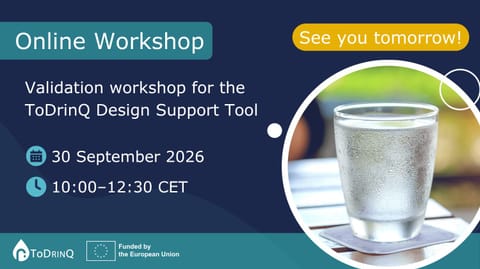
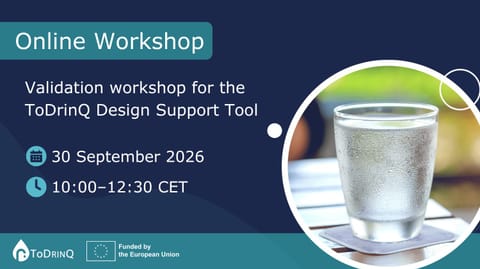
- Tomorrow is the day! Join us online tomorrow, 30 September, from 10:00 to 12:30 CET, for the ToDrinQ Decision Support Tool (DST) Validation Workshop. 💻 Get a first-hand look at the ToDrinQ DST through a live demonstration, explore how the tool can support drinking water management, and share your feedback through an interactive discussion and validation exercise. Your input will help us validate the tool and ensure it responds to the needs of its future users. 📅 30 September 2026 ⏰ 10:00–12:30 CET 📍 Online 👉 Last
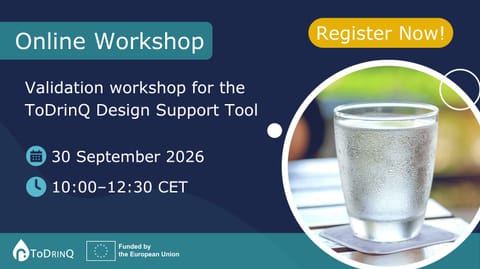
- Only 2 weeks to go! Explore the ToDrinQ EU Design Support Tool at our Workshop on 30 September | 10:00–12:30 CET | Online During the workshop, participants will explore the tool through an extensive live demonstration and help assess its practical usefulness in the context of the revised #DrinkingWaterDirective. 💡Your expertise can help us understand how digital tools such as the DST can better respond to the needs of water professionals and support safer drinking water systems. 📅 30 September | 10:00–12:30 CET | Online
- One of Europe’s key event for water innovation is heading to Ireland! Grab your ticket and join us in #Dublin on 13–14 October. Sponsored by Veolia and supported by the Irish Presidency of the Council of the EU 2026, #WIE2026 will debate on the Water Framework Directive implementation and continue to turn the Water Resilience Strategy into action. 🎟️Register and check the agenda: https://lnkd.in/eTxGJicf 📣Are you an utility, a solution provider, a local & regional authority or another actor of the water sector? 🚨You have two

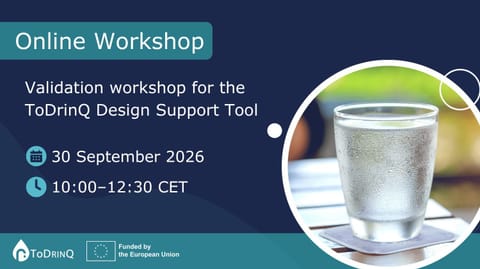
- In just three weeks, participants will have the opportunity to go inside the ToDrinQ EU Design Support Tool and explore how it can support drinking water treatment decisions. 📅 30 September | 10:00–12:30 CET A comprehensive live demonstration will show the DST in action, giving participants the opportunity to understand: 🔹The objectives and structure of the tool 🔹How the platform supports treatment plant design 🔹How different information can be integrated into decision-making 🔹Its potential application in the context of
- Our sister project H2OforAll has published a new scientific review: “Holistic overview on disinfection by-products formation and their analytical characterisation.” The open-access publication provides a comprehensive overview of disinfection by-products (#DBPs) in #drinkingwater, exploring: 🧪DBP precursors and formation mechanisms 🔬Current analytical detection and quantification methods 📊Challenges linked to low concentrations and complex monitoring protocols 📡Opportunities for in-line DBP monitoring and robust sensing
- Why does the Design Support Tool matter? Developed as an interoperable decision-support platform, the #DST aims to strengthen #drinkingwater treatment design and improve the ability of systems to respond to changing conditions. On 30 September, ToDrinQ EU will open the tool to researchers, utilities and policymakers during a dedicated online Validation Workshop. 🔎Discover how it works. 💬Discuss its practical application. 📝Help assess its usefulness for the drinking water sector. When?📅 30 September | 10:00–12:30 CET
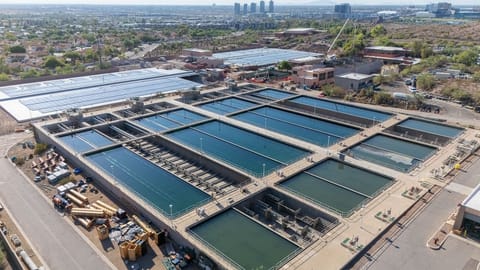
- How and why do disinfection by-products form in #drinkingwater? A new scientific review published by our sister project H2OforAll provides a holistic overview of #DBP formation, looking at how disinfectants interact with natural organic matter and other compounds present in source waters. The publication explores DBP precursors, formation mechanisms, analytical challenges and emerging approaches that could support better monitoring and control of these compounds. 💧Understanding when, where and why DBPs form is essential to


Something wrong or missing? Send an update. Fixed within 24 hours.