
Overview
Zensor, founded in 2013, operates under the tagline 'Smart from Remote.' The company offers industry-specific and infrastructure solutions for remote asset and monitoring management.
In the news
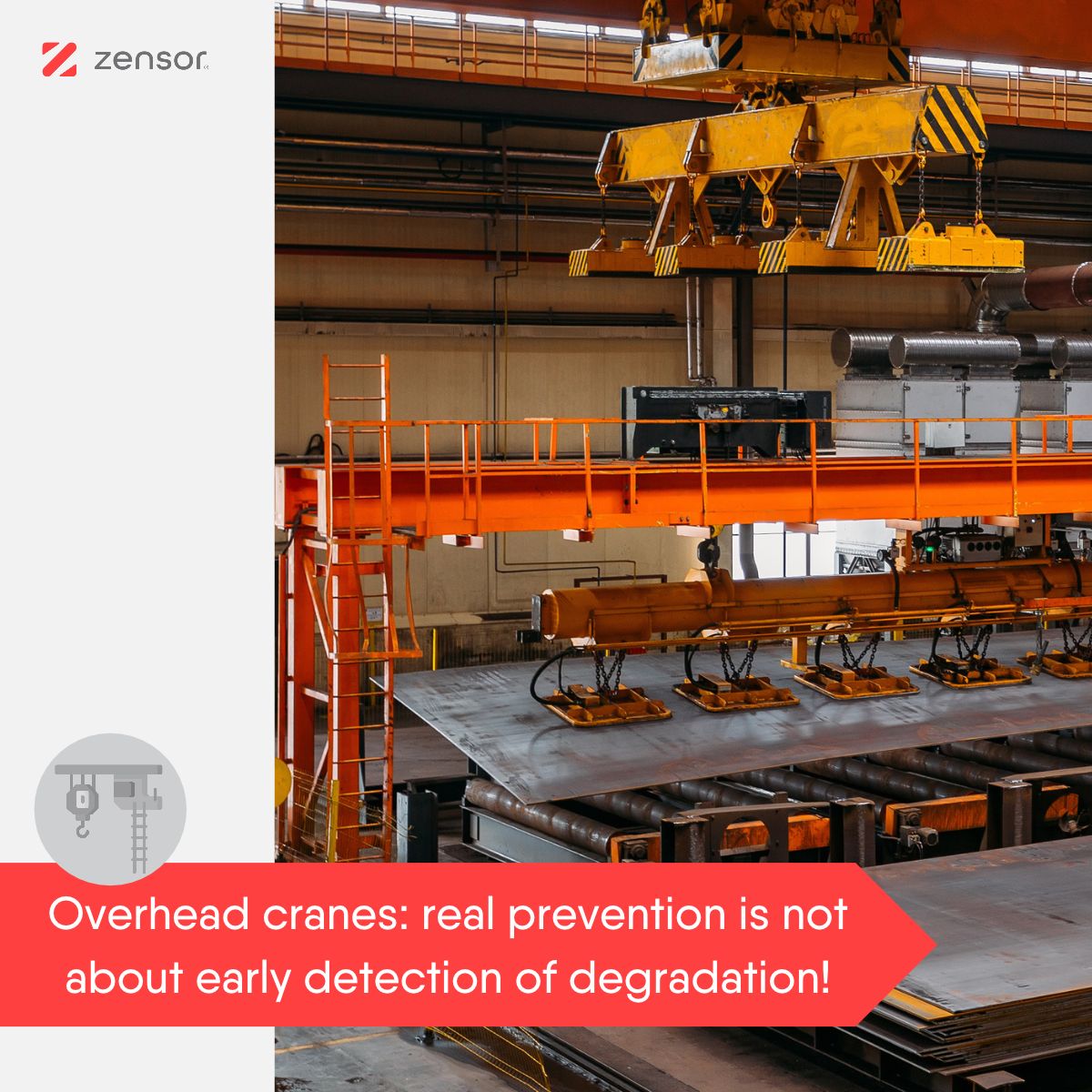
- Overhead cranes are destined to fulfill their role for many years. Drive trains and hoists are important: without them no lifting or moving of the loads. The surrounding elements are however essential as well. When they fail, there’s no way around it. Rail damage, runway issues, girder fatigue… These issues do not only represent a safety risk, they also affect components looked at more frequently like the drive train: issues with the rail or runway get picked up by the wheels, resulting in increased vibrations, axle issues, couplings
- Brussels Minister-President Boris Dilliès spent his Voka summer internship day with Zensor. We proposed not to do it at the office — desks and screens say very little about what we actually build 🏗️ . So we went to see real work: the DoubleTree by Hilton near Rogier, a SOCATRA and Denys construction site, where one of our systems is monitoring the structure. The challenge: building a hotel on top of a live metro tunnel. The Minister-President also helped moving one of the sensors installed to a new location. Four things we wanted
- Boring is not always bad... 📚 As what your caster turret is doing: rotate a bit... cast; rotate a bit again... cast;... Till it stops doing that. Simple but critical. Adding some smart monitoring, you can avoid that it stops turning. Read the brochure to get a glimpse of our dedicated product to monitor turret health.
- When the EAF is melting its charge, you hear a lot of noise. A lot of components Shake, Rattle and Roll. This is also the title of a major hit from the 50s of the previous century. People born in that era, by listening to the Shaking, Rattling and Rolling, could tell if something was off with the furnace, and most probably also what. These people have long left the mill. And other experienced ones are doing so as well. Signs of “something being wrong” are not picked up that readily any more. This is a challenge. Today one can
- Why do most overhead cranes rely on positive camber? Because you're not buying a crane for a season. You're buying 15-20+ years of lifting, and the girder has to hold its geometry for all of it 🏋. Camber is the upward curve built into the beam so that under self-weight and rated load, it deflects back toward straight — not into a sag. Lose that curve over time, and you're not just losing precision. Rail alignment drifts, wheel loads go uneven, end trucks start fighting the runway — and every cycle after that accelerates fatigue at
- An automated crane, is it a blessing or a curse? Steel mills and non-ferrous production sites are increasingly shifting to the use of automated cranes, mainly in expedition and storage areas. The rationale behind is related to higher efficiency, throughput and safety. Adaptive scheduling, optimal control and route optimization indeed bring a lot of benefits. There is a caveat though. In “the old days” the crane drivers used to be the eyes and the ears of the maintenance manager. They would report if anything strange was
- When steel enters the Ladle Furnace (LF), it is nearing its highest value. Here, the final treatments determine its composition. As a result, the LF plays a key role in the steel mill’s added-value process. When it fails, the mill’s overall profitability is affected. Most of these failures have a mechanical and/or electrical origin. Examples include issues with the electrode lifting system, process deviations caused by electrode vibrations, damage to the slewing bearing, transformer problems, a failing gantry, and electrode

Alumni 1 went on to found or lead
 Tom BusscheAdvisor→Chief Executive Officer at Qbus Building Intelligence
 Guillaume MarionResearch Analyst→AI Team Lead at Proximus Ada
Something wrong or missing? Send an update. Fixed within 24 hours.