Overview
He teaches mathematics and IT at Sint-Paulusschool Campus VTI Waregem and is its pedagogical IT coordinator, working half-time in that role. His second half-time position is within Howest Bachelor secondary education for the XR Action Plan of the Ministry of Education, supporting schools in Flanders with one-on-one guidance and workshops.
He is a mathematics and IT teacher and pedagogical IT coordinator at Sint-Paulusschool Campus VTI Waregem, where he has worked for years on XR in education, mainly mixed reality with Microsoft HoloLens. ErgoXR started when he approached Charlotte Larmuseau of Howest's Smart Technology Research lab with the question whether XR could support ergonomic training. Howest's HITLAB research group developed the app together with Sint-Paulusschool Waregem, with ergonomist Lieven Maertens labelling the data, funded by imec's Smart Education at Schools programme. The app combines VR headsets with body sensors, scores posture with REBA and gives red, orange and green feedback. It was also an InnoVET 2023-24 project and is available in Dutch and English. A follow-up research project, Ergo XR 2, is led at Howest by Ine Van der Cruyssen. ErgoXR has since become a startup under his leadership, with expanded exercises, multilingual versions and work towards the healthcare and retail sectors. The application targets the cost of musculoskeletal disorders in Belgium with 20-minute sessions that can run on the shop floor or in a care ward. Alongside VTI Waregem he works half-time within Howest Bachelor secondary education on the XR Action Plan of the Ministry of Education, guiding secondary schools across Flanders and running workshops on XR in technical education. He gave a keynote on Ergo XR at Advanced Engineering Belgium.
Career history
Insights & ideas
The through-line
Every post returns to the same conviction: ergonomics training fails when it stays theoretical, and only works when the body actually performs the movement, repeatedly, with correction in the moment. Bram Van de Wege states it directly, "Dát is het verschil tussen weten hoe het moet en het ook echt dóén" [1], and frames the current default as broken: "Van een eenmalige theoretische ergonomieopleiding blijft amper 10% hangen. Je lichaam leert een beweging nu eenmaal niet uit een presentatie" [12]. This thesis does not shift across the two weeks of posts; instead each entry applies it to a different piece of the product, a technique video, a dashboard, a feedback system, a science explainer, so the through-line is less an evolving argument than a single belief restated through successive features.
On doing versus knowing
The recurring contrast is between watching and performing. "In ErgoXR bekijk je deze beweging niet alleen: je doet ze zelf, stap voor stap, en wordt bij elke afwijking meteen bijgestuurd" [1]. The same structure appears with the wheelbarrow example: "je voert de beweging zelf uit, stap voor stap, terwijl ErgoXR elke houding live meet en je onmiddellijk corrigeert. Eerst met virtuele begeleiding, daarna zelfstandig — tot de juiste techniek een automatisme is" [8]. The learning model is explicitly staged from guided to independent: "Van begeleid oefenen naar zelfstandig correct bewegen" [15].
On the science of repetition
Van de Wege grounds the product claim in a specific mechanism: "Een beweging wordt pas een gewoonte na 30 tot 50 herhalingen" [11][13], contrasted with "Ons leermodel toont aantoonbare gedragsverandering na 30 interactieve sessies van 20 minuten" [11]. The conclusion is stated as a general rule, not just a product feature: "Kort, frequent en actief oefenen verslaat één lange theorieles — elke keer" [11], and again, "één cursus per jaar werkt niet — en korte, regelmatige oefensessies wél" [13].
On scaling training
A separate preoccupation is operational: training programs fail not just pedagogically but logistically. "Geen trainer inplannen. Geen groep verzamelen. Geen productiestop" [3] describes the barrier, and the fix is framed as a scale problem solved: "Dat maakt ergonomietraining eindelijk schaalbaar: van 10 naar 1.000 werknemers, zonder 100x de kost" [3].
On objective data
Van de Wege repeatedly insists that posture assessment should be measured, not judged. "REBA... normaal een handmatige analyse door een ergonoom. Bij ErgoXR gebeurt dat live, tijdens elke beweging, automatisch" [6]. The dashboard extends this to management: "Objectieve data over houdingsverbetering doorheen de tijd — geen buikgevoel, maar meetbare vooruitgang" [7]. Feedback within the training itself follows the same logic of immediate, measured correction: "nudges op het juiste moment, replay en pauze om je houding te bekijken, en sterren per fase" [14].
Takeaways
- Training sticks only through repetition and correction in the moment, not through watching or one-off theory sessions [1][12].
- The claimed threshold for habit formation is 30 to 50 repetitions of a movement, with measurable behavior change after 30 sessions of 20 minutes [11][13].
- Self-directed training removes the scheduling and production-stop barriers that make group ergonomics training hard to scale, going from 10 to 1,000 employees without multiplying cost [3].
- Posture risk (via live REBA scoring) and progress (via a dashboard of exercises, time, attempts, replays) are meant to be tracked objectively rather than assessed by gut feeling [6][7].
- The learning software is built in three phases, from step-by-step guided practice with virtual objects to unguided practice to real objects [15].
- The underlying team combines engineers, ergonomists and innovators with scientific backing from University of Antwerp and Ghent University advisors [4].
In the news
- Nieuwe set oefeningen Weten hoe het moet is niet gelijk aan het ook juist doen. Daarom breiden we uit: nieuwe oefeningen in ErgoXR. Zelf uitvoeren, stap voor stap, met directe feedback bij elke afwijking. En laat één ding duidelijk zijn: ergonomie eindigt niet aan de poort van de werkvloer. De beweging die je leert om een doos correct op te nemen, gebruik je 's avonds bij de boodschappen, aan de winkelkar en bij het inladen van de koffer. Wat je lichaam aanleert, neemt het overal mee. Welke beweging zou jij in deze lijst willen

- Neem net zoals ik op 8 oktober deel aan Learning Bytes Festival. https://lnkd.in/eQdEjZMp
- Uitrol ErgoXR bij Decathlon België Van pilot naar uitrol: ErgoXR komt naar de Decathlon-winkels in België. 🛒 Na de testfase in enkele vestigingen zet Decathlon de stap naar een bredere uitrol. De eerste sessies worden begeleid door hun externe preventiedienst Securex — en dat detail is belangrijker dan het lijkt. Bij de eerste sessies staat een ergonoom van Securex mee op de vloer. Zo blijft het niet bij een oefening in een headset, maar ook begeleiding en sturing op de werkplek. Waarom Decathlon hierop inzet: in retail wordt
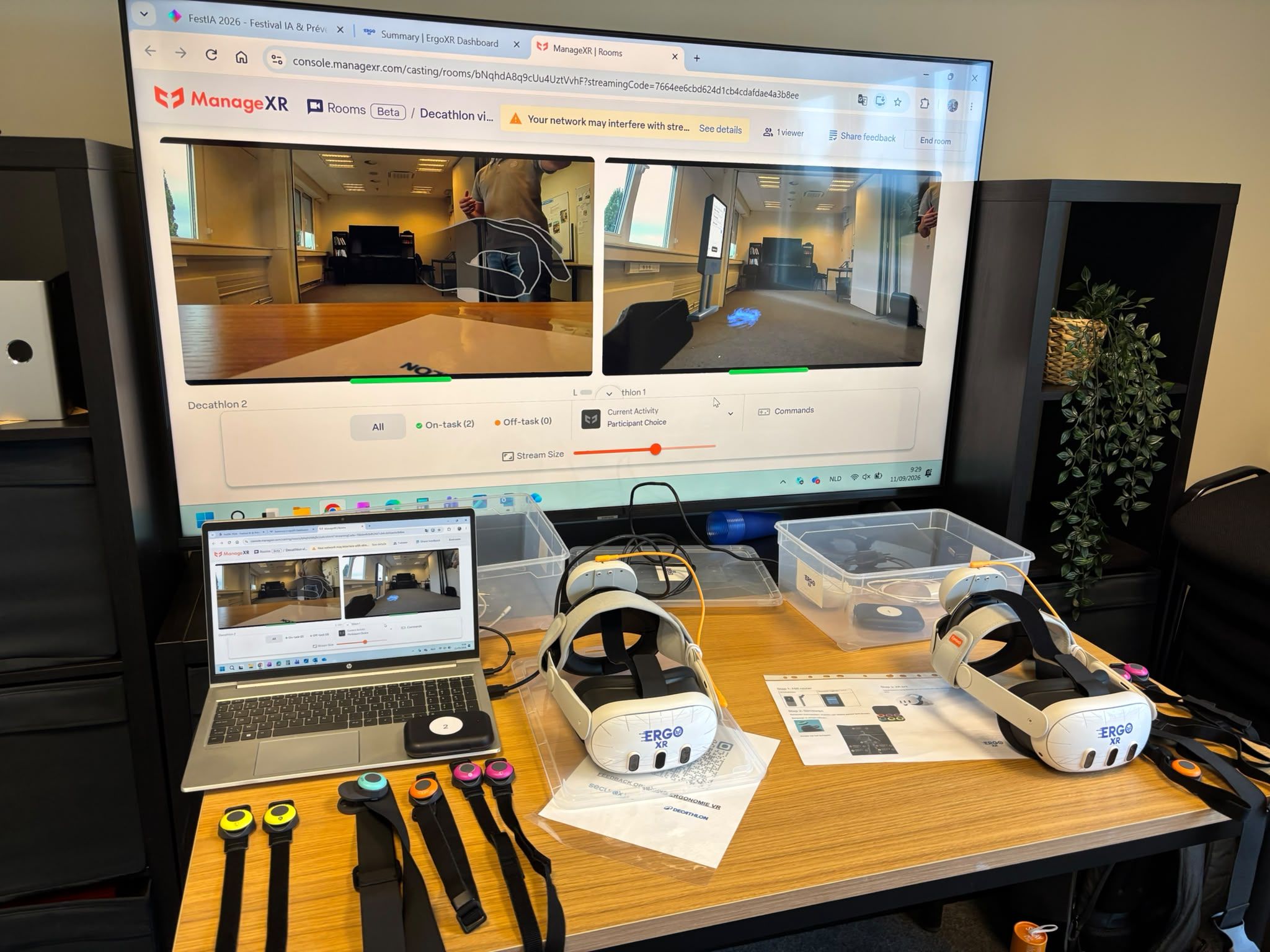
- Testing ErgoXR Wil jij ook ErgoXR ontdekken? Kijken of dit past binnen uw bedrijfscultuur van zorgzaam omgaan met de gezondheid van uw personeel. Stuur gerust een bericht. Wil jij deelnemen aan één van onze testdagen en zo onze nieuwe features ontdekken. Laat zeker je mailadres achter in een comment. #HRTech #Edtech #preventie #MSK #wellbeing

- Weekendtip: verdeel je gewicht Weekendtip 🛍️ Boodschappen, gieters, zakken potgrond: verdeel het gewicht. Twee tassen van 5 kilo dragen je rug beter dan één van 10. Woensdag toonden we het principe met twee emmers — thuis geldt precies hetzelfde. Symmetrisch dragen, dicht bij het lichaam, en niet draaien met een last in je handen: verplaats je voeten. Goed bewegen is geen werkregel, het is een gewoonte. Zeven dagen per week. 🇬🇧 Weekend tip 🛍️ Groceries, watering cans, bags of soil: split the weight. Two 5-kilo bags treat your

- Het inzicht van Decathlon Hun inzicht is opvallend eenvoudig — en net daarom sterk: wacht niet tot er klachten zijn. In retail wordt er de hele dag getild, gebukt, gereikt en verplaatst: rekken vullen, magazijn werk, click-and-collect. Veel Decathlon-medewerkers zijn twintigers zonder één klacht. Precies dát is voor hen het juiste moment. Bewustwording creëren vóór de eerste rugpijn, niet erna. Het is exact wat we deze week schreven over de boekentas: wie jong leert dat een last dicht bij het lichaam hoort, doet dat twintig jaar

- Techniek van de week: twee emmers opnemen Twee emmers dragen is minder belastend dan één. 🪣🪣 Klinkt tegenstrijdig, maar het is dezelfde logica als de boekentas van gisteren: twee banden in plaats van één. Eén zware emmer trekt je zijwaarts uit balans en belast je onderrug asymmetrisch. Verdeel je het gewicht links en rechts, dan blijft je romp recht en werkt je rug zoals hij hoort te werken. De techniek 👇 ▪️ Ga tussen of dicht bij de emmers staan, voeten op schouderbreedte ▪️ Zak door de knieën, rug recht, heupen naar achter ▪️

- Preventie #EersteSchooldag #MSK #StartYoung #EdTech #HRTech #Education

Related profiles
This page shows public professional information only, each fact cited. Is this you? send a correction, or ask for removal within 24 hours, no questions asked.