Overview
Chuck de Liedekerke co-founded Soil Capital in Belgium, building the platform that created Europe's first certified carbon payment programme in 2019. Soil Capital works with farmers to measure, reward, and certify regenerative agricultural practices, connecting agricultural land management to corporate carbon credit buyers.
The company posted 2196% revenue growth in the Deloitte Technology Fast 50 Belgium 2025, reflecting significant commercial traction in the voluntary carbon market and regenerative agriculture sector.
Career history

In the news
- Happy 10 years, Regrow Ag 🥳. We are proud to feature in Regrow's anniversary series, A Decade in the Field, to take a look back at the growth of the regenerative field. Our CEO Chuck de Liedekerke reflects on how the circle of capital behind regenerative agriculture has widened, from farmers to corporates to banks, investors and policymakers in the past decade. When Soil Capital signed its first corporate partnership, it was worth €3,000. Today, farmers in our programmes have been paid more than €20 million for their transition
- When we started Soil Capital, my banking friends asked me why anyone in finance would ever care about soil. This week, our resilience analytics work is on the Bloomberg Terminal, the screen where much of the world’s capital gets allocated. I’ll admit I smiled. What I’ve learnt alongside 1,800 farmers over the years: healthy soil isn’t only good for the climate. It is what keeps a farm standing in a drought, a flood or a bad price year. That makes it a risk signal, for the farmer, for the bank behind them, and for the food
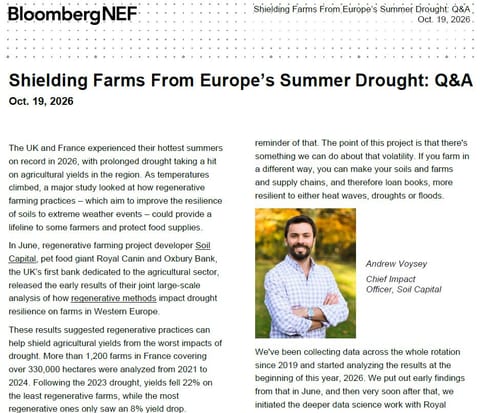
- The Bloomberg Terminal is known the world over for providing valuable information to financial markets. It's therefore a meaningful milestone for us all in this space to see extensive coverage of our work to codify the quantification of how farm management practices reduce yield volatility during weather extremes into capital allocation decisions published by BloombergNEF on the terminal. Over the summer, with Europe's 2026 drought still in full force, I sat down with our partners Nick Evans of Oxbury Bank Plc and Rémi ROCCA
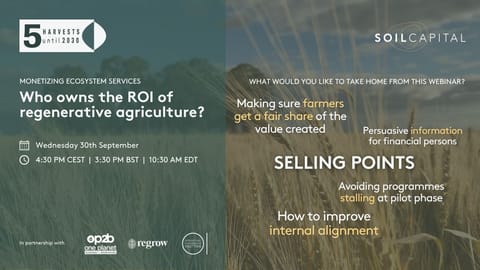
- Spoiler alert: no single team owns the ROI of regenerative agriculture." Our CEO Chuck de Liedekerke said that a year ago (link in the comments), walking through the financial model of a regenerative transition. Judged on one department's expense line only, the transition will always look like a cost while the returns land in everyone else's P&L (profit and loss). Hundreds of you have already registered for our webinar taking place next week. And when we asked what you want to take away from the conversation, one theme
- We are thrilled to announce a new partnership with Kellogg's centered around supporting wheat farmers in the UK. Our goal is straightforward: 100% of the UK wheat volumes used by Kellogg’s will be covered by the Soil Capital regenerative agriculture programme over the next five years. To put it plainly, that’s more than 20,000 tonnes of grain! We dare you to find a bowl large enough to fit it all in your morning menu. “At a time when UK farmers are facing challenges, from unpredictable weather, to pressure on

- It is with great excitement that we are starting a partnership with HEINEKEN UK on what could be one of the UK's largest regenerative malting barley programmes. Through the collaboration of farmers, maltsters, a grain merchant, a brewer and agronomists, by 2027, almost half of The HEINEKEN Company's malted barley will come from farms using regenerative practices, backed by Soil Capital’s independent verification and direct payments to farmers for verified outcomes. The future of food depends on partnerships like this, and we
- Delighted to firm up the collaboration between Regrow Ag and Soil Capital, with this special focus on LatAm. Thanks to Jonathan Unger, Yannick D. and teams for brining this together, and to Anastasia Volkova, PhD, looking forward to our continued good work together!
- Lu dans Time To Sign Off (dont je recommande la lecture bien sûr): "Le gouvernement révèle les premières estimations des dégâts causés par la canicule pour les agriculteurs. Une cata : -30% de production pour le maïs cette année (= "son plus bas niveau depuis 26 ans"), -50% pour le houblon ou les carottes dans certaines régions, jusqu’à -20% de production dans la filière arboricole (pommes, abricots, pêches) + "forte tension hydrique" pour le reste des fruits/légumes et mort de 2,5 à 3M de volailles (environ 1% de la production
Related profiles
This page shows public professional information only, each fact cited. Is this you? send a correction, or ask for removal within 24 hours, no questions asked.