
Overview
Dominique Demolle is chief executive officer of Cognivia, a role she has held since January 2014. She is based in Brussels.
Before that, she was a co-founder of Aepodia SA, where she worked from February 2007 until January 2014. From 2004 to February 2007 she was associate director of global early phase operations at Eli Lilly and Company.
She obtained a Ph.D. in biochemistry from the Free University of Brussels in 1989.
Career history

In the news
- Innovation is not in short supply in clinical research. The challenge is connecting technology, data, processes, and people in a way that creates measurable and sustainable change. Today at the Fortrea Innovation & Technology Summit EU in Basel, Dominique Demolle, CEO of Cognivia, joins leaders from Fortrea and Veeva Systems to explore how our industry can move beyond individual innovations and work collectively toward transforming clinical development at scale. Looking forward to discussing what it will take to turn promising

- Everyone agrees that clinical research needs to transform. The harder questions are: • Why do so many transformation initiatives fail to scale? • How do we balance innovation with trust and governance? • How do we bring people along rather than impose change upon them? • What does responsible adoption actually look like in practice? These are some of the questions that will be explored at the upcoming Fortrea Innovation & Technology Summit in Basel. We're proud that Dominique Demolle, CEO of Cognivia, has been invited to join
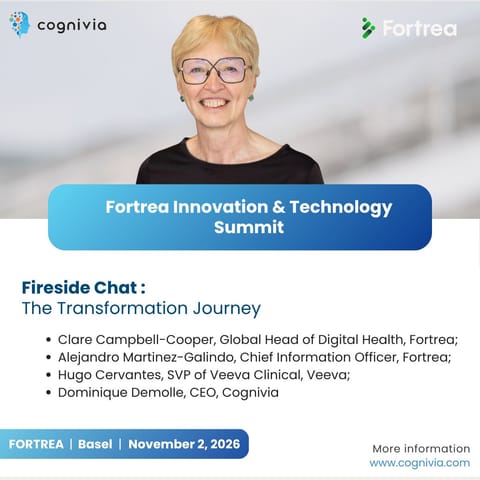
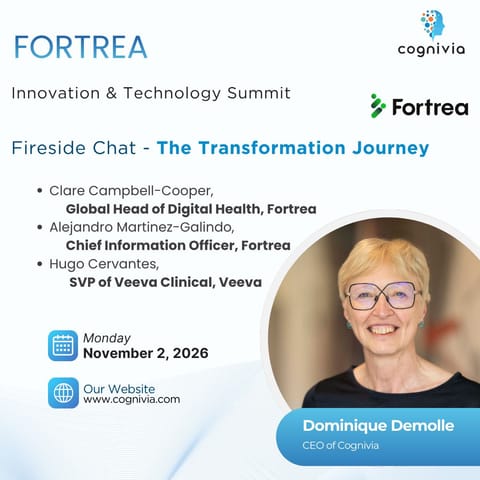
- We're pleased to share that our CEO, Dominique Demolle, has been invited to participate in a panel discussion at the Fortrea Innovation & Technology Summit in Basel alongside leaders from Fortrea and Veeva Systems including Clare Campbell-Cooper Hugo Cervantes and Alejandro Martinez Galindo. Clinical research is entering a period of profound transformation. New technologies are creating significant opportunities, but lasting change will depend on much more than technology alone. The future of clinical development will require
- In conversations about AI in clinical trials, one topic consistently takes center stage: data quality. But an equally important question may deserve more attention: Are we collecting the information that is most relevant to the decisions we're trying to make? This question emerged repeatedly during the development of our recent thought-leadership paper on AI adoption in clinical development with Fortrea. It's a subtle distinction, yet one that could have significant implications for how our industry evaluates risk, designs
- With @ClareCampbell-Cooper and @JohnKennett from @Fortrea, and my colleague @StephanieAlvarez from @Cognivia, we recently wrote a white paper dedicated to "From potential to practice: What will it take to make AI work in clinical trials?" In my opinion, the next stage will not be determined solely by better algorithms. Success in trial execution and data interpretation will depend on our ability to define the right problem, decide on the most relevant information to collect, and then use technology to optimize conduct and reduce

- Patient behavior has often sat outside that framework, acknowledged as important but difficult to quantify. That may be starting to change. I was pleased to see #TheHealthcareTechnologyReport highlight the growing role of behavioral intelligence in clinical research. Not because it recognizes Cognivia, but because it reflects a broader evolution in how our industry is approaching some of its most persistent challenges. Retention, adherence, missed visits, treatment discontinuation. These are often discussed as operational problems.
- Clinical trials are built to reduce uncertainty. Yet one important source of uncertainty is often treated as noise rather than studied directly: #humanbehavior. When #clinicaltrial outcomes vary, our first instinct is often to look for biological explanations. 1️⃣ Did the drug work differently? 2️⃣ Was the patient population different? 3️⃣ Were there underlying disease-related factors? But what if some of that variability comes from differences in #expectations, #motivation, #adherence, or #engagement throughout the study? In a
- We are thrilled to begin collaborating with Mayo Clinic. Behavioral intelligence is a “missing layer” in better understanding patient motivation and the challenges of adhering to treatment recommendations or staying engaged in clinical studies or treatment procedures. We are honored to benefit from #MayoClinic’s insights and shared decision-making, and to collaborate on patient retention methodologies. #ClinicalResearch #BehavioralIntelligence #PatientEngagement #ClinicalTrials #SharedDecisionMaking
This page shows public professional information only, each fact cited. Is this you? send a correction, or ask for removal within 24 hours, no questions asked.