
Overview
Felix Van de Maele is the Founder and CEO of Collibra[1], a data intelligence platform that connects IT and business operations to build data-driven cultures for digital enterprises[2]. Van de Maele has held this position since May 2008[3]. Beyond Collibra, Van de Maele serves as a Board advisor at Guardsquare as of March 2019[4] and holds the position of Fellow van de Hogenheuvelcollege at KU Leuven since October 2013[5]. Van de Maele's educational background includes a Master of Science in Computer Science from Ecole des Mines de Nantes and Universidad Nacional de La Plata, both completed in 2007[8][9], as well as a Master in General Management from Vlerick Business School in 2008[7]. Prior to founding Collibra, Van de Maele worked as a Researcher at Vrije Universiteit Brussel from March to August 2007[6].
Profile introduction
Collibra is the Data Intelligence company. We accelerate trusted business outcomes by connecting the right data, insights and algorithms to all Data Citizens. Our cloud-based platform connects IT and the business to build a data-driven culture for the digital enterprise. Global organizations choose Collibra to unlock the value of their data and turn it into a strategic, competitive asset. We have a diverse global footprint, with offices in the US, Belgium, Australia, France, UK, Czech Republic and Poland. For more information, visit collibra.com.
Career history
- Founder, CEOMay 2008 to presentCollibra
- Board advisorMar 2019 to presentGuardsquare
- Fellow van de HogenheuvelcollegeOct 2013 to presentKU Leuven
- ResearcherMar 2007 to Aug 2007Vrije Universiteit Brussel


Education
Master in General Management, Management2007 - 2008Vlerick Business School
- Master of Science, Computer Science at Universidad Nacional de La Plata2007 - 2007Education
- Master of Science, Computer Science at Ecole des Mines de Nantes2006 - 2007Education
Insights & ideas
The through-line
Across every source, Van De Maele returns to one claim: the constraint on enterprise AI is no longer the model, it is what surrounds it. In mid-2026 he starts framing this explicitly as a category shift, "for years, enterprise AI was defined by model capability. Today, the models are no longer the limiting factor" [5], and repeats variations of "the failure point in enterprise AI is rarely the model. It is the context around it" [6][7]. Over the course of these posts the argument sharpens from a diagnosis into a prescription: first he names the gap (context that exists but can't be reached by agents) [6][8][12], then he ships a product answer to it (the Governed Context Compiler) [6][7], then he extends the argument into unstructured data via acquisition [9], and finally he reframes the whole category around enforcement, ROI, and budget allocation rather than model selection [2][3][4][10][11]. The throughline hardens from "context matters" to "governed context that flows is the product," with hallucination reframed not as a technical glitch but as a business cost he calls the hallucination tax [4][15].
On governed context
Van De Maele's central distinction is between context that merely exists and context that is governed and delivered. "More context isn't the win. Governed context is" [1]. He argues catalogued definitions are inert unless agents can act on them: "A definition an agent can't access is just documentation. Governed context can't simply exist. It has to flow" [6][7]. This is why two AI applications can give different answers to the same question about monthly active users, "neither model is wrong. They are working from different business definitions" [6][7]. His fix is architectural: pulling "governed context from the Collibra Knowledge Graph" and delivering it "through REST APIs, MCP, or YAML export," built to be "deterministic by design" [6][7]. He extends this to the semantic layer: "A semantic layer gives AI a shared business language. Context governance builds on that foundation by providing the meaning, trust, lineage, and policy AI needs to reason reliably and act with confidence" [8].
On the hallucination tax
He coins and repeats a specific cost concept: "Every time your team has to second-guess an output, manually verify a recommendation, or redo an AI-driven task, you're paying the 'hallucination tax'" [4]. The stakes escalate as AI moves from answering to acting: "poor governance isn't just an accuracy problem. It's a business liability" [4]. He uses a concrete benchmark to make the point vivid, "if a company like Anthropic only achieved a 21% accuracy rate on its own data without the right business context, what do you think happens inside the average enterprise?" [4]. Elsewhere he frames the tax as an emotional as much as operational cost: "AI confidently producing answers that simply can't be trusted" [15].
On enforcement and trust
Van De Maele distinguishes having a policy from being able to enforce it: "Most have an AI policy. Far fewer can tell me which production models are running without a documented accuracy score... That is the gap in AI governance right now. Not the absence of rules, but the ability to enforce them" [2]. He backs this with third-party data points he treats as validating evidence: Forrester found that "out of the thousands of organizations they surveyed, exactly zero reported a 2x return on their AI investment" while "nearly three-quarters plan to increase their AI spending" [10], and he cites a colleague's formulation that stuck with him, "Data and knowledge governance is the runtime memory of an enterprise agent" [10]. He also leans on Gartner's prediction that "By 2027, 60% of organizations will fail to realize AI value due to a lack of integration between data governance and AI governance" [11] to argue that fragmented tooling "doesn't scale" [11].
On unstructured data
He treats unstructured content as the next governance frontier rather than a side case. "Every AI model enters your enterprise knowing almost everything about the world, and almost nothing about your business," including whether a policy changed yesterday or what it's allowed to act on [8]. He frames the acquisition of Deasy Labs as extending governance "into the 80% of enterprise data that has traditionally been out of reach: documents, contracts, call transcripts, emails, and other unstructured content that AI agents depend on to reason accurately and act with confidence" [9]. His broader claim is that "the quality of an agent's decisions ultimately depends on something much more fundamental: the context it has access to," and much of that "lives in unstructured data" [12].
From the stage
In interview and podcast settings he gives sequencing and mechanism detail the written posts skip. On go-to-market, he identifies product-market fit as the necessary first step before scaling "through thought leadership, product leadership, and market leadership in that specific order" [17]. On building the company, he stresses that "hiring the right people, particularly co-founders and the first 10-20 employees, is essential to building company culture and avoiding the need for micromanagement as the company grows" [17]. On the category itself, he describes Collibra's evolution into an "enterprise AI control plane" and explains that effective agentic AI requires "aligning technical and business teams to build semantic models and ontologies that teach agents how to interpret and navigate business processes, not just connecting data to agents" [18], with the stated aim of helping organizations "run agents faster and cheaper" in production [18]. He also points to the pandemic as a public illustration of the trust problem, noting that COVID-19 dashboards and statistics forced society to confront "questions about data trustworthiness" [16].
Takeaways
- Don't just catalog business definitions, make sure agents can actually reach them at runtime; an inaccessible definition is "just documentation" [6][7].
- Before adding model spend, audit whether production models even have documented accuracy scores or classified training data, since that gap is where governance actually breaks [2].
- Treat unstructured content (contracts, transcripts, emails) as governance scope, not just structured data, since it's roughly 80% of enterprise data agents depend on [9].
- Expect near-zero AI ROI without integrated governance: Forrester found zero organizations reporting 2x AI ROI even as spending keeps rising [10].
- When budgeting for AI, protect the data and governance layer rather than raiding it to fund models and infrastructure [3].
- If scaling internationally, invest as much in culture and team-building as in go-to-market, and hire founding and early employees deliberately to avoid future micromanagement [13][17].
Media & appearances
- SiliconANGLE theCUBEYouTubeFelix Van de Maele, Collibra | theCUBE + NYSE Wired: Mixture of ExpertsFelix Van de Maele discusses how Collibra has evolved from providing data governance for analytics to serving as an "enterprise AI control plane" that governs data for agents and models. He explains that effective agentic AI requires aligning technical and business teams to build semantic models and ontologies that teach agents how to interpret and navigate business processes, not just connecting data to agents. He emphasizes that Collibra is focused on providing context and control to help organizations run agents faster and cheaper while moving AI use cases into production at scale.
- the c-suite podcastYouTubePodcast Interview - Unicorn Companies; Felix Van De Maele, Co-Founder & CEO, CollibraFelix Van De Maele describes Collibra as a data intelligence software company that helps large organizations find, understand, and trust their data through data governance, data cataloguing, and data privacy compliance services. He discusses how data chaos has increased over the past decade due to growing data volumes, cloud migration, and more people consuming and producing data, and notes that the pandemic highlighted these issues as society grappled with questions about data trustworthiness in COVID-19 dashboards and statistics.
- Tech TourYouTubeInterview with Felix van de Maele, Co-Founder & CEO, CollibraFelix Van De Maele discusses how Collibra achieved product-market fit seven years after its university founding, which he identifies as the critical first step before scaling through thought leadership, product leadership, and market leadership in that specific order. He emphasizes that hiring the right people, particularly co-founders and the first 10-20 employees, is essential to building company culture and avoiding the need for micromanagement as the company grows.
In the news
- Getting AI from experimental pilots into dependable enterprise production is still one of the hardest challenges facing technology leaders today. The hidden barrier is context. Without verified semantics and active guardrails, confident AI models quickly create operational friction and costly hallucinations. Looking forward to joining Isaac Sacolick on September 11 for Episode 187 of Coffee with Digital Trailblazers alongside an incredible group of CIOs and digital advisors. Topic: The Hidden Cost of Confident AI: Semantics,
- If your team is spending more time double-checking AI outputs than doing the actual work, you are paying the hallucination tax. Getting AI to answer a prompt is simple. Trusting an agent to take actions on behalf of your business requires an entirely different standard: relevance, context, and governance over raw volume. You cannot have trusted AI without trusted data. Models are only as good as the context they're given. I joined Kolawole Samuel Adebayo (KSA) and Leah Stern on Season 2 of the Machine Dreams Podcast to talk through
- Agents are moving faster than the data and context they depend on, a problem I discussed with Informa TechTarget's Scott Thompson. Without trusted definitions, ownership, policies, and business context, agents will get things wrong. Every output that needs to be checked, corrected, or redone adds to the hallucination tax enterprises are already paying. The challenge isn't giving AI more data. It's making sure AI has the right context, governed and ready to use. That foundation is what will separate prototypes from AI that can
- More context isn't the win. Governed context is. There's a gap most AI strategies never name: the distance between the data a model can see and the data an enterprise can actually govern. Everyone's racing to close the first gap. Almost nobody is working on the second. That gap is where hallucinations turn into bad decisions, and bad decisions turn into actions nobody approved. Collibra's Context Governance Series takes on the questions most vendors skip: what context actually is, how it differs from semantics and ontology, and how
- I spend a lot of time talking to CIOs and CDOs. Most have an AI policy. Far fewer can tell me which production models are running without a documented accuracy score, or which were trained on data that was never classified for sensitivity. The policy exists. Whether anything checks it is a different question. That is the gap in AI governance right now. Not the absence of rules, but the ability to enforce them. And the hard part is turning policy into something operational. A meaningful control has to understand both what the
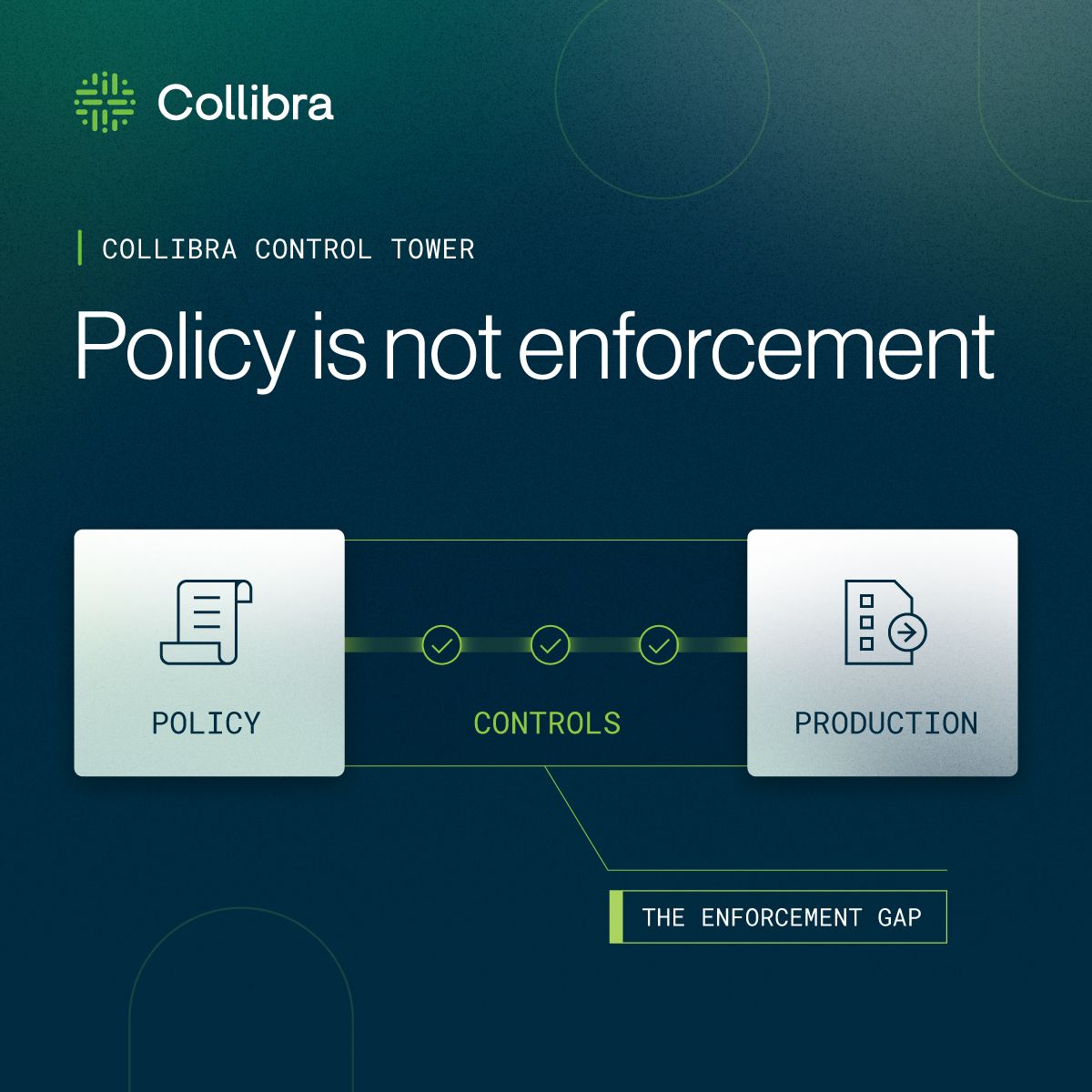
- Most companies have their AI budget backwards. They picture the spend as models, infrastructure, and talent. Data and governance become the overhead you trim to free up cash for the exciting part. It is exactly the reverse. AI depends on the foundation underneath it: the data it retrieves, the governance that controls what it can access, and the systems of record it relies on. Yet those are often the same investments teams are tempted to raid to fund AI. That is why I push back when the conversation becomes AI versus everything else.
- If a company like Anthropic only achieved a 21% accuracy rate on its own data without the right business context, what do you think happens inside the average enterprise? As enterprise AI moves from answering questions to taking autonomous action, poor governance isn't just an accuracy problem. It's a business liability. Every time your team has to second-guess an output, manually verify a recommendation, or redo an AI-driven task, you're paying the "hallucination tax." The companies that win the AI era won't necessarily have the
- The world changed, and our category had to follow. For years, enterprise AI was defined by model capability. Today, the models are no longer the limiting factor. The challenge is making sure AI can reason with the right business context, use trusted data, follow policy, and operate in a way that organizations can actually trust. As AI moves from answering questions to taking actions, that challenge becomes even more important. An agent doesn't pause to ask whether it has the right definition of a customer or whether the
Related profiles


This page shows public professional information only, each fact cited. Is this you? send a correction, or ask for removal within 24 hours, no questions asked.