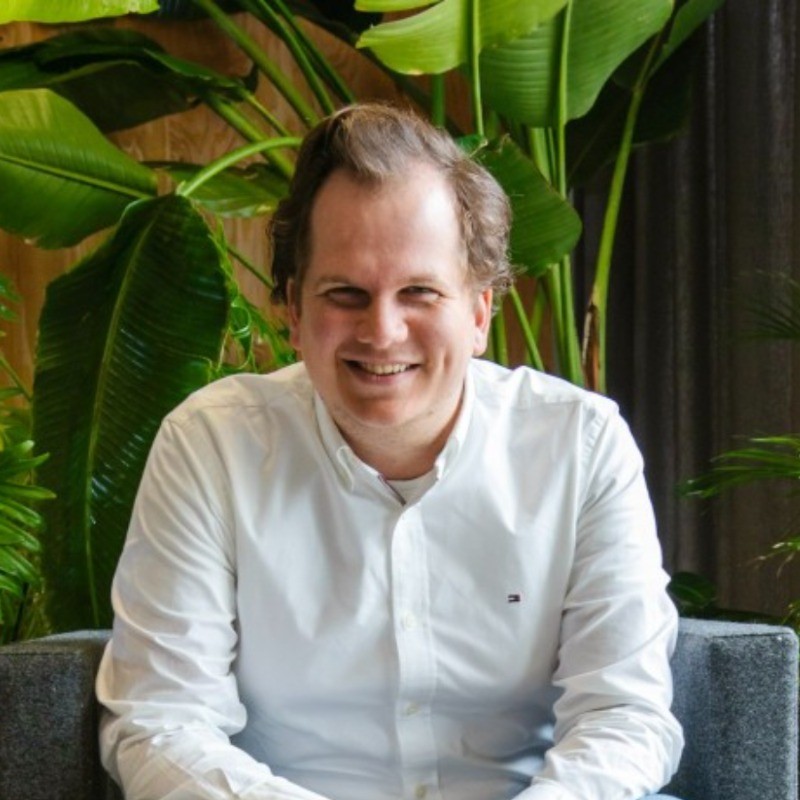
Overview
Smet holds a Master in Science in Business Engineering from KU Leuven and went on an Erasmus exchange to South Korea in 2011. He founded his first company, Interhost Solutions, at the age of 23; that hosting business grew into Lemon Holding, which reached 150 employees and 30 million euro in annual revenue. In November 2020 Tom Celis, one of the company's first software engineers, took over as CEO of Lemon Companies, and Smet moved his focus to the parent technology group Road21, which he co-founded with Fabian Van Kerckhove and which grouped technology companies in Kontich. He later completed the KMO Challenge, KMO Excellence and Executive MBA programmes at Vlerick Business School. He now runs AMOTEK Technologies, which combines software development with venture building, business planning, financial structuring and fundraising support.
Filip Smet is the founder and CEO of AMOTEK Technologies, a software company in Kontich. He started it in 2020, and the Belgian entity was incorporated on 27 May 2020. AMOTEK builds the AMOTEK Stack, a modular platform that lets organisations assemble digital applications from AI modules, automation and integrations with the systems they already run, and it works from Kontich with further locations in Ghent, Bruges and Geel. Customers named by the company include Proximus, Atlas Copco, La Lorraine, Daikin, Renson, Bridgestone, Bank Van Breda, Pluxee, Aquafin, Orfit and the Belgian federal service BOSA. In June 2026 the company acquired the Ghent vendor and compliance management platform Vendorvue and folded it into the AMOTEK Stack. Smet was named Young Entrepreneur of the Year 2025 by Jong Voka Antwerpen-Waasland at a ceremony in Antwerp on 27 February 2025. Alongside AMOTEK he is Entrepreneur in Residence at the Vlerick Entrepreneurship Academy and a mentor at Birdhouse. He has said the company name stands for amo-tech, loving technology and loving what you do.
Career history

Insights & ideas
The through-line
The constant across everything Filip Smet says is that ideas are cheap and execution, and the people who do it, are not. He describes the current moment as a gap between an enormous "idea cloud" and an execution capacity that barely grew, precisely because "everyone can build now, so building stopped being the hard part" [5]. The same instinct runs backwards through his own history: he did not dare start a capital-intensive smart trash bin idea twelve years ago, watched those bins become commonplace, and drew the lesson that hesitation is the expensive part, "Kiezen en niet teveel twijfelen, gewoon doen" [8]. What has shifted over time is the horizon. Early goals were purely quantitative, revenue growth above all, and they evolved into qualitative ones: what drives him, what gives him energy, what makes him happy [8]. Having exited several times young changed the calculation again, lengthening his horizon and moving the scarce resource from money to time [7].
That shift produced the structure he now works in. Where Road21 was a tech holding of thirteen or fourteen companies built to turn employees into entrepreneurs [8], AMOTEK Technologies is explicitly designed never to be sold: "Ik wil dat ook nooit exit ofzo" [7]. Everything else, the investment filters, the fanatical time protection, the insistence on culture, follows from choosing to build something you intend to keep.
On daring to start
The decision to begin gets more weight in his account than capital does. The mental push mattered more than the money: entrepreneurial in-laws asking what he had to lose, a service business needing little investment, and the fallback that a failure just means getting a job again [8]. He puts the same idea in a harder image, that you have to dare sail your little boat to the island, set the boat on fire, and start building there [7]. Dreaming is part of the method rather than decoration: "Je moet durven dromen om het waar te maken" [8]. And the ownership is total, which is the point: "Het is uw eigen schip, dus je kiest zelf" [8]. His own trigger was an Erasmus stay in South Korea, where QR-code ordering in the metro already existed more than ten years ago, which lit the interest in technology and entrepreneurship [8].
On time as the only thing worth buying
He treats time as the one genuinely scarce input. "Time is the only thing you can buy" [7], and equally "Iedereen heeft evenveel tijd" [8]. The two lines fit together in his argument that nobody actually lacks time, everyone has the same amount, so the real question is priorities, and choosing where your time goes is one of the most valuable freedoms entrepreneurship offers [8]. The trap he names is working on "de meest dringende dingen maar niet altijd de meest belangrijke dingen" [8]. The defences are extreme and deliberate: no business phone, notifications off, and no personal mailbox for eight or nine years, with an assistant filtering everything to a target of only ten percent reaching him [7]. It is the same reasoning applied to himself that he applies to his companies, protecting the scarce resource by designing systems that do the filtering.
On growing out of your own company
The transition from entrepreneur to manager is the part he describes as painful and formative. Past forty to fifty employees you cannot hold more than five or six direct reports, so delegation, structure and follow-up become forced rather than optional, and some early employees simply cannot grow with the company [8]. When you nearly double the team every year, the company is a different company every quarter, and the question of whether people can stretch with that growth has to be asked continuously [8]. He is direct about a mistake he made: a good technician is not automatically a good manager or project manager, and promoting people into roles they cannot handle is his own error to learn from [8]. The endpoint is uncomfortable and non-negotiable, that a business only generates real value when it runs without the founder, so you must consciously work on making yourself dispensable, which he calls the hardest thing he has done [8]. He also knows his own limit, stepping out of companies once too much structure and bureaucracy arrives, because that is not where his energy or strengths lie [7].
His management style inside that structure is deliberately narrow: "Ik manage niet op hoe de dingen doen, puur op resultaat" [8]. Busyness is not the measure, what you deliver at the end of the month is [8].
On ownership, governance and written agreements
He gives key people equity in the companies even when they do not ask for it, on the theory that shareholding creates long-term commitment [8]. He pairs that immediately with a warning, because people forget how things came about, which makes clear shareholder agreements and explicit expectation management essential [8]. The maxim is blunt: "Goede afspraken maken altijd de beste vrienden... en geschreven nog beter" [7]. As a company grows, he insists on strictly separating the roles of shareholder, board member and manager, and argues that appointing at least one external, binding board member, not just an informal advisory board, is a good decision for every company [7].
On what he backs and what he builds
His investment filter starts and largely ends with people: everything begins with the team, fulltime commitment is a hard requirement and a side project is an immediate no, then coachability, gratitude, whether the case gives him energy, and cross-pollination with the rest of the portfolio [7]. The structure around those bets is designed so the bets can be patient. AMOTEK Technologies is a finance and IT knowledge hub whose consulting arm only needs to break even, with the real upside coming from participations, own products and spin-offs [7]. Road21 worked on a related model, co-founding new ventures with its own employees and aiming at a Belgian version of a venture builder like Rocket Internet [8]. From day one, Lemon developed software for clients while reinvesting cashflow into its own products, growing deliberately without external capital [8]. His fondness for hosting comes from the same arithmetic, a customer who stays five to ten years when service and price are right, which builds a very valuable recurring base [8]. He also read the sector correctly, anticipating the consolidation wave in webhosting and partially exiting several times ahead of it [7].
Learning, in his telling, is borrowed rather than invented: surround yourself with fellow entrepreneurs who are further along than you and learn from them, including informal mentors such as a self-made SME founder neighbour [8].
On culture as the actual strategy
"Culture eats strategy for breakfast" is a line he says often and means every time [2]. His definition of culture is concrete rather than aspirational: it is built by the people you choose to surround yourself with every day, no drama, no energy wasted on negativity, people who push each other to do better, bring positive energy into the room and genuinely want to see each other win [2]. He credits that selection directly for the way AMOTEK Technologies keeps growing, and reduces the whole thing to an instruction, surround yourself well and the rest follows [2]. It is the same filter he applies to investments, where whether a case gives him energy is an explicit criterion [7], applied to the people he works with daily.
On the gap between AI ideas and AI that works
Before AI, ideas were the bottleneck and every idea had to survive weeks of work before anyone knew if it was worth pursuing; now anyone can produce ten "AI use cases" before their coffee gets cold while execution capacity barely moved [5]. He is specific about what the surplus produces: pilots that impress the steering committee and never reach a real user, chatbots plugged into a wiki nobody has touched since 2019, dashboards nobody opens because nobody trusts the data behind them, ten "AI agents" automating a task that took five minutes anyway, and roadmaps full of AI ambition with zero systems that actually talk to each other [5]. An idea costs nothing [5].
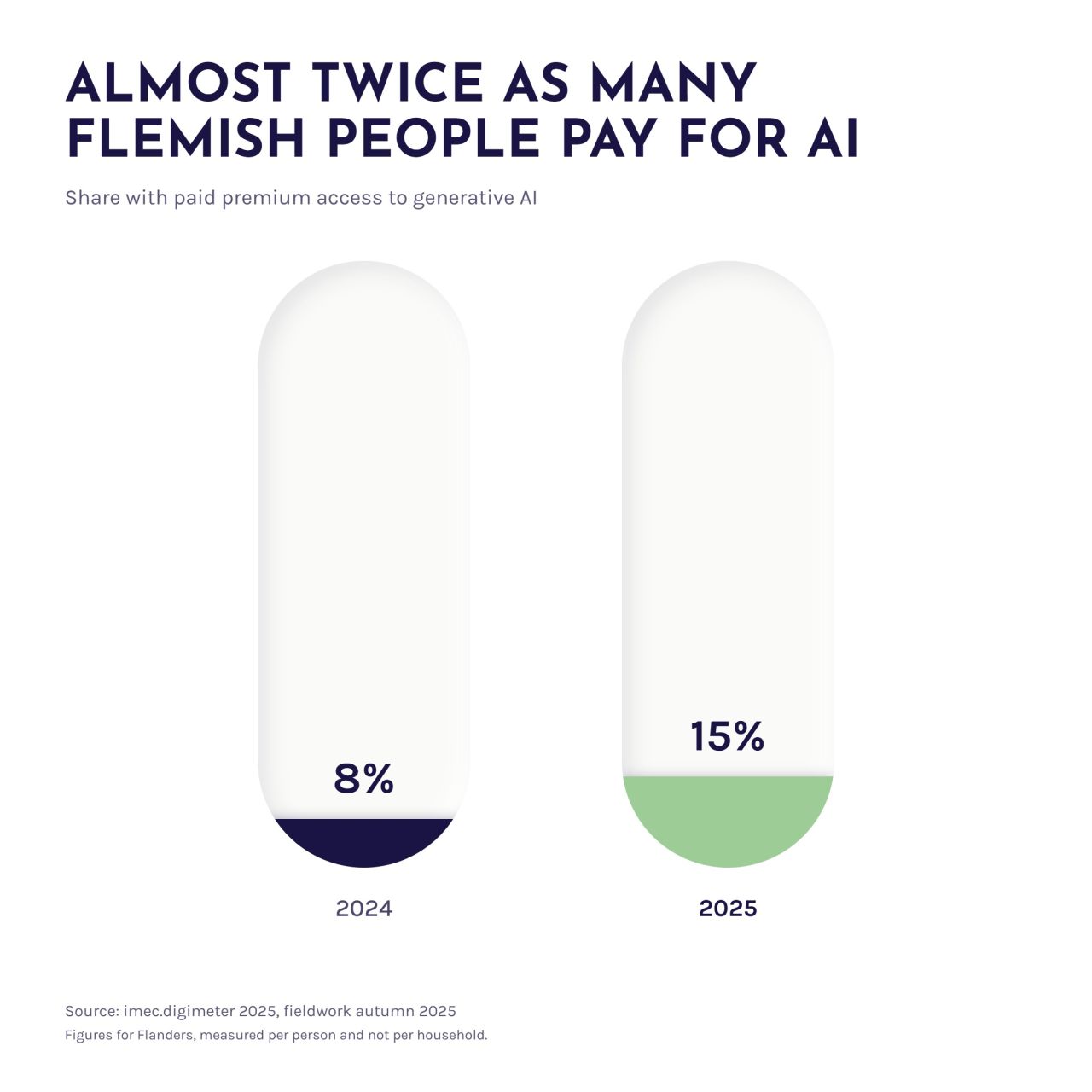
The adoption data tells him the same story from the demand side. Paid AI use in Flanders went from 8 percent to 15 percent in twelve months, close to doubling, and imec calls generative AI's spread unmatched by any technology before it [1]. But five out of six people still pay nothing, and not out of ignorance, since 43 percent are habitual users who simply stay on the free tier [1]. His reading is that the question is no longer whether people use AI but whether they get enough value to open their wallet, and that the ones who upgrade do it because a tool solves something that used to cost them time or money [1]. That standard also explains why he thinks good software matters more, not less, as AI gets slapped onto everything: searching now means navigating search results, AI summaries and ads to find the page you should have found in the first place, and a tool earns its place by taking you straight to the right answer instead of leading you further away from it [3]. People turning directly to Claude or ChatGPT is the visible symptom, because just asking is often faster than scrolling through ten tabs [3].
On making capability available regardless of budget
What he singles out in FIFA's "Football AI Pro", built with Lenovo, is not the technology but the distribution. It combines structured match data, video and FIFA's own "Football Language" model to turn hundreds of millions of data points into tactical insights and reports, and although it currently serves only the 48 competing teams, coaches and analysts, every federation gets equal access rather than only the wealthiest ones with the biggest analytics departments, with fan access said to be coming [4]. He names the principle directly: democratizing data, making insight accessible regardless of budget or scale [4].
On securing infrastructure from the inside out
Security is framed as a promise of assurance and complete transparency to clients that their information is always in safe hands, with AMOTEK Technologies securing data from the inside out [6]. The reason he gives for not settling for standard solutions is that cyber threats are themselves evolving rapidly through AI-driven automation [6]. The practice is proactive testing and hardening of infrastructure against advanced network breaches, from IP whitelisting to hypervisor-level ARP spoofing prevention, demonstrated by Samuel Wouters, and delivered with Kristof Van Stappen, Jonas Delrue and Jacky De Schepper from Jimber and Cyberplan, detecting security gaps and implementing solutions including AMOTEK Stack and Jimber [6].
Takeaways
- Judge AI initiatives by whether they reach a real user, not by whether they impress a steering committee; an idea costs nothing now that everyone can build [5].
- The paid-versus-free split is the honest measure of AI value: 43 percent of Flemish people are habitual users but only 15 percent pay, and those who upgrade do so because a tool saves them time or money [1].
- Screen investments on the team first, treat anything less than fulltime commitment as an immediate no, then weigh coachability, gratitude, energy and cross-pollination with the portfolio [7].
- Protect time structurally rather than by willpower: no business phone, notifications off, and an assistant filtering the inbox so only about 10 percent reaches you [7].
- Work consciously on making yourself dispensable, because a business only generates real value when it runs without the founder [8].
- Give key people equity before they ask, but write down shareholder agreements and expectations, since people forget how things came about [8].
- Separate the roles of shareholder, board member and manager as you grow, and appoint at least one external, binding board member rather than an informal advisory board [7].
- Do not promote a good technician into management by default; it is a mistake with a predictable cost [8].
- Manage on results delivered at the end of the month, not on how the work gets done or how busy people look [8].
- Choose the people around you as the primary act of culture-building: no drama, no negativity, people who want each other to win [2].
In the news
- We're looking for a Legal Counsel 🚀🍀 Interested? More info in the comments. Ready to apply? Send your CV to info@amotek.be #hiring #wearehiring #legalcounsel #legaljobs #juniorjobs #mediorjobs #vacature #kontich #antwerp Filip Smet Ben De Schepper Samuel Wouters Luna Vanbiervliet Matteo Martin Matthias Coquin Alexander Vandeputte Massimo P. Senne Christiaens Mike Meyers Shari Slagmolen Nicolas Vanhuynegem Niels Verdickt Christophe Dutoict Kenny Embrechts Charlotte Hargreaves Vincent Machiels Cindy Buyle
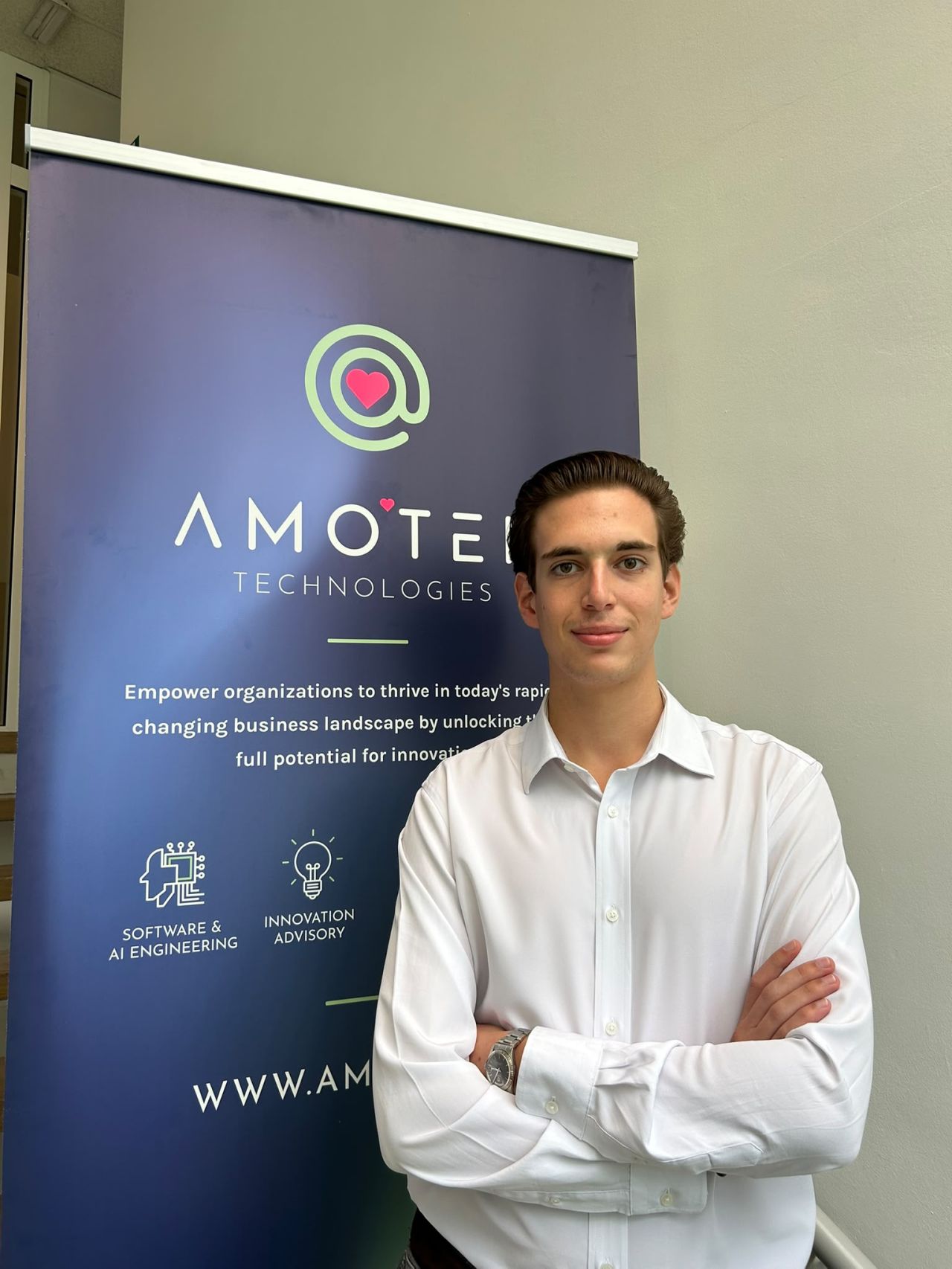
- Last October, Nathan Majorovic reached out to me out of nowhere and asked if he could do his summer internship at AMOTEK Technologies. 🍀 I liked the initiative and I liked his background in Computer Science & Engineering, so I invited him in and we made it happen. Here is some of what he leaves behind after a full summer with us: 🔹an internal lead dashboard for us to use in our daily scrum meetings 🔹our buy-side M&A prospecting, from longlist to first conversations 🔹a mapping of the synergies across our ventures 🔹the client
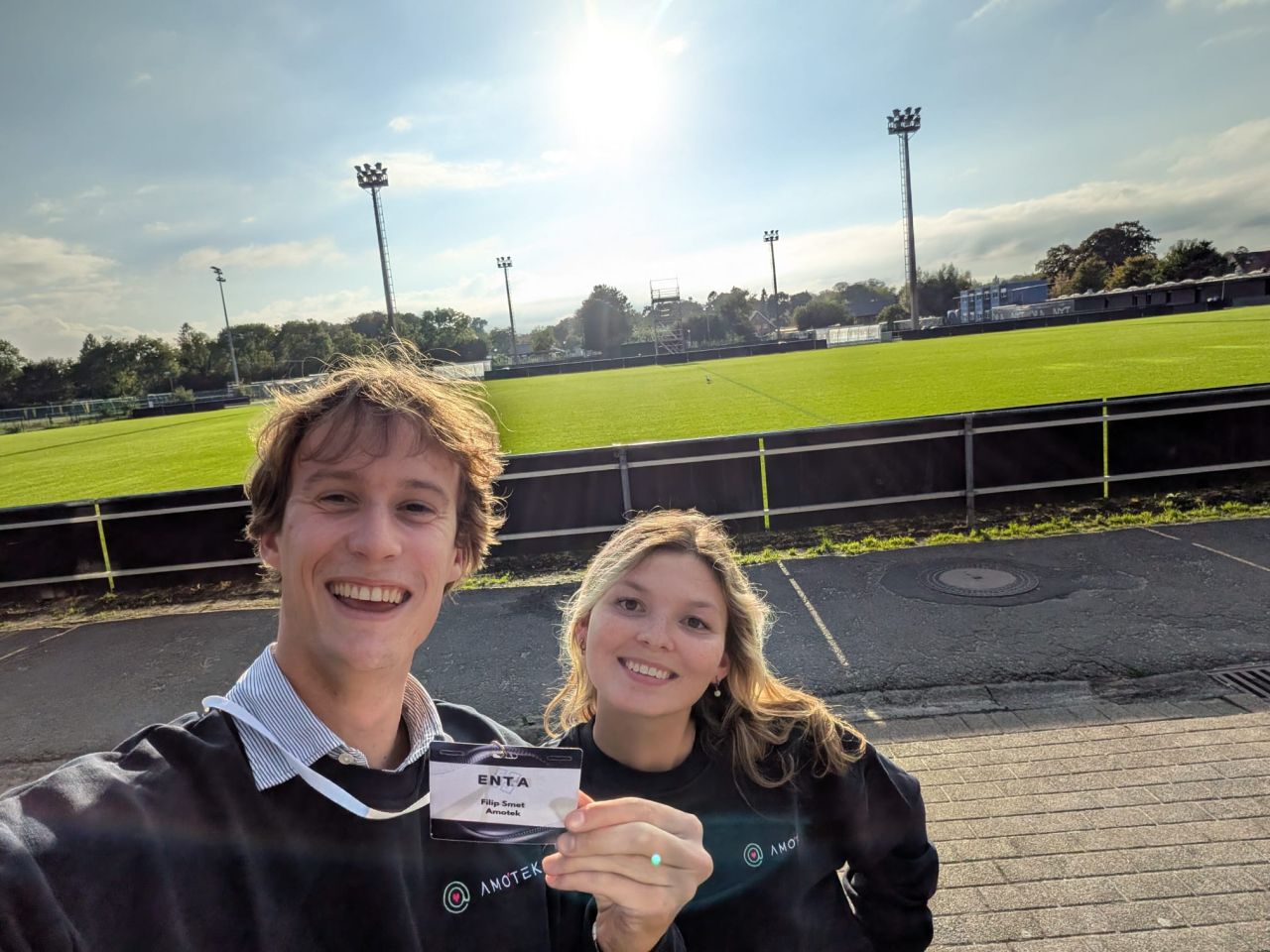
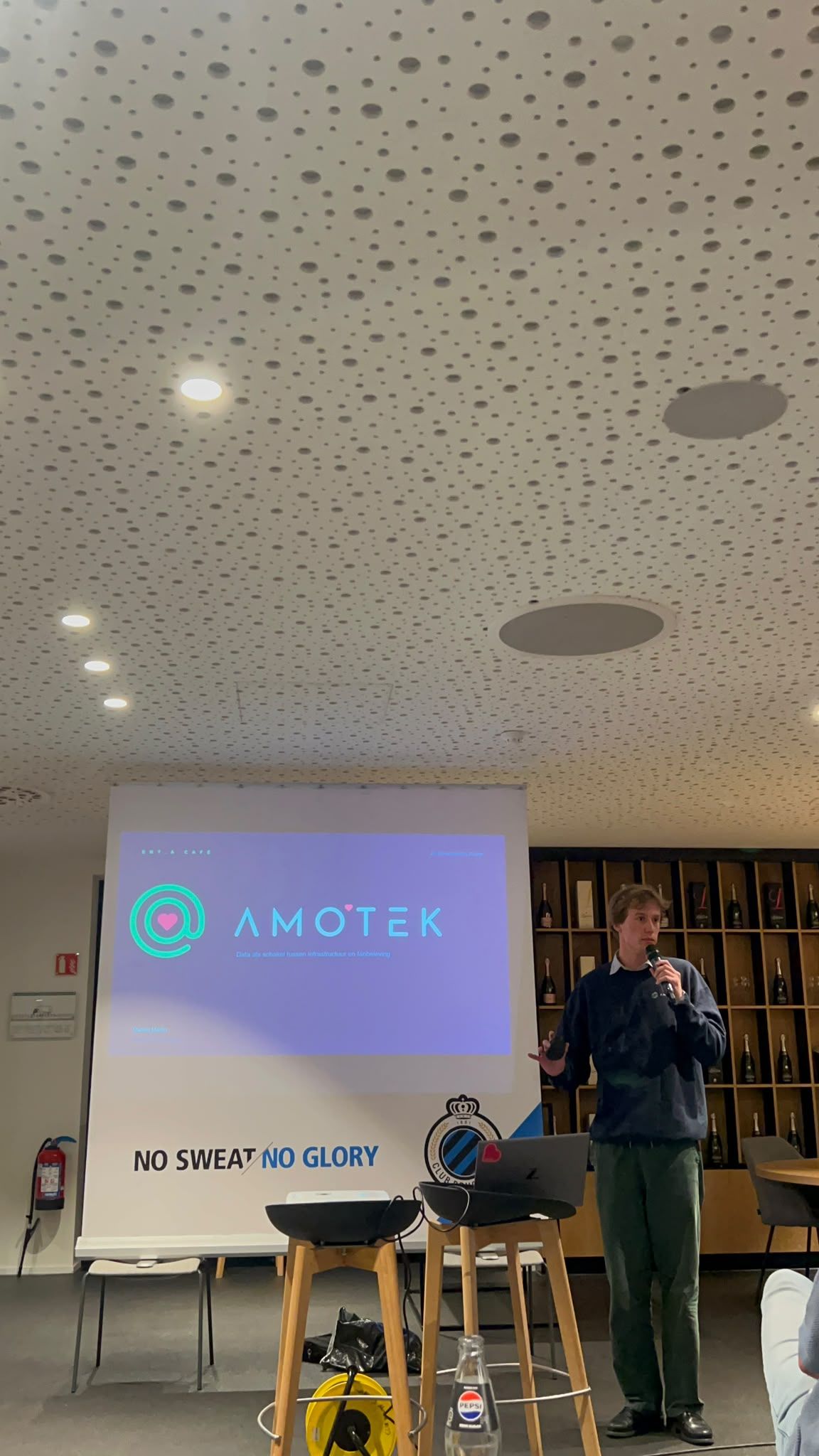
- 𝐘𝐨𝐮'𝐝 𝐞𝐱𝐩𝐞𝐜𝐭 𝐭𝐨 𝐭𝐚𝐥𝐤 𝐚𝐛𝐨𝐮𝐭 𝐟𝐨𝐨𝐭𝐛𝐚𝐥𝐥 𝐢𝐧 𝐉𝐚𝐧 𝐁𝐫𝐞𝐲𝐝𝐞𝐥. 𝐖𝐞 𝐭𝐚𝐥𝐤𝐞𝐝 𝐚𝐛𝐨𝐮𝐭 𝐀𝐈 𝐰𝐨𝐫𝐤𝐟𝐥𝐨𝐰𝐬.⚽🚀😍 Last night we were guests at the ENT.A - Entertainment Associatie Café in the Club Brugge stadium. Thomas Rypens walked us through how Club Brugge looks at the fan journey, and what the new stadium means for the way you use data to shape that experience. Sophie Detremmerie shared the story behind Gent Festival van Vlaanderen and Festival STROOM. Matteo Martin closed the
- We're looking for a Junior/Medior Developer 🚀 Interested? More info in the comments. Ready to apply? Send your CV to info@amotek.be #hiring #wearehiring #backenddeveloper #softwareengineer #developerjobs #techjobs #jobsbelgium #kontich #antwerp #jointventures #amotek Filip Smet Ben De Schepper Samuel Wouters Matthias Coquin Alexander Vandeputte Massimo P. Luna Vanbiervliet Matteo Martin Senne Christiaens Nicolas Vanhuynegem Mike Meyers Niels Verdickt Christophe Dutoict Kenny Embrechts Charlotte Hargreaves Vincent Machiels
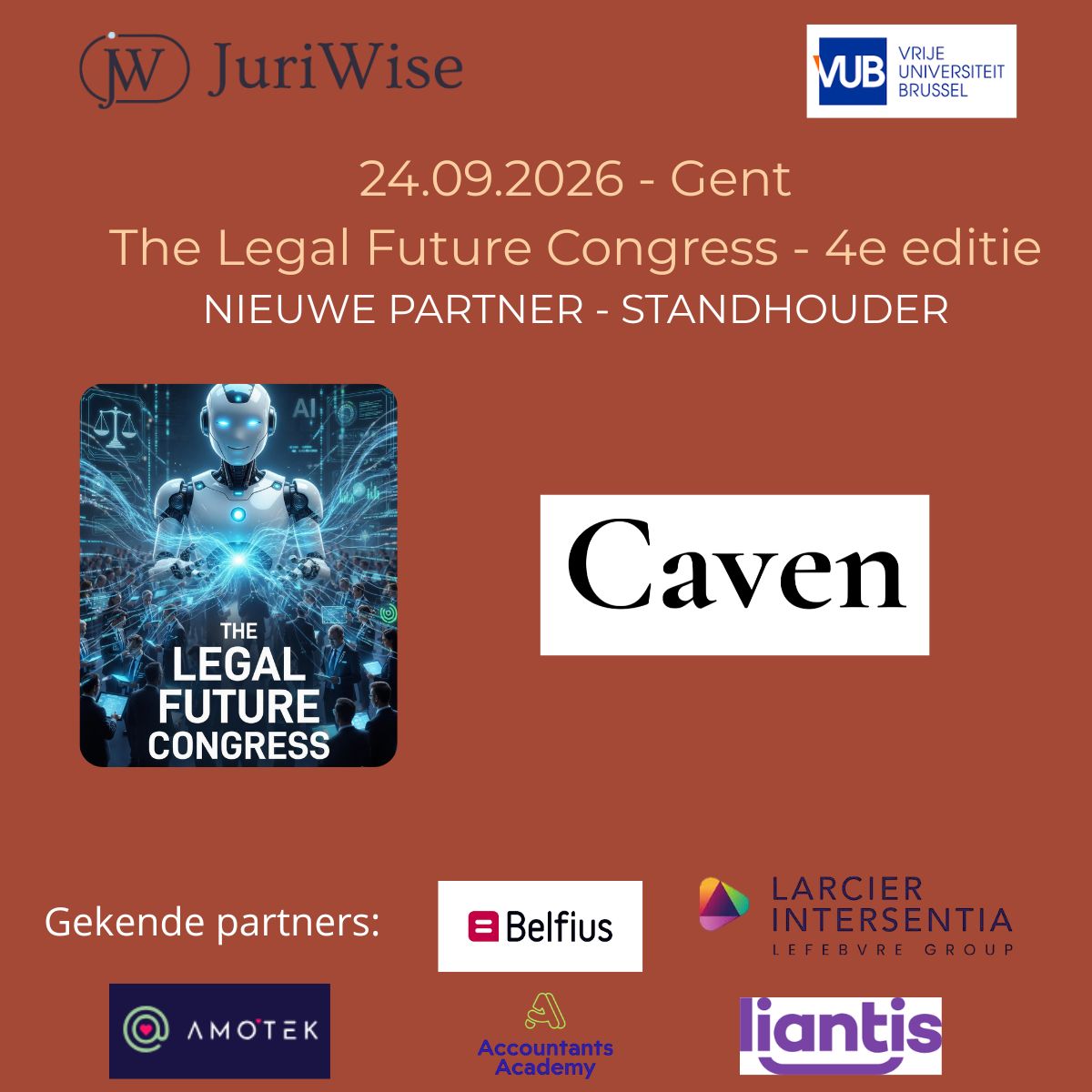
- 𝗡𝗜𝗘𝗨𝗪𝗘 𝗣𝗔𝗥𝗧𝗡𝗘𝗥/𝗦𝗧𝗔𝗡𝗗𝗛𝗢𝗨𝗗𝗘𝗥 𝗧𝗛𝗘 𝗟𝗘𝗚𝗔𝗟 𝗙𝗨𝗧𝗨𝗥𝗘 𝗖𝗢𝗡𝗚𝗥𝗘𝗦𝗦 🙌We zijn verheugd een nieuwe partner/standhouder te mogen verwelkomen voor onze JuriWise – VUB “The Legal Future Congress” (4e editie). Caven is the name ladies & gentlemen. Remember the name. Caven is een privacy-first meeting assistent die AI veilig inzetbaar maakt tijdens vertrouwelijke gesprekken. Met onze desktop en mobiele applicaties neem je gesprekken op via eender welk platform en zet je ze in seconden om naar
- 𝐋𝐚𝐬𝐭 𝐲𝐞𝐚𝐫 𝟖 𝐩𝐞𝐫𝐜𝐞𝐧𝐭 𝐨𝐟 𝐅𝐥𝐞𝐦𝐢𝐬𝐡 𝐩𝐞𝐨𝐩𝐥𝐞 𝐩𝐚𝐢𝐝 𝐟𝐨𝐫 𝐀𝐈. 𝐓𝐨𝐝𝐚𝐲 𝐢𝐭 𝐢𝐬 𝟏𝟓 𝐩𝐞𝐫𝐜𝐞𝐧𝐭. Almost double in twelve months. imec calls the spread of generative AI unmatched by any technology before it, and that speed is now showing up in people's wallets. But flip the number around. Five out of six people in Flanders still pay nothing. Not because they ignore AI, since 43 percent are now habitual users. They simply stay on the free tier. ✨ That is the real story. The question is no
- 𝐂𝐮𝐥𝐭𝐮𝐫𝐞 𝐞𝐚𝐭𝐬 𝐬𝐭𝐫𝐚𝐭𝐞𝐠𝐲 𝐟𝐨𝐫 𝐛𝐫𝐞𝐚𝐤𝐟𝐚𝐬𝐭. 🚀 At AMOTEK Technologies we believe a high-performing team is built on trust, honesty and people who feel safe enough to bring their real ideas to the table. 🍀 When people don't have to hide who they are, they work better. They think faster. They stay longer. That's not a soft skill. That's a competitive advantage. Our CEO Filip Smet says it best: '𝘤𝘶𝘭𝘵𝘶𝘳𝘦 𝘦𝘢𝘵𝘴 𝘴𝘵𝘳𝘢𝘵𝘦𝘨𝘺 𝘧𝘰𝘳 𝘣𝘳𝘦𝘢𝘬𝘧𝘢𝘴𝘵.' We're proud to build ours every single day.
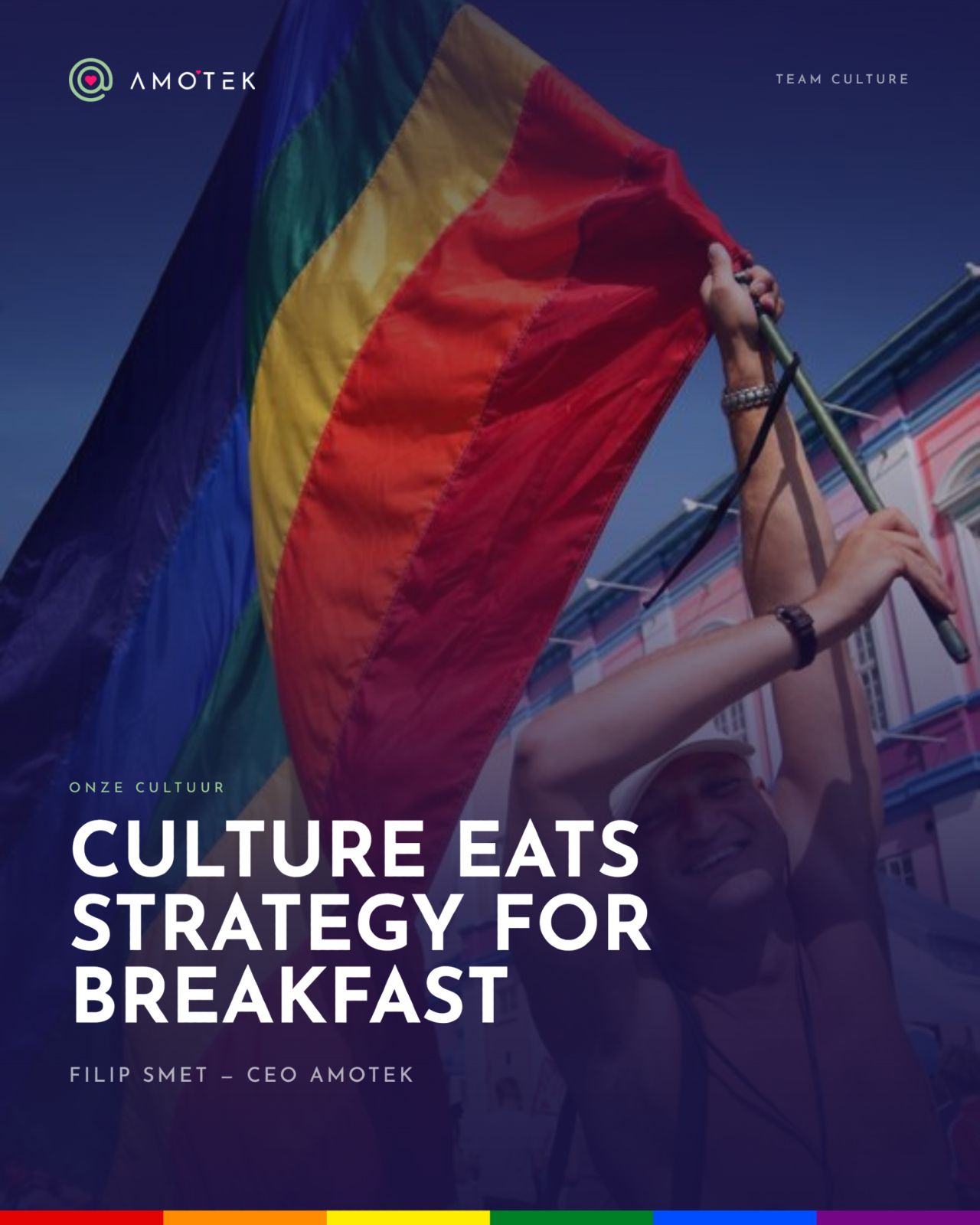
- 𝐂𝐮𝐥𝐭𝐮𝐫𝐞 𝐞𝐚𝐭𝐬 𝐬𝐭𝐫𝐚𝐭𝐞𝐠𝐲 𝐟𝐨𝐫 𝐛𝐫𝐞𝐚𝐤𝐟𝐚𝐬𝐭." 𝐈𝐭'𝐬 𝐚 𝐥𝐢𝐧𝐞 𝐈 𝐬𝐚𝐲 𝐨𝐟𝐭𝐞𝐧, 𝐚𝐧𝐝 𝐈 𝐦𝐞𝐚𝐧 𝐢𝐭 𝐞𝐯𝐞𝐫𝐲 𝐭𝐢𝐦𝐞. 🍀 One of the things I believe in most as a founder: culture is built by the people you choose to surround yourself with every day. No drama. No energy wasted on negativity. Just people who push each other to do better, who bring positive energy (🌞) into the room and who genuinely want to see each other win. 🚀 That's the team we've been building at AMOTEK Technologies. And
This page shows public professional information only, each fact cited. Is this you? send a correction, or ask for removal within 24 hours, no questions asked.